 History of Bulgaria

Joe Mabel · CC BY-SA 3.0 · Wikimedia Commons
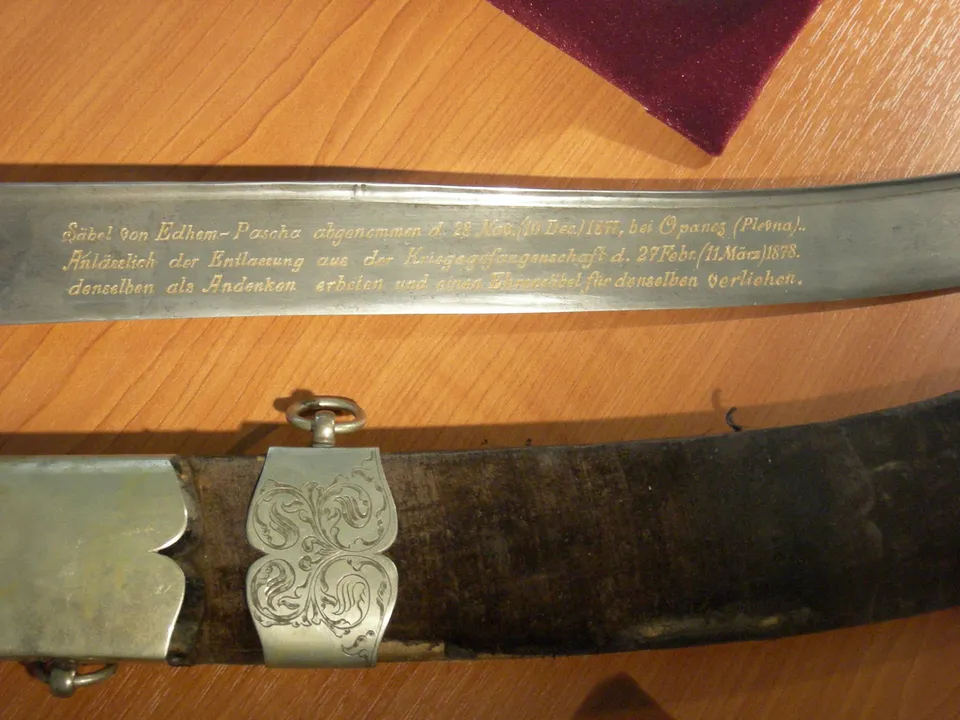
Museum detail of a sword and scabbard. The inscription names Edhem Pasha and the two capture dates. It is not established as Osman Pasha’s sword.
Full attribution
Joe Mabel / Wikimedia Commons, CC BY-SA 3.0. Museum detail of a sword and scabbard. The inscription names Edhem Pasha and the two capture dates. It is not established as Osman Pasha’s sword. Processed image.
Earthworks stop repeated attacks. Then the roads bringing food are closed. A story about Osman Pasha, Russian and Romanian troops, and the difference between a battlefield and a painting of it.
Part 1 · Revival
The town on the roads
July 1877. Russia's army has crossed the Danube in its war against the Ottoman Empire. Ahead lies Pleven, a town of about 17,000 people according to the museum guide. Important roads pass through it. Troops based here can threaten movement along them.
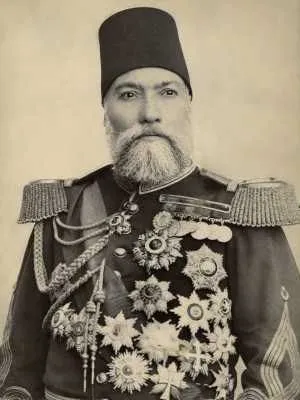
On 19 July, the Ottoman commander Osman Pasha arrives. Pasha is a title for a senior Ottoman official or commander. He comes from Vidin and places his soldiers on the heights around the town. The defenders build earthworks: banks of earth that provide cover.
Sources · 5
- Umut Akcakaya Battles of Pleven: A Glorious Defeat in Military History
- Регионален военноисторически музей – Плевен Зали и изображения — аудиогид на Панорама „Плевенска епопея 1877 г.“
- Machiel Kiel PLEVNE
- Abdülkadir Özcan PAŞA
- Abdullah frères File:GhaziOsmanPasha.jpg


Part 2 · Revival
Two assaults against the earthworks
Russian troops attack on 20 July. The town stays in Ottoman hands. A second assault follows on 30 July. An assault is a direct attack to capture a position. This attempt also fails.
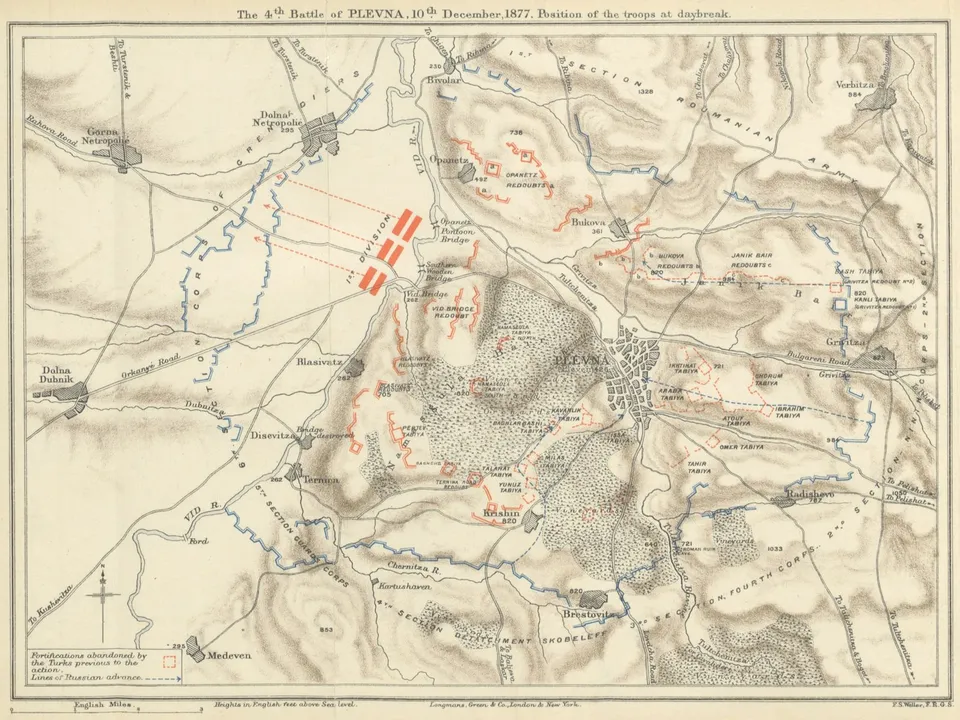
Around Pleven stand redoubts: separate forts protected by earth banks. Attackers must reach them under fire. The defenders hold the town. Russian commanders prepare another attack. On the map, Grivitsa lies east of Pleven. Romanian troops will also fight there in the next major assault.
Sources · 4
- Umut Akcakaya Battles of Pleven: A Glorious Defeat in Military History
- Frederick William von Herbert; map signed F. S. Weller, F.R.G.S.; digitised by the British Library The 4th Battle of Plevna, 10th December, 1877. Position of the troops at daybreak
- Wikimedia geographical database contributors Pleven: geographical record
- Wikimedia geographical database contributors Grivitsa: geographical record
Part 3 · Revival
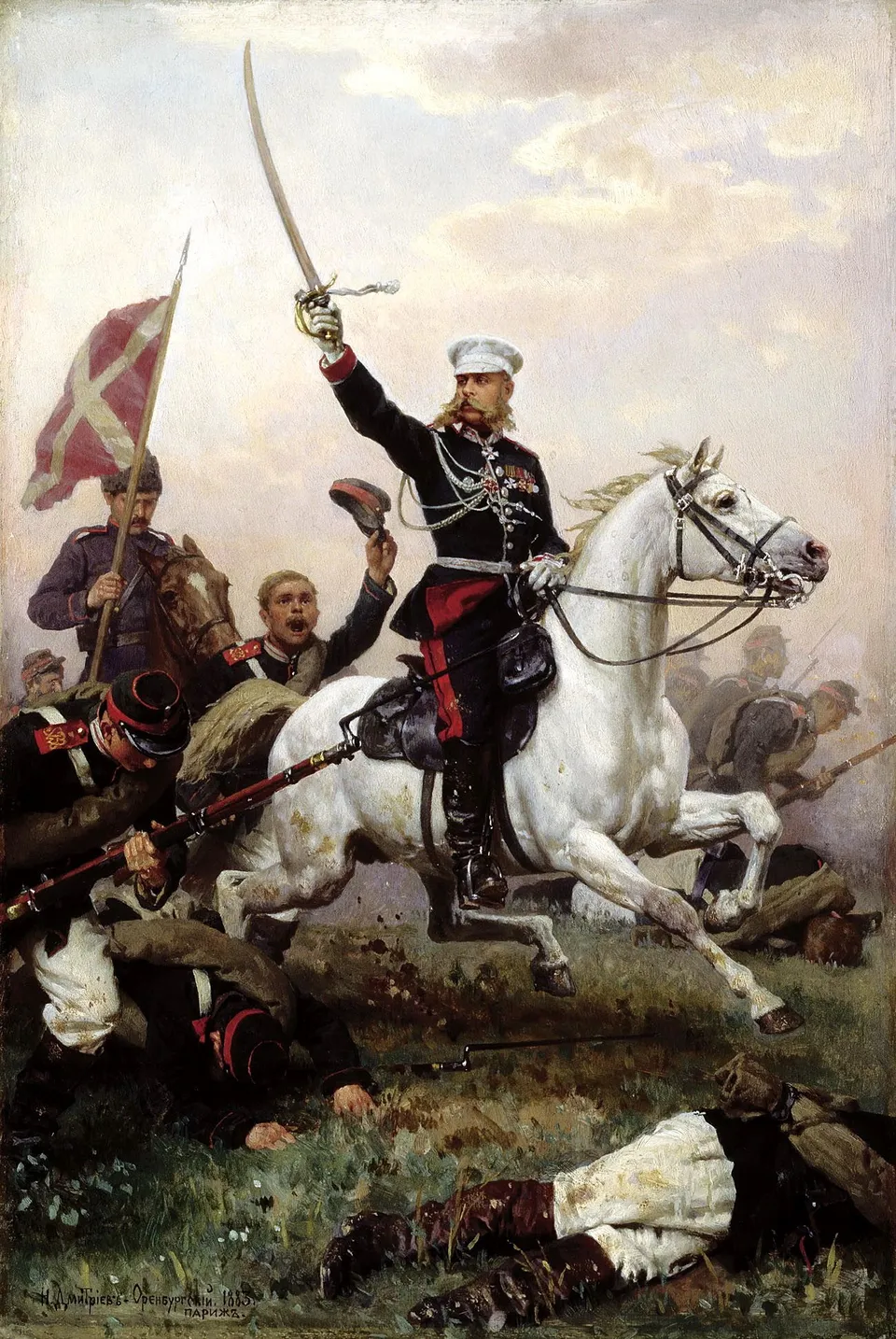
The redoubt in the painting
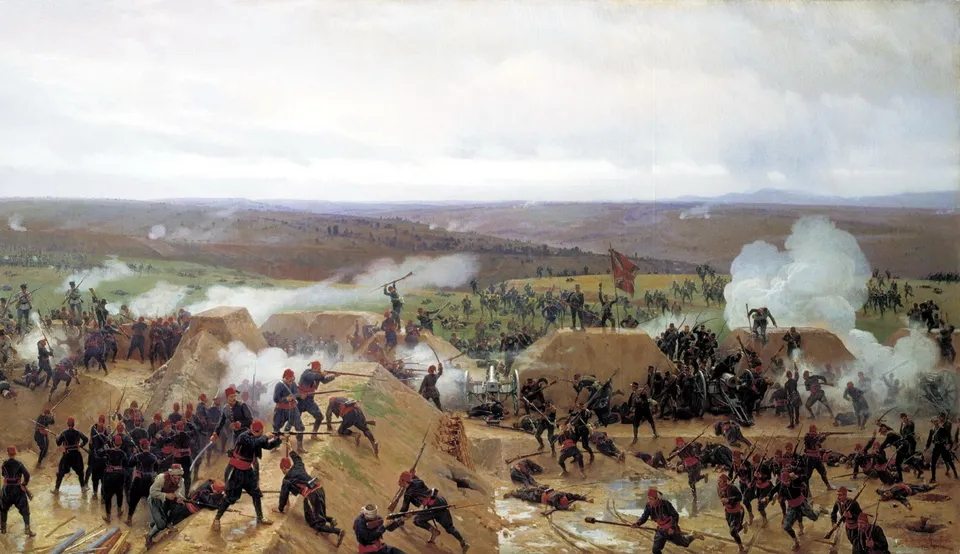
The third assault comes on 11 and 12 September. Romania's army, led by Prince Carol I, now fights alongside Russia's. At Grivitsa, Romanian soldiers with Russian support capture a fort. Pleven itself is not taken.
The painting shows earth banks, guns and smoke. It is an artistic reconstruction. It helps us imagine the fort, but cannot prove where every soldier stood.
- 1 · Earth bank
- This earth bank is part of the fort. The artist shows a battle, not an exact plan.
- 2 · Gun
- A gun is painted behind the bank. Soldiers fight around it.
- 3 · Painted smoke
- The artist adds smoke to the battle scene. This is a painting from 1885.
- Grivitsa · Approximate location
Sources · 5
- Регионален военноисторически музей – Плевен Зали и изображения — аудиогид на Панорама „Плевенска епопея 1877 г.“
- Регионален военноисторически музей – Плевен Панорама „Плевенска епопея 1877 г.“
- Umut Akcakaya Battles of Pleven: A Glorious Defeat in Military History
- Nikolai Dmitriev-Orenburgsky File:Zahvat grivickogo reduta.jpg
- Nikolai Dmitriev-Orenburgsky File:General Skobelev (Dimitriev-Orenburgsky).jpg
Part 4 · Revival
Activity: the redoubt and the town
What do Romanian troops with Russian support achieve at Grivitsa in the third assault?
Why is that?
The local success at Grivitsa does not break the entire defence. Pleven remains in Ottoman hands.
Correct · They capture one fortification, but not Pleven.
- Регионален военноисторически музей – Плевен Зали и изображения — аудиогид на Панорама „Плевенска епопея 1877 г.“
- Umut Akcakaya Battles of Pleven: A Glorious Defeat in Military History
Sources · 2
- Регионален военноисторически музей – Плевен Зали и изображения — аудиогид на Панорама „Плевенска епопея 1877 г.“
- Umut Akcakaya Battles of Pleven: A Glorious Defeat in Military History
Part 5 · Revival
The road that brings food
After the third failure, Russian and Romanian troops change tactics. General Eduard Totleben directs a blockade. The blockade closes roads bringing food and reinforcements.
This does not happen all at once. According to the museum guide, the ring closes completely in late October. Food in Pleven runs low. Hunger and disease weaken Osman Pasha's army. The commander must decide whether to surrender or try to lead his troops through the blockade.
Sources · 3
- Umut Akcakaya Battles of Pleven: A Glorious Defeat in Military History
- Регионален военноисторически музей – Плевен Зали и изображения — аудиогид на Панорама „Плевенска епопея 1877 г.“
- Frederick William von Herbert; map signed F. S. Weller, F.R.G.S.; digitised by the British Library The 4th Battle of Plevna, 10th December, 1877. Position of the troops at daybreak
Part 6 · Revival
Activity: put events in order
Put these events at Pleven in order, earliest first.
Why is that?
The Russian attacks fail. During the next major assault, Romanian soldiers capture a fort at Grivitsa, but not Pleven. A blockade follows and closes supply roads.
Correct order
- Russian attacks on Pleven
- Fort captured at Grivitsa
- Supply roads closed
- Umut Akcakaya Battles of Pleven: A Glorious Defeat in Military History
- Община Плевен Историческа справка
- Регионален военноисторически музей – Плевен Зали и изображения — аудиогид на Панорама „Плевенска епопея 1877 г.“
Sources · 3
- Umut Akcakaya Battles of Pleven: A Glorious Defeat in Military History
- Община Плевен Историческа справка
- Регионален военноисторически музей – Плевен Зали и изображения — аудиогид на Панорама „Плевенска епопея 1877 г.“
Part 7 · Revival
Two dates on a sword
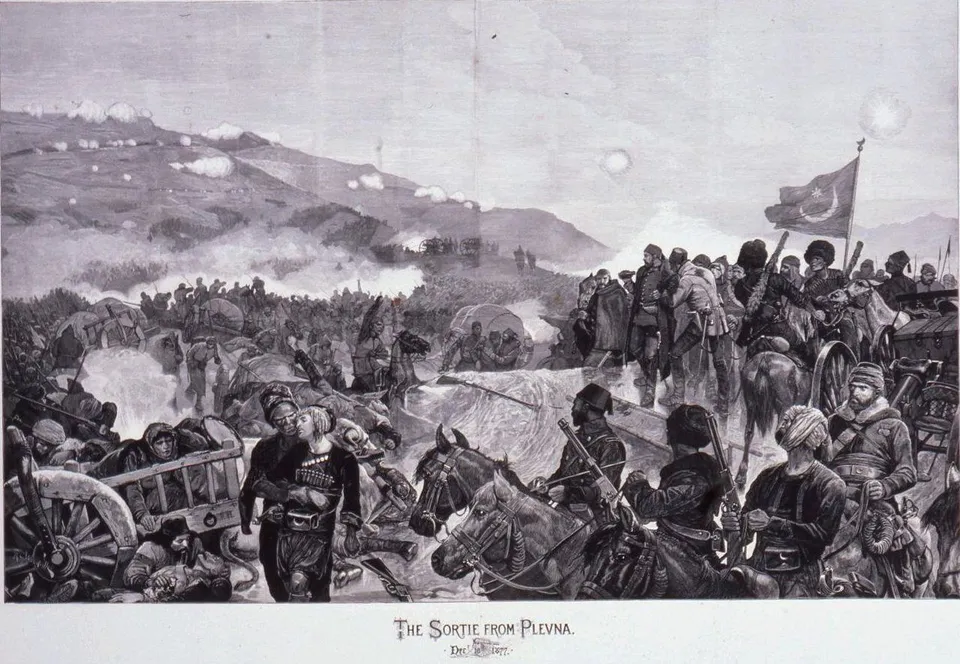
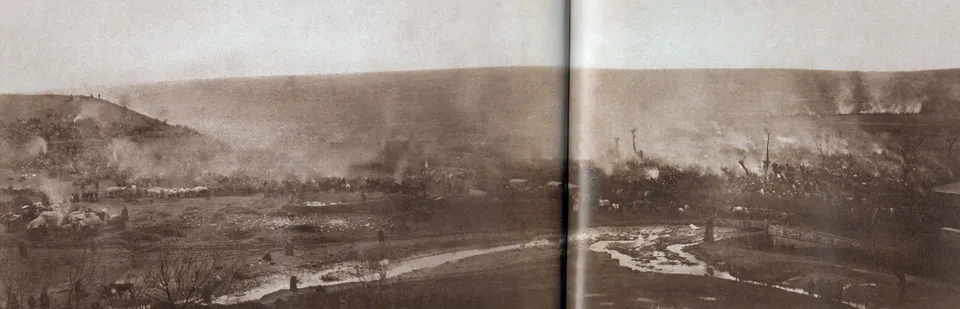
Osman Pasha tries to lead his troops through the blockade. On 10 December his troops attack westwards, near the Vit River. The attempt is repulsed. He is wounded and surrenders.
The museum sword shown here bears two dates: 28 November and 10 December 1877. This is one day recorded in two calendars. The Julian calendar, called Old Style, then runs twelve days behind the Gregorian calendar, or New Style. This story uses New Style dates.
The inscription associates the sword with Edhem Pasha, not Osman Pasha.
- 1 · The name
- The inscription reads “Edhem Pasha”. This is a different name from Osman Pasha.
- 2 · Two dates
- It gives 28 November and 10 December 1877: one day in Old and New Style.
- 3 · Scabbard
- Below the blade is the scabbard, the sword's protective sheath. This is a museum detail, not an image of the surrender.
- Pleven · Approximate location
Sources · 4
- Umut Akcakaya Battles of Pleven: A Glorious Defeat in Military History
- Община Плевен Историческа справка
- Romanian Ministry of National Defence, MoD Press Office Ceremony dedicated to the Pleven Heroes
- Joe Mabel File:Plevna sword.jpg
Part 8 · Revival
The 115-metre canvas
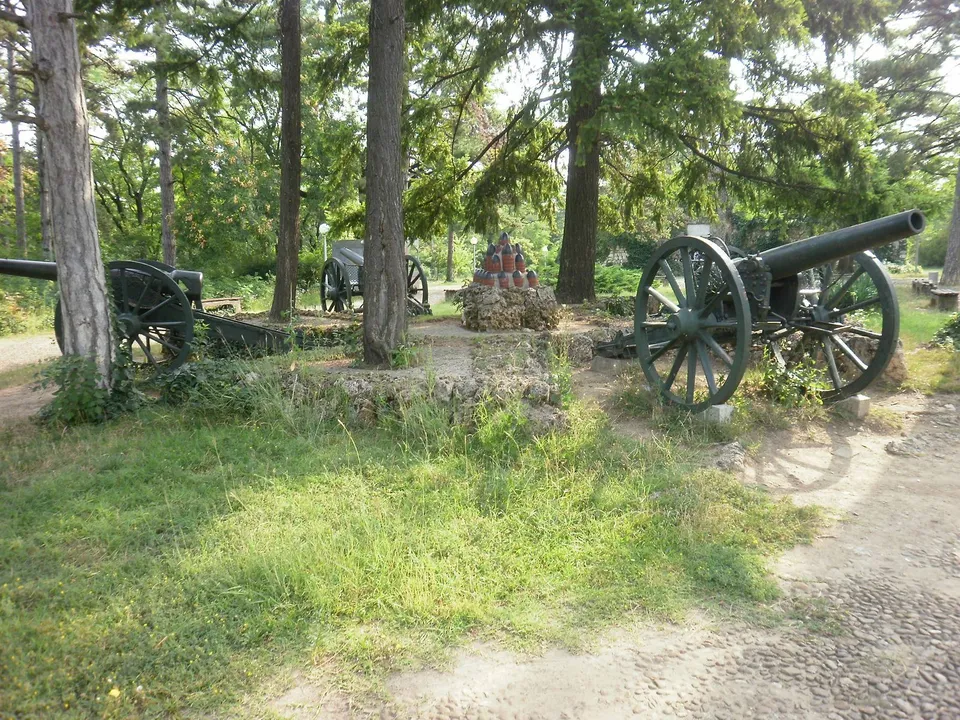
The Panorama opens on 10 December 1977. Its 115-metre-long canvas depicts the September assault. Painted landscape meets a model of the terrain in front of it. The December battle appears separately: a painting with a terrain model in front of it. The Panorama helps visitors imagine the battle. The huge painting was made to remember the war. It is not a photograph of the past.
- Skobelev Park · Approximate location
- Pleven Panorama · Approximate location
Sources · 5
- Община Плевен Парк-музей „Ген. М. Д. Скобелев“
- Регионален военноисторически музей – Плевен Панорама „Плевенска епопея 1877 г.“
- Регионален военноисторически музей – Плевен Зали и изображения — аудиогид на Панорама „Плевенска епопея 1877 г.“
- Umut Akcakaya Battles of Pleven: A Glorious Defeat in Military History
- Спасимир File:Park Scobelev 03.jpg
Part 9 · Revival
Activity: match
Match each commander with his role in the story.
Why is that?
The story distinguishes the defence, the blockade and the actions of individual allied commanders.
- Umut Akcakaya Battles of Pleven: A Glorious Defeat in Military History
- Регионален военноисторически музей – Плевен Зали и изображения — аудиогид на Панорама „Плевенска епопея 1877 г.“
- Регионален военноисторически музей – Плевен Панорама „Плевенска епопея 1877 г.“
Sources · 3
- Umut Akcakaya Battles of Pleven: A Glorious Defeat in Military History
- Регионален военноисторически музей – Плевен Зали и изображения — аудиогид на Панорама „Плевенска епопея 1877 г.“
- Регионален военноисторически музей – Плевен Панорама „Плевенска епопея 1877 г.“
A new find for your collection
Pleven fell after a blockade and a failed breakout. The later Panorama depicts another moment: the September assault.
People in this story
Sources
- Umut Akcakaya Battles of Pleven: A Glorious Defeat in Military History
- Община Плевен Историческа справка
- Wikimedia geographical database contributors Pleven: geographical record
- Wikimedia geographical database contributors Grivitsa: geographical record
- Frederick William von Herbert; map signed F. S. Weller, F.R.G.S.; digitised by the British Library The 4th Battle of Plevna, 10th December, 1877. Position of the troops at daybreak
- Nikolai Dmitriev-Orenburgsky File:Zahvat grivickogo reduta.jpg
- Abdullah frères File:GhaziOsmanPasha.jpg
- Спасимир File:Park Scobelev 03.jpg
- Nikolai Dmitriev-Orenburgsky File:General Skobelev (Dimitriev-Orenburgsky).jpg
- Joe Mabel File:Plevna sword.jpg
- Machiel Kiel PLEVNE
- Регионален военноисторически музей – Плевен Зали и изображения — аудиогид на Панорама „Плевенска епопея 1877 г.“
- Регионален военноисторически музей – Плевен Панорама „Плевенска епопея 1877 г.“
- Община Плевен Парк-музей „Ген. М. Д. Скобелев“
- Abdülkadir Özcan PAŞA
- Romanian Ministry of National Defence, MoD Press Office Ceremony dedicated to the Pleven Heroes
Images
Joe Mabel · CC BY-SA 3.0 · Wikimedia Commons
Museum detail of a sword and scabbard. The inscription names Edhem Pasha and the two capture dates. It is not established as Osman Pasha’s sword.
Full attribution
Joe Mabel / Wikimedia Commons, CC BY-SA 3.0. Museum detail of a sword and scabbard. The inscription names Edhem Pasha and the two capture dates. It is not established as Osman Pasha’s sword. Processed image.
Abdullah frères · Public domain · Wikimedia Commons
Portrait of Osman Pasha, about 1890–1895; not a siege photograph. Scanned and retouched by Tim Ross.
Full attribution
Abdullah frères / Wikimedia Commons, Public domain. Portrait of Osman Pasha, about 1890–1895; not a siege photograph. Scanned and retouched by Tim Ross. Processed image.
F. S. Weller · Public domain · Wikimedia Commons / British Library
Later map in a defender’s book. It shows no state borders and is not a modern survey. Map from 1895, Public domain. The British Library provides this collection under Public Domain Mark.
Full attribution
F. S. Weller (map); Frederick William von Herbert (book); British Library (digitisation) / Wikimedia Commons, Public domain. Later map in a defender’s book. It shows no state borders and is not a modern survey. Map from 1895, Public domain. The British Library provides this collection under Public Domain Mark. Processed image.
Nikolai Dmitriev-Orenburgsky · Public domain · Wikimedia Commons
Painting by Nikolai Dmitriev-Orenburgsky, 1885. Artistic reconstruction, not a battle photograph.
Full attribution
Nikolai Dmitriev-Orenburgsky / Wikimedia Commons, Public domain. Painting by Nikolai Dmitriev-Orenburgsky, 1885. Artistic reconstruction, not a battle photograph. Processed image.
Nikolai Dmitriev-Orenburgsky · Public domain · Wikimedia Commons
Painted portrait by Nikolai Dmitriev-Orenburgsky, 1883; later depiction.
Full attribution
Nikolai Dmitriev-Orenburgsky / Wikimedia Commons, Public domain. Painted portrait by Nikolai Dmitriev-Orenburgsky, 1883; later depiction. Processed image.
Joe Mabel · CC BY-SA 3.0 · Wikimedia Commons
Museum detail of a sword and scabbard. The inscription names Edhem Pasha and the two capture dates. It is not established as Osman Pasha’s sword.
Full attribution
Joe Mabel / Wikimedia Commons, CC BY-SA 3.0. Museum detail of a sword and scabbard. The inscription names Edhem Pasha and the two capture dates. It is not established as Osman Pasha’s sword. Processed image.
Unknown author · Public domain · Wikimedia Commons
Print in The Illustrated London News, February 1878; artistic depiction of the breakout.
Full attribution
Unknown author / Wikimedia Commons, Public domain. Print in The Illustrated London News, February 1878; artistic depiction of the breakout. Processed image.
Unknown author · Public domain · Wikimedia Commons
Wide archival photographic view with a join, catalogued as the surrender. The photographer and precise exposure moment are Unknown; the event date does not establish the photograph date.
Full attribution
Unknown author / Wikimedia Commons, Public domain. Wide archival photographic view with a join, catalogued as the surrender. The photographer and precise exposure moment are Unknown; the event date does not establish the photograph date. Processed image.
Спасимир · CC BY-SA 3.0 · Wikimedia Commons
Later, part of the battlefield becomes Skobelev Park. It has an ossuary, a building holding remains of the dead. Issa Aga redoubt is restored. The guns are displayed in the park for visitors. The photograph does not show their positions during the battle. The model and combat history of each gun have not been established.
Full attribution
Спасимир / Wikimedia Commons, CC BY-SA 3.0. Later, part of the battlefield becomes Skobelev Park. It has an ossuary, a building holding remains of the dead. Issa Aga redoubt is restored. The guns are displayed in the park for visitors. The photograph does not show their positions during the battle. The model and combat history of each gun have not been established. Processed image.
Geographic context, without historical borders
Tom Patterson · Nathaniel Vaughn Kelso · Public domain · Natural Earth
Full attribution
Tom Patterson · Nathaniel Vaughn Kelso