 History of Bulgaria
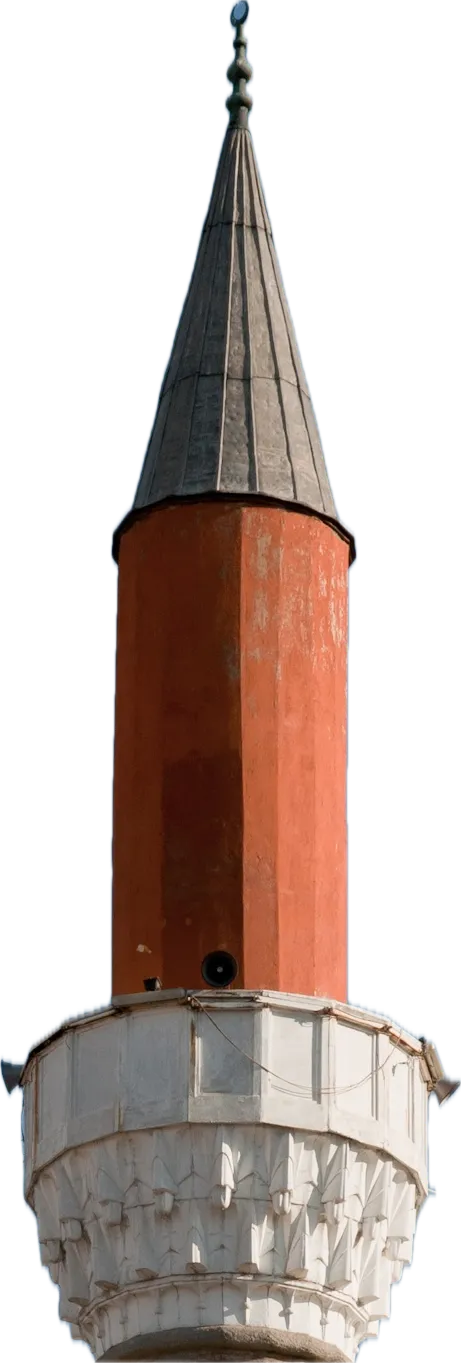
© Plamen Agov • studiolemontree.com · CC BY-SA 3.0 · Wikimedia Commons
Upper part of the minaret: tower, pale balcony and pointed roof. The lower part extends beyond the frame.
Full attribution
Photo: © Plamen Agov • studiolemontree.com; Wikimedia Commons; CC BY-SA 3.0. Cut-out detail; background removed.
A mosque, old baths and nearby places of worship tell of different centuries in Sofia’s life.
Part 1 · Ottoman period
The tower and nearby prayer houses
The photograph shows Banya Bashi’s minaret. A minaret is a mosque’s tower. A mosque is a Muslim prayer house. Nearby are the synagogue, where Jewish people pray, and St Nedelya church. St Joseph Cathedral is nearby too. A cathedral is a bishop’s main church. A bishop leads churches in an area. St Nedelya is Orthodox; St Joseph is Catholic. These are two Christian communities. Streets separate the buildings. Warm mineral water is beside the former Central Baths.
Sources · 6
- Sofia Tourism Administration Banya Bashi Mosque
- Central Sofia Synagogue History
- Sofia Tourism Administration St Nedelya Church
- Sofia Municipality Вода
- Sofia Municipality Cathedral of St Joseph
- Боряна Генчева Централната минерална баня има историческата основа за „воден“ център на София
Part 2 · Ottoman period
Stone, brick and a donor
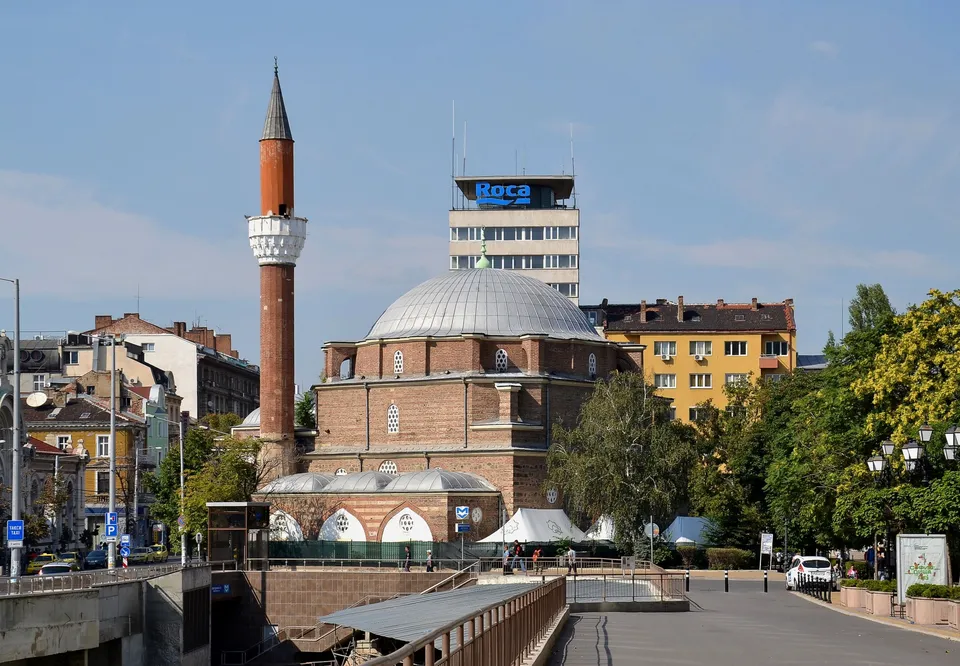
In the sixteenth century, Sofia was a city in the Ottoman Empire. The donor Seyfullah provided money for the mosque. According to the Grand Mufti’s Office, a Muslim religious institution, the mosque was built around 1566–1567. In the photograph, find the dome, minaret and walls of stone and brick.
- 1 · Dome
- The large rounded roof over the prayer hall. This photograph shows the building in 2013.
- 2 · Minaret
- The slender tower beside the mosque. A pale balcony is visible in the photograph.
- 3 · Stone and brick
- Rows of brick and pale stone in the mosque wall.
Sources · 2
- Sofia Tourism Administration Banya Bashi Mosque
- Главно мюфтийство Бюлетин / Annual Report 2014 PDF
Part 3 · Ottoman period
Two kinds of bath
Warm water is useful for bathing, but old baths did not all work the same way. A hammam is a public bath using artificially heated water. A thermal bath uses water that arrives warm from underground. Ottoman Sofia had several thermal baths.
Sources · 2
- Стефан Пейчев „Софийската баня“: османското хидротермално наследство като абстракция
- Photographer: Unknown / Fotograf: okänd Banya Bashi Mosque and minaret, Sofia, Bulgaria.jpg
Part 4 · Ottoman period
Who used the water
In yearbooks of the 1870s, the Ottoman administration describes Sofia baths for Muslim, Christian and Jewish residents. A yearbook collects information about a particular year. More than one community belongs in the story of this water. This does not mean that everyone bathed together. In our view, nearby places of worship do not prove people always lived in harmony.
Sources · 3
- Стефан Пейчев „Софийската баня“: османското хидротермално наследство като абстракция
- Катедрален храм Света Неделя История на храма
- Central Sofia Synagogue History
Part 5 · Ottoman period
Task: two kinds of bath
What distinguishes a thermal bath from a hammam in this story?
Why is that?
Thermal water comes naturally warm from underground. In the distinction used here, hammam water is artificially heated.
Correct · Its water arrives warm from underground.
Sources · 1


Part 6 · Ottoman period
Three buildings, three years
The buildings are close on the map, but date from different times. The new St Nedelya church was consecrated in 1867. Consecration is the church ceremony when a new church opens. Further rebuilding followed, so its appearance today differs from that in the sixteenth century. The Jewish community collected donations for a new synagogue. It opened in 1909. The large Central Mineral Baths opened in 1913. This was a new public bath building, not the surviving Ottoman bathhouse.
- Banya Bashi
- Sofia Synagogue
- St Nedelya
- Central Mineral Baths and water-tap precinct · Approximate location
- St Joseph
Sources · 3
- Катедрален храм Света Неделя История на храма
- Central Sofia Synagogue History
- Regional History Museum Sofia History of the Municipal Central Mineral Baths Building
Part 7 · Ottoman period
Task: put the openings in order
Put these events in order, earliest first.
Why is that?
The years establish the order: 1867, 1909, 1913. They refer to the specific buildings or openings named, not the arrival of the three faiths.
Correct order
- St Nedelya consecrated
- Synagogue opens
- Large bath opens
- Катедрален храм Света Неделя История на храма
- Central Sofia Synagogue History
- Regional History Museum Sofia History of the Municipal Central Mineral Baths Building
Sources · 3
- Катедрален храм Света Неделя История на храма
- Central Sofia Synagogue History
- Regional History Museum Sofia History of the Municipal Central Mineral Baths Building
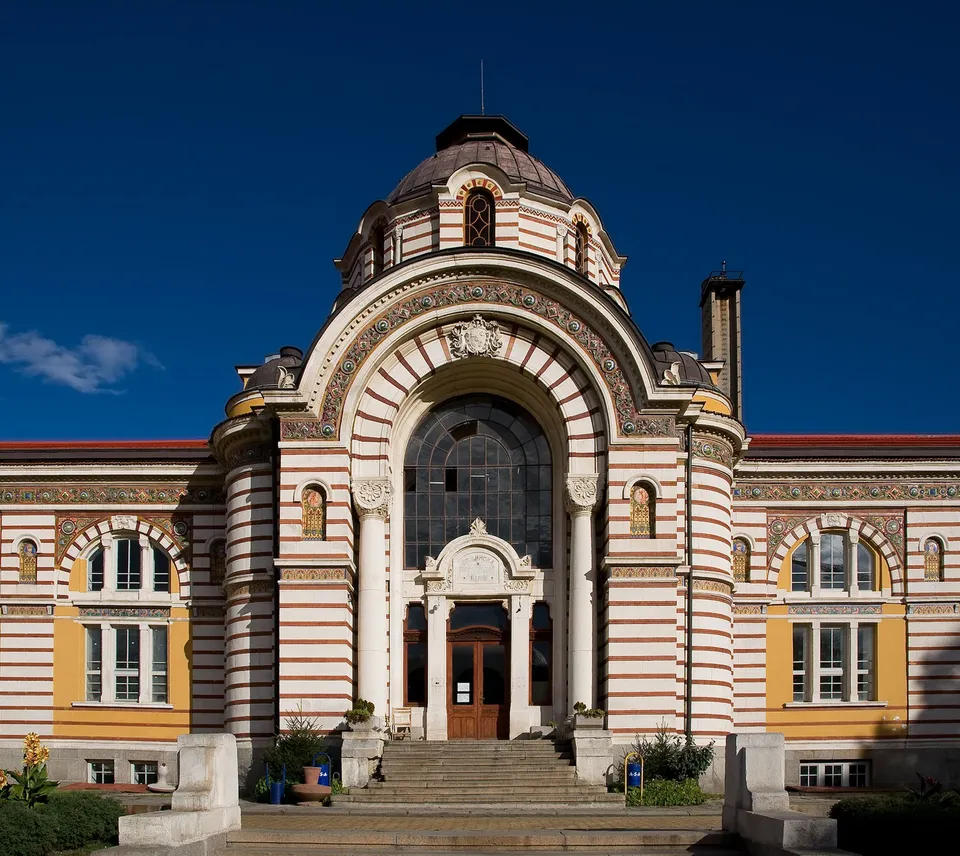
Part 8 · Ottoman period
The old bath entrance
Look at the entrance to the former Central Baths. On the facade, find the colourful tiles, made from fired clay. Inside the building, the permanent Sofia history museum exhibition opened in 2015. Mineral-water taps stand beside the former Central Baths.
- 1 · Bath entrance
- The entrance to the Central Mineral Baths. The large bath opened in 1913.
- 2 · Ceramic decoration
- Colourful decoration above the large arch. The museum credits Haralampi Tachev with decorative drawings for the facade.
- 3 · Tall window
- A window above the entrance. This photograph dates to 2010, before the permanent museum exhibition opened here in 2015.
Sources · 6
- Regional History Museum Sofia History of the Municipal Central Mineral Baths Building
- Sofia Tourism Administration Regional History Museum – Sofia
- Sofia Municipality Вода
- Sofia Municipality Cathedral of St Joseph
- Sofia Tourism Administration Banya Bashi Mosque
- Боряна Генчева Централната минерална баня има историческата основа за „воден“ център на София
Part 9 · Ottoman period
Task: building and use
Match each building to its use today.
Why is that?
The mosque and synagogue remain places of prayer. The former bath building houses the permanent history exhibition.
- Sofia Tourism Administration Banya Bashi Mosque
- Central Sofia Synagogue History
- Sofia Tourism Administration Regional History Museum – Sofia
Sources · 3
- Sofia Tourism Administration Banya Bashi Mosque
- Central Sofia Synagogue History
- Sofia Tourism Administration Regional History Museum – Sofia
A new find for your collection
The neighbouring buildings date from different times and serve different purposes.
People in this story
Sources
- Regional History Museum Sofia History of the Municipal Central Mineral Baths Building
- Sofia Municipality Cathedral of St Joseph
- Sofia Tourism Administration Banya Bashi Mosque
- Главно мюфтийство Бюлетин / Annual Report 2014 PDF
- Sofia Tourism Administration Regional History Museum – Sofia
- Катедрален храм Света Неделя История на храма
- Sofia Tourism Administration St Nedelya Church
- Стефан Пейчев „Софийската баня“: османското хидротермално наследство като абстракция
- Photographer: Unknown / Fotograf: okänd Banya Bashi Mosque and minaret, Sofia, Bulgaria.jpg
- Central Sofia Synagogue History
- Sofia Municipality Вода
- Боряна Генчева Централната минерална баня има историческата основа за „воден“ център на София
Images
© Plamen Agov • studiolemontree.com · CC BY-SA 3.0 · Wikimedia Commons
Upper part of the minaret: tower, pale balcony and pointed roof. The lower part extends beyond the frame.
Full attribution
Photo: © Plamen Agov • studiolemontree.com; Wikimedia Commons; CC BY-SA 3.0. Cut-out detail; background removed.
Pudelek · CC BY-SA 3.0 · Wikimedia Commons
The mosque with its dome, minaret and stone-and-brick walls, surrounded by modern streets.
Full attribution
Photo: Pudelek (Marcin Szala); Wikimedia Commons; CC BY-SA 3.0. Processed image.
Archive
Unknown photographer · CC0 · Wikimedia Commons / Swedish National Heritage Board
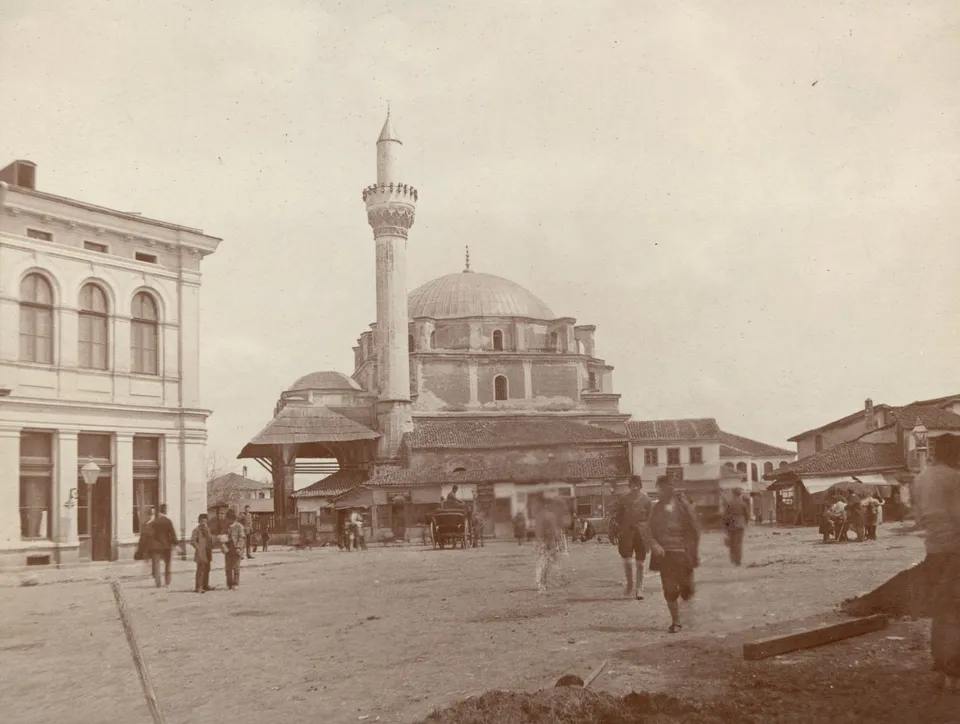
The archival photograph shows the mosque in the late nineteenth century, not the present Central Baths.
Full attribution
Photo: Unknown photographer; Wikimedia Commons / Swedish National Heritage Board; CC0. Processed image. Archival photograph
Javier Sánchez Portero · CC BY-SA 3.0 · Wikimedia Commons
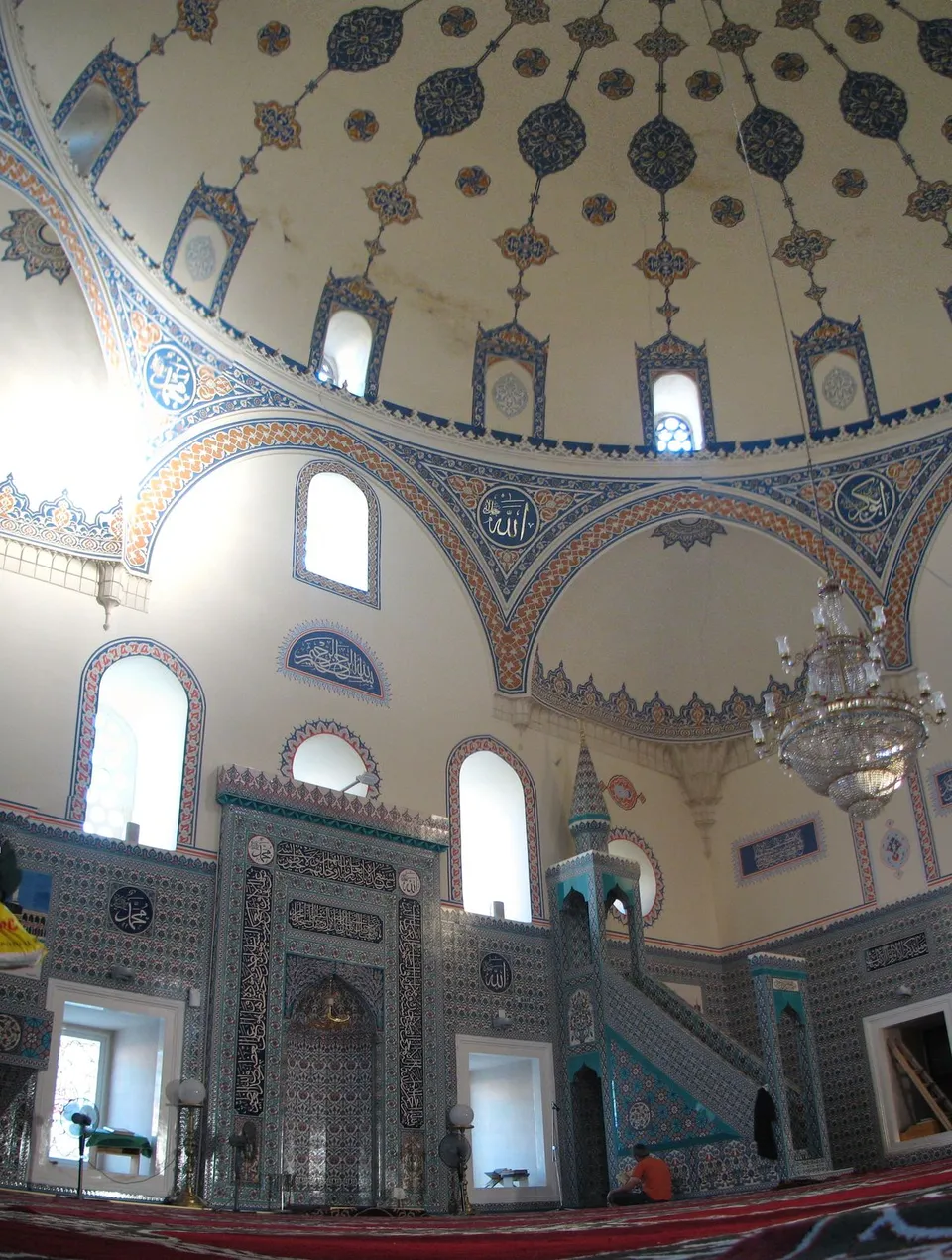
Stitched panoramic photograph of the prayer hall, 2012. A dome, windows and a chandelier are visible.
Full attribution
Photo: Javier Sánchez Portero; Wikimedia Commons; CC BY-SA 3.0. Processed image.
© Plamen Agov • studiolemontree.com · CC BY-SA 3.0 · Wikimedia Commons
An entrance, a tall window and colourful tiles made from fired clay.
Full attribution
Photo: © Plamen Agov • studiolemontree.com; Wikimedia Commons; CC BY-SA 3.0. Processed image.
Geographic context, without historical borders
Tom Patterson · Nathaniel Vaughn Kelso · Public domain · Natural Earth
Full attribution
Tom Patterson · Nathaniel Vaughn Kelso