 History of Bulgaria
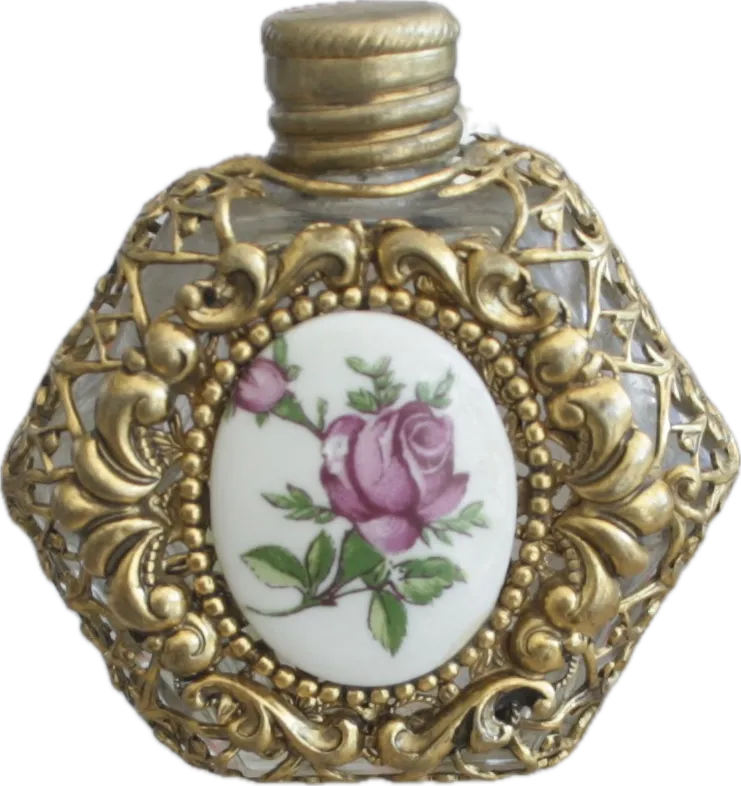
Lyudmil Buyukliev · CC BY-SA 4.0 · Wikimedia Commons
Full attribution
Image: Lyudmil Buyukliev, Wikimedia Commons, CC BY-SA 4.0. Ornate bottle and vessels, museum display. Cut-out detail; background removed.
Pickers, stills and export vessels connect fields near Karlovo and Kazanlak to distant markets. Follow fresh blossom as it becomes oil.
Part 1 · Ottoman period
Blossoms for a kilogram of oil
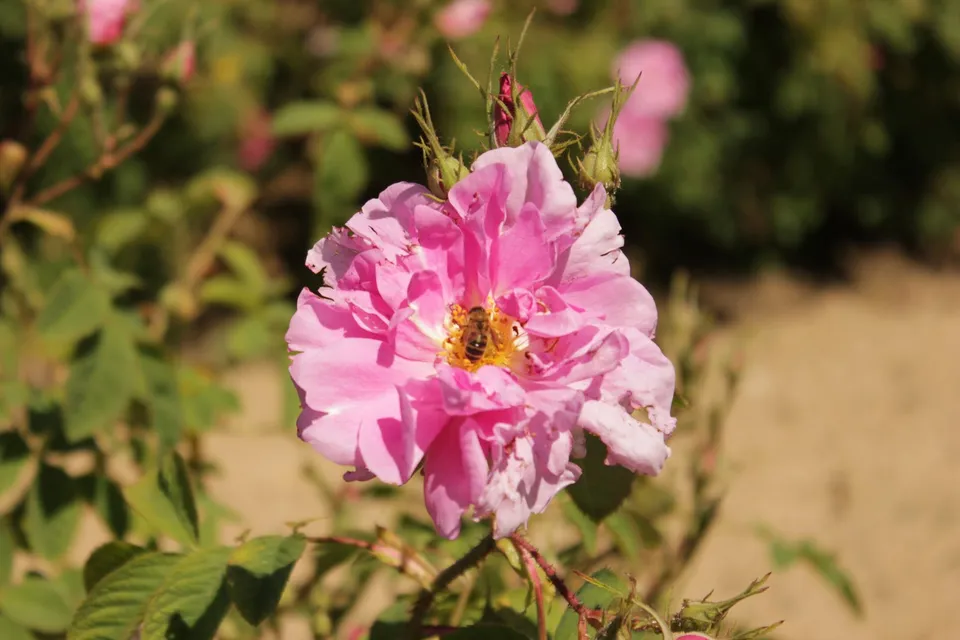
The photograph shows a Damask rose blossom. How many such flowers are needed for a kilogram of oil? About three and a half tonnes of rose blossom are needed. The amount varies with the flowers and the processing method.
An oil-bearing rose is grown for the fragrant oil in its flowers. The oil is not squeezed out like lemon juice. The flowers go into a still: a vessel for heating them with water. First, someone must pick them.
Sources · 4
- European Commission Publication of an application: Българско розово масло (Bulgarsko rozovo maslo), 2014/C 122/05
- Регионален етнографски музей – Пловдив; Институт по математика и информатика – БАН The Bride (Maiden) — Digital Cultural Road “Shepherd and Bride”
- OMDA (editor not named) Traditional Rose Oil Production
- Edal Anton Lefterov Bulgarian Rosa damascena.JPG


Part 2 · Ottoman period
Karlovo and Kazanlak
Find Karlovo and Kazanlak in the Rose Valley, between the Balkan range and Sredna Gora. The map marks towns, not old fields.
Roses were grown for oil under Ottoman rule, when this region belonged to the Ottoman Empire. The European specification links production’s development to the seventeenth century. These accounts name no first grower. In 1853 a magazine described roses, water and copper vessels. Heating and cooling extracted oil for sale. Work in the fields starts early.
Sources · 3
- European Commission Publication of an application: Българско розово масло (Bulgarsko rozovo maslo), 2014/C 122/05
- OMDA (editor not named) Traditional Rose Oil Production
- Anonymous Oil of Roses
Part 3 · Ottoman period
Rose pickers fill the sacks
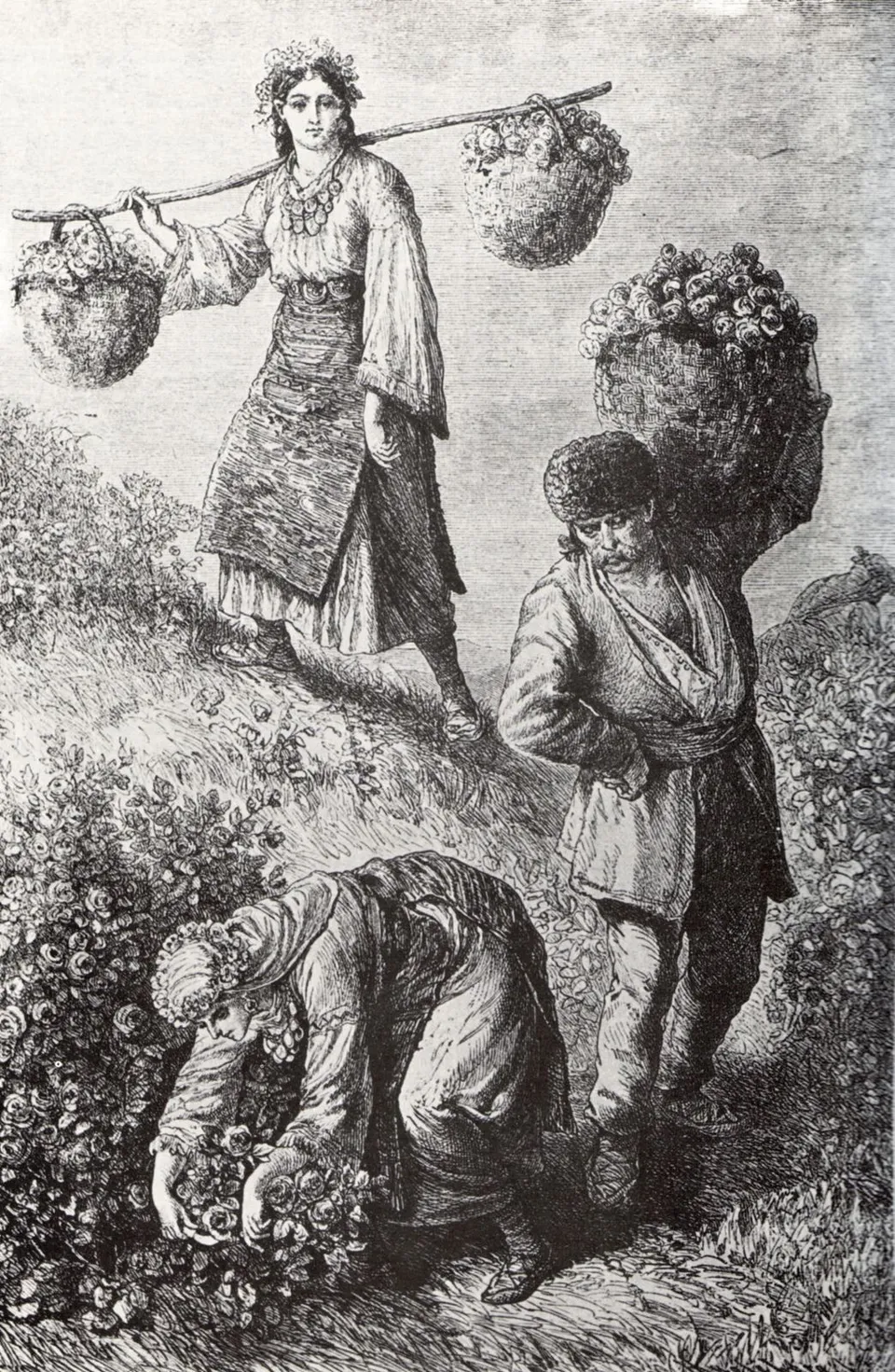
Rose picking starts early. The museum account mentions the time before sunrise. The modern specification gives five or six in the morning. Fresh flowers must quickly reach the distillery, where oil is extracted.
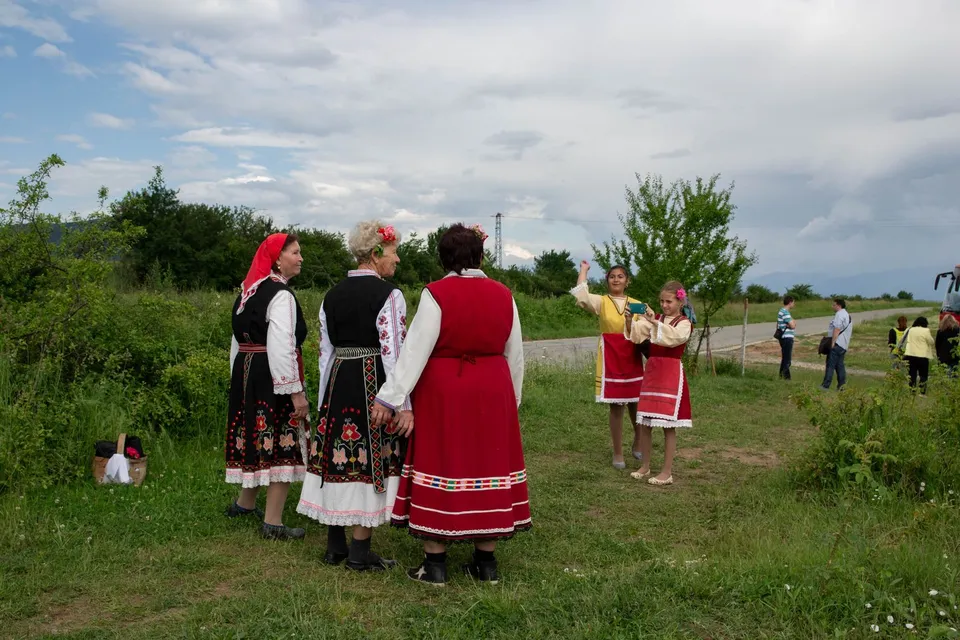
A 2020 report from Yagoda describes women picking with sacks. Sevdo recalls picking with his siblings as a child. This later recollection is not evidence about Ottoman rule. The engraving is a drawing from the past. The modern photograph shows festival participants near Kazanlak.
Sources · 5
- European Commission Publication of an application: Българско розово масло (Bulgarsko rozovo maslo), 2014/C 122/05
- Регионален етнографски музей – Пловдив; Институт по математика и информатика – БАН The Bride (Maiden) — Digital Cultural Road “Shepherd and Bride”
- Marina Mihaylova Rose-picking with harmonica
- Felix Philipp Kanitz Rose-picking in Bulgaria 1870ies.jpg
- Dachegraphy Young rose pickers are documenting their grandma's outfits (Kazanlak, Bulgaria).jpg
Part 4 · Ottoman period
The still turns water into steam
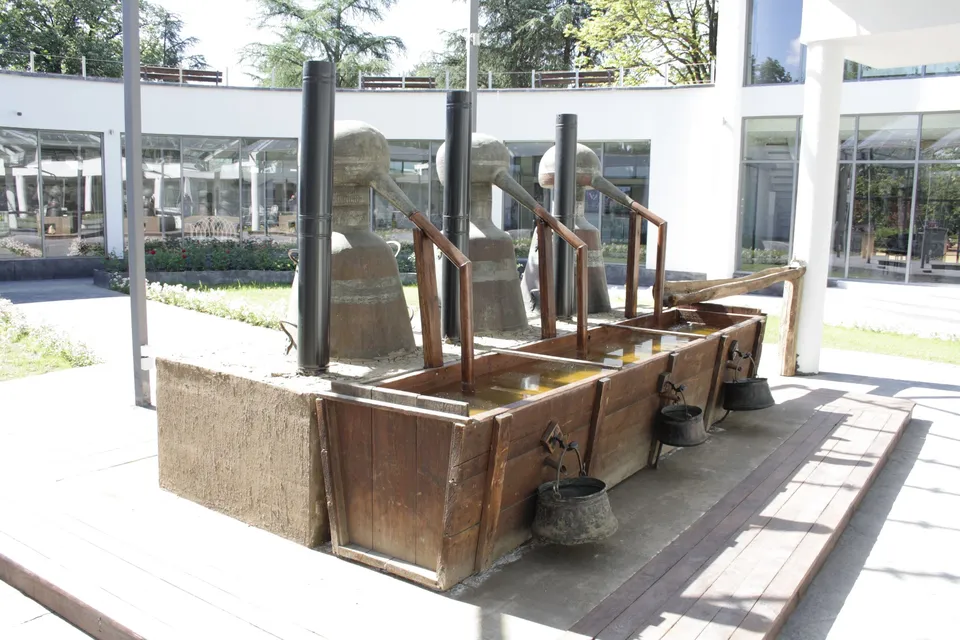
Look at the museum installation. Flowers and water are heated in the still. Steam carries fragrant substances along the pipe. The cooler holds cold water around the steam pipe. Cooling turns steam into liquid. Heating and cooling are part of distillation. Oil is then separated from rose water.
The European specification also describes distilling the fragrant water again for more oil. The photograph shows a museum arrangement, not a nineteenth-century working shift. Find the still, pipe and cooler.
- 1 · Still
- Flowers and water are heated here. This is a museum installation.
- 2 · Steam pipe
- The sloping pipe leads the steam towards the cooler.
- 3 · Cooler
- Water in the trough cools the pipe. The steam inside turns into liquid.
Sources · 4
- European Commission Publication of an application: Българско розово масло (Bulgarsko rozovo maslo), 2014/C 122/05
- OMDA (editor not named) Traditional Rose Oil Production
- Anonymous Oil of Roses
- Lyudmil Buyukliev 19th c. Distillation of Rose Oil.jpg
Part 5 · Ottoman period
Activity: why hurry?
Why must the blossom reach the distillery quickly?
Why is that?
Freshness matters for quality. Distilleries are close to the fields.
Correct · So it can be processed fresh.
Sources · 1
Part 6 · Ottoman period
The label on the export vessel
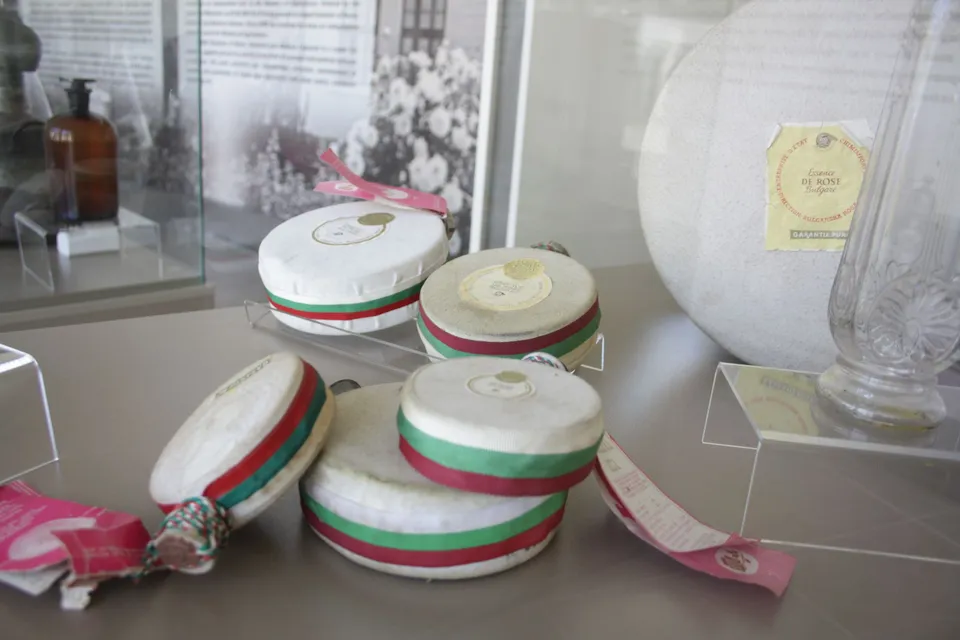
By the end of the nineteenth century, rose products reached France, England and the United States. This was export: selling goods abroad. We can see the vessel as a trace of pickers’, craftspeople’s and merchants’ work.
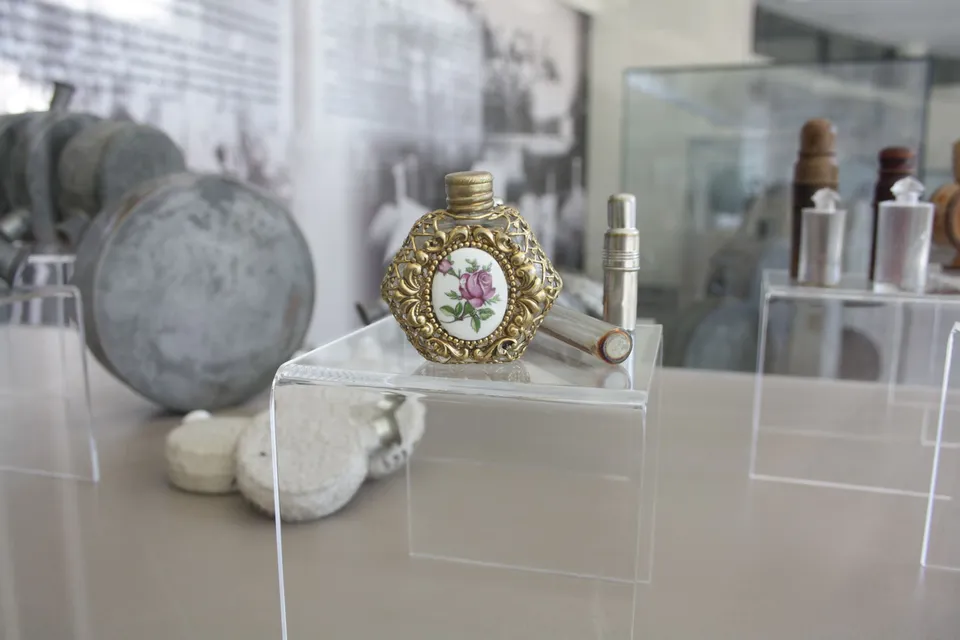
The 1853 account mentions copper vessels sealed with melted metal after filling. The photograph shows museum export packages with coverings and labels. Another display contains an ornate bottle decorated with a rose. It presents the fragrant product differently. It is not a distilling tool.
- 1 · Export package
- A covered vessel in the museum export display. Its inner metal is not visible in this photograph.
- 2 · Label
- The label says Essence de rose: French for “rose essence”. The words name the product.
- 3 · Tie
- Cord and ribbon are visible on the package. They belong to its wrapping; their colours alone do not date the vessel.
Sources · 5
- Красимир Кръстев; Момчил Маринов За някои практики от дейността и контактите на български розотърговски фирми (1879 г. – края на XIX в.) PDF
- Anonymous Oil of Roses
- Община Казанлък Музей на розата
- Lyudmil Buyukliev Export Konkumas - Rose Oil Containers.jpg
- Lyudmil Buyukliev Konkumas - Rose Oil Containers.jpg
Part 7 · Ottoman period
Activity: from blossom to oil
Put the main steps from the still scene in order.
Why is that?
First the raw material is gathered. Heating makes steam, cooling turns it into liquid, and oil is then separated. These are the main steps; the story also mentions redistillation.
Correct order
- Pick fresh flowers.
- Heat flowers and water.
- Cool the steam into liquid.
- Separate oil from water.
- OMDA (editor not named) Traditional Rose Oil Production
- European Commission Publication of an application: Българско розово масло (Bulgarsko rozovo maslo), 2014/C 122/05
Sources · 2
- OMDA (editor not named) Traditional Rose Oil Production
- European Commission Publication of an application: Българско розово масло (Bulgarsko rozovo maslo), 2014/C 122/05
Part 8 · Ottoman period
Stills in the museum
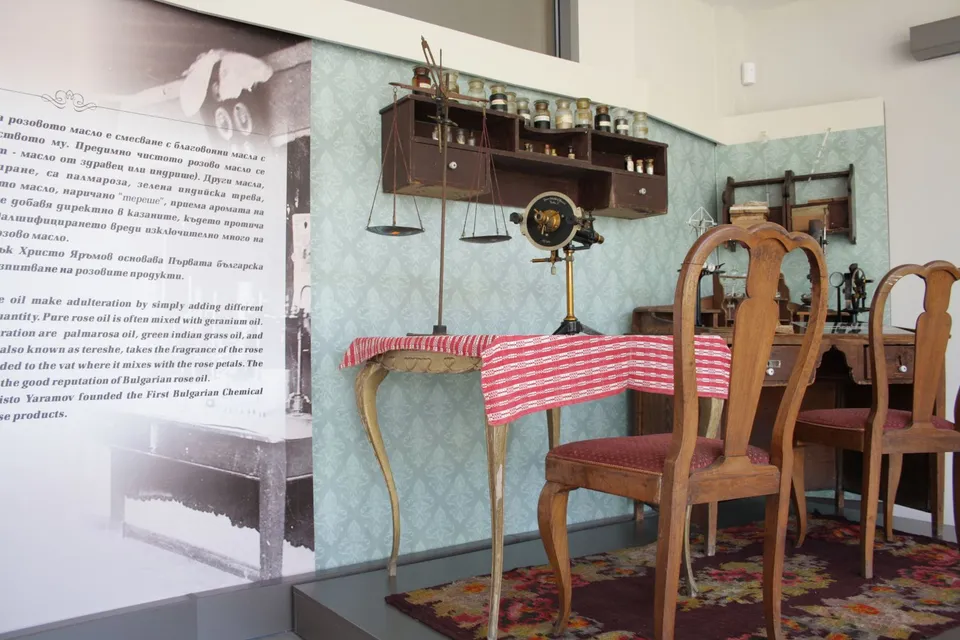
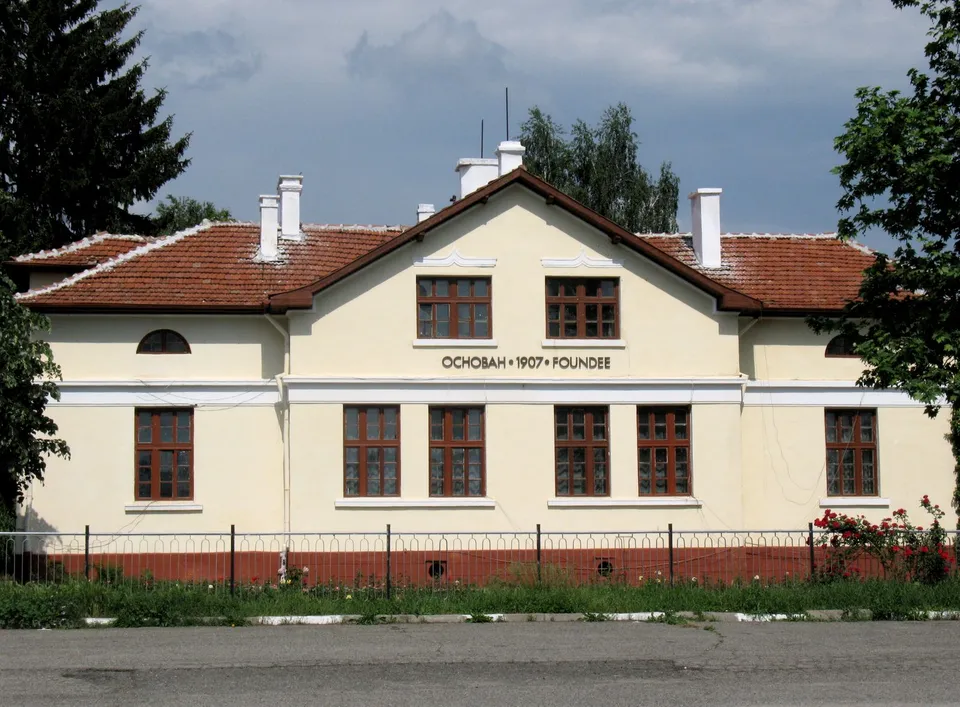
The Rose Museum in Kazanlak preserves evidence of rose-oil production. In 1969 an earlier exhibition became a museum. Inside are tools, oil vessels and a reconstructed laboratory. A reconstruction is an arrangement showing how the laboratory once looked. The old building in the separate photograph is the museum’s former home. The stills and vessels show how oil is made and sold.
- Kazanlak · Approximate location
Sources · 4
- Община Казанлък Музей на розата
- Министерство на туризма на Република България Музей на розата
- Lyudmil Buyukliev Rose Oil Laboratory.jpg
- Михал Орела Museum of the Rose Kazanlak.jpg
Part 9 · Ottoman period
Activity: match
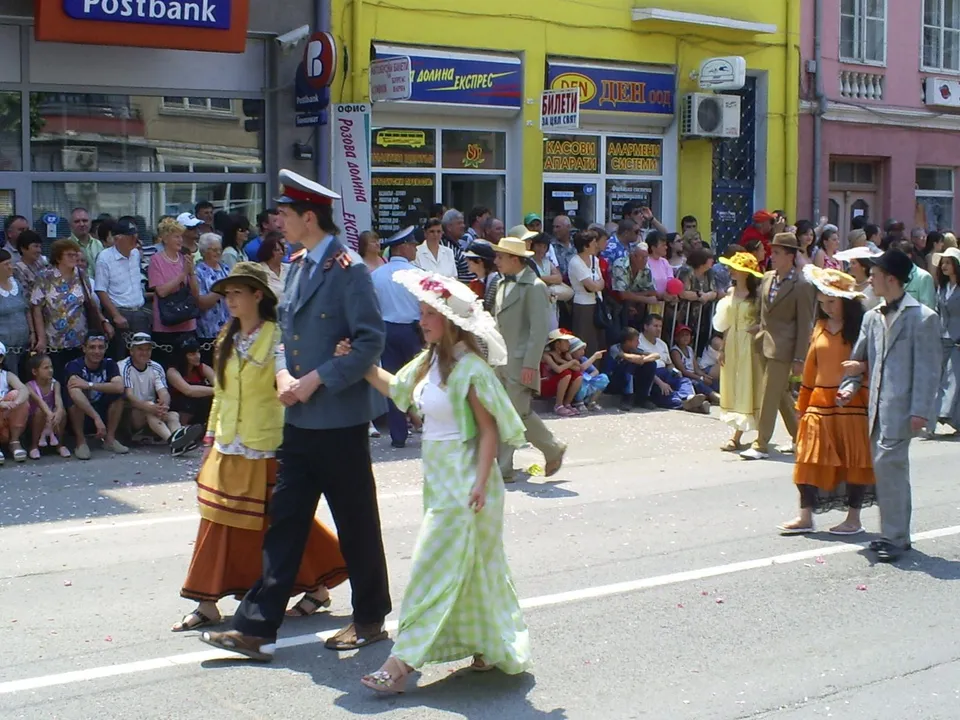
The Rose Festival has demonstrations of rose picking and distilling. There is also a procession: participants walk together past the audience. Kazanlak municipality dates the festival’s beginning to 1903. Match each thing to its role in the story.
Why is that?
The plant supplies the raw material, the cooler works in distillation, and the procession belongs to the festival.
- European Commission Publication of an application: Българско розово масло (Bulgarsko rozovo maslo), 2014/C 122/05
- OMDA (editor not named) Traditional Rose Oil Production
- Община Казанлък Фестивал на розата
- Община Казанлък Празникът на розата удължи патента си до 2034 година
- Moni Monev Kazanluk(BULGARIA) praznik na rozata - panoramio.jpg
Sources · 5
- European Commission Publication of an application: Българско розово масло (Bulgarsko rozovo maslo), 2014/C 122/05
- OMDA (editor not named) Traditional Rose Oil Production
- Община Казанлък Фестивал на розата
- Община Казанлък Празникът на розата удължи патента си до 2034 година
- Moni Monev Kazanluk(BULGARIA) praznik na rozata - panoramio.jpg
A new find for your collection
A small vessel of oil brings together the work of pickers, craftspeople and merchants.
People in this story
Sources
- Регионален етнографски музей – Пловдив; Институт по математика и информатика – БАН The Bride (Maiden) — Digital Cultural Road “Shepherd and Bride”
- European Commission Publication of an application: Българско розово масло (Bulgarsko rozovo maslo), 2014/C 122/05
- Община Казанлък Празникът на розата удължи патента си до 2034 година
- Община Казанлък Фестивал на розата
- Marina Mihaylova Rose-picking with harmonica
- Министерство на туризма на Република България Музей на розата
- Община Казанлък Музей на розата
- OMDA (editor not named) Traditional Rose Oil Production
- Lyudmil Buyukliev Konkumas - Rose Oil Containers.jpg
- Felix Philipp Kanitz Rose-picking in Bulgaria 1870ies.jpg
- Lyudmil Buyukliev Export Konkumas - Rose Oil Containers.jpg
- Moni Monev Kazanluk(BULGARIA) praznik na rozata - panoramio.jpg
- Lyudmil Buyukliev Rose Oil Laboratory.jpg
- Михал Орела Museum of the Rose Kazanlak.jpg
- Dachegraphy Young rose pickers are documenting their grandma's outfits (Kazanlak, Bulgaria).jpg
- Edal Anton Lefterov Bulgarian Rosa damascena.JPG
- Lyudmil Buyukliev 19th c. Distillation of Rose Oil.jpg
- Anonymous Oil of Roses
- Красимир Кръстев; Момчил Маринов За някои практики от дейността и контактите на български розотърговски фирми (1879 г. – края на XIX в.) PDF
Images
Lyudmil Buyukliev · CC BY-SA 4.0 · Wikimedia Commons
Full attribution
Image: Lyudmil Buyukliev, Wikimedia Commons, CC BY-SA 4.0. Ornate bottle and vessels, museum display. Cut-out detail; background removed.
Edal Anton Lefterov · CC BY-SA 3.0 · Wikimedia Commons
Full attribution
Image: Edal Anton Lefterov, Wikimedia Commons, CC BY-SA 3.0. Damask rose, modern photograph. Processed image.
Felix Philipp Kanitz · Public domain · Wikimedia Commons
Full attribution
Image: Felix Philipp Kanitz, Wikimedia Commons, Public domain. Rose picking, nineteenth-century engraving after Felix Kanitz. Wikimedia Commons dates its publication to 1879. Processed image.
Dachegraphy · CC BY-SA 4.0 · Wikimedia Commons
Full attribution
Image: Dachegraphy, Wikimedia Commons, CC BY-SA 4.0. Modern festival scene near Kazanlak. Processed image.
Lyudmil Buyukliev · CC BY-SA 4.0 · Wikimedia Commons
Full attribution
Image: Lyudmil Buyukliev, Wikimedia Commons, CC BY-SA 4.0. Rose-distilling installation, museum arrangement in Kazanlak. Processed image.
Lyudmil Buyukliev · CC BY-SA 4.0 · Wikimedia Commons
Full attribution
Image: Lyudmil Buyukliev, Wikimedia Commons, CC BY-SA 4.0. Rose-oil export packages, museum display. Processed image.
Lyudmil Buyukliev · CC BY-SA 4.0 · Wikimedia Commons
Full attribution
Image: Lyudmil Buyukliev, Wikimedia Commons, CC BY-SA 4.0. Ornate bottle and vessels, museum display. Processed image.
Lyudmil Buyukliev · CC BY-SA 4.0 · Wikimedia Commons
Full attribution
Image: Lyudmil Buyukliev, Wikimedia Commons, CC BY-SA 4.0. Reconstructed laboratory, Rose Museum. Processed image.
Photo
Mihal Orela · CC BY 3.0 · Wikimedia Commons
Full attribution
Image: Mihal Orela (Михал Орела), Wikimedia Commons, CC BY 3.0. Former Rose Museum building, photographed in 2007. Processed image. Former building · photograph
Moni Monev · CC BY 3.0 · Wikimedia Commons
Full attribution
Image: Moni Monev, Wikimedia Commons, CC BY 3.0. Rose Festival procession in Kazanlak, modern photograph. Processed image.
Geographic context, without historical borders
Tom Patterson · Nathaniel Vaughn Kelso · Public domain · Natural Earth
Full attribution
Tom Patterson · Nathaniel Vaughn Kelso