 History of Bulgaria
Photo
Aleksander Dragnes · CC BY 2.0 · Wikimedia Commons
Full attribution
Source: Aleksander Dragnes / Wikimedia Commons, CC BY 2.0 Processed image. Site today
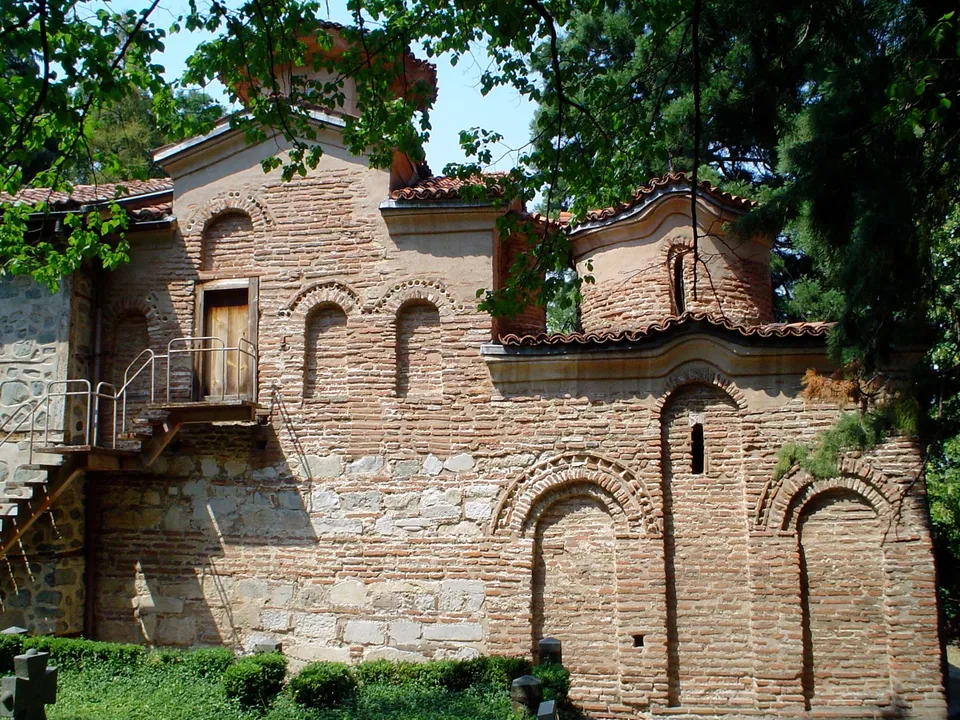
Two portrait pairs, a church model and bread on a painted table: a closer look at Boyana’s murals.
Part 1 · Second Tsardom
Faces from 1259
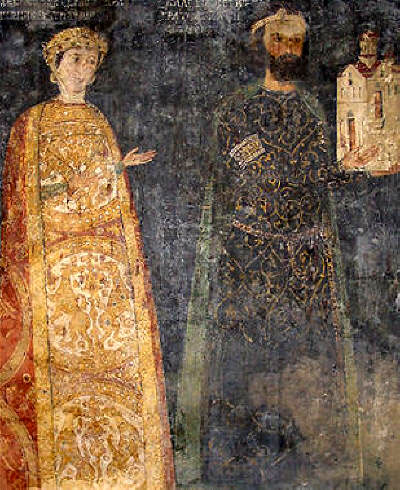
In 1259, artists in a church near Sofia painted people who were alive in their own time. Among them were Kaloyan and Desislava. Look at their faces, then their hands and clothes. These are named individuals within a religious painting programme. What makes their presence feel so tangible?
The National History Museum stresses the portrait character of the secular figures; UNESCO highlights vitality within the Byzantine canon. Their expressiveness works within a medieval tradition. It does not prove a break with that tradition. The date is not a guess based on style: the donor inscription in the narthex records the painting year in another calendar. The National History Museum dates the paintings to 1259. The church’s Bulgarian home page uses 1258/59; here we follow the museum’s dating. A donor helped support the church.
Sources · 4
- Национален исторически музей Боянска църква „Св. Никола и св. Пантелеймон“
- UNESCO World Heritage Centre Boyana Church (World Heritage List, no. 42bis)
- Национален исторически музей; Фондация „Балканско наследство“ Боянската църква / Boyana church
- Sebastian Kempgen Remarks on the Patron’s Inscription of the Boyana Church: Reproductions and Unicode-based Wikipedia Representation


Part 2 · Second Tsardom
A building growing westward
Boyana Church stands in today’s Boyana district, at the foot of Vitosha. The map point marks the surviving building, not the boundaries of a medieval estate. Imagine approaching from east to west: this is the direction in which the church grew.
UNESCO dates the oldest eastern part to the tenth–eleventh centuries; BYZART, to the late tenth or eleventh century. Kaloyan commissioned a western addition in the thirteenth century: early in UNESCO’s short English description, mid-century in BYZART. Below was the vestibule, also called the narthex; above was a family chapel dedicated to Saint Panteleimon. The final western extension is nineteenth-century: early in UNESCO’s account, mid-century in the National History Museum’s. The parts we see together today were not built at the same time. The church entered the World Heritage List in 1979.
Sources · 4
- Emmanuel Moutafov; Margarita Kuyumdzhieva; Ivan Vanev; Alexander Kuyumdzhiev; Maya Zaharieva; Tereza Bacheva; Anna Shoyleva-Chomakova Visual testimonies of élite Patronage from the 13th to the 15th century in Bulgaria PDF
- Национален исторически музей Боянска църква „Св. Никола и св. Пантелеймон“
- UNESCO World Heritage Centre Boyana Church (World Heritage List, no. 42bis)
- Национален исторически музей; Фондация „Балканско наследство“ БОЯНСКАТА ЦЪРКВА / THE BOYANA CHURCH
Part 3 · Second Tsardom
The donor holds a church
Kaloyan holds a small church. The model can be read as a sign of the donation. His wife Desislava stands beside him. Her hand touches the cord of her cloak. Follow the gestures, then examine the decoration on the clothes.
Kaloyan’s title is sebastocrator. He is not the tsar in the other portrait. Researchers read the couple’s elaborate dress as signs of social standing. That is an interpretation of the image. The photograph lets us examine the painted faces, but cannot establish how closely they resembled the living people.
- 1 · Kaloyan
- The sebastocrator is the male donor in this pair.
- 2 · Church model
- Kaloyan holds a church model. It can be read as a sign of the donation; it is not an architectural drawing.
- 3 · Desislava
- Kaloyan’s wife. Her hand is at the cord of her cloak.
Sources · 3
- Emmanuel Moutafov; Margarita Kuyumdzhieva; Ivan Vanev; Alexander Kuyumdzhiev; Maya Zaharieva; Tereza Bacheva; Anna Shoyleva-Chomakova Visual testimonies of élite Patronage from the 13th to the 15th century in Bulgaria PDF
- Национален исторически музей; Фондация „Балканско наследство“ БОЯНСКАТА ЦЪРКВА / THE BOYANA CHURCH
- Wikimedia Commons contributors; individual creators recorded per asset Boyana Church: photographs
Part 4 · Second Tsardom
Facing them: the rulers
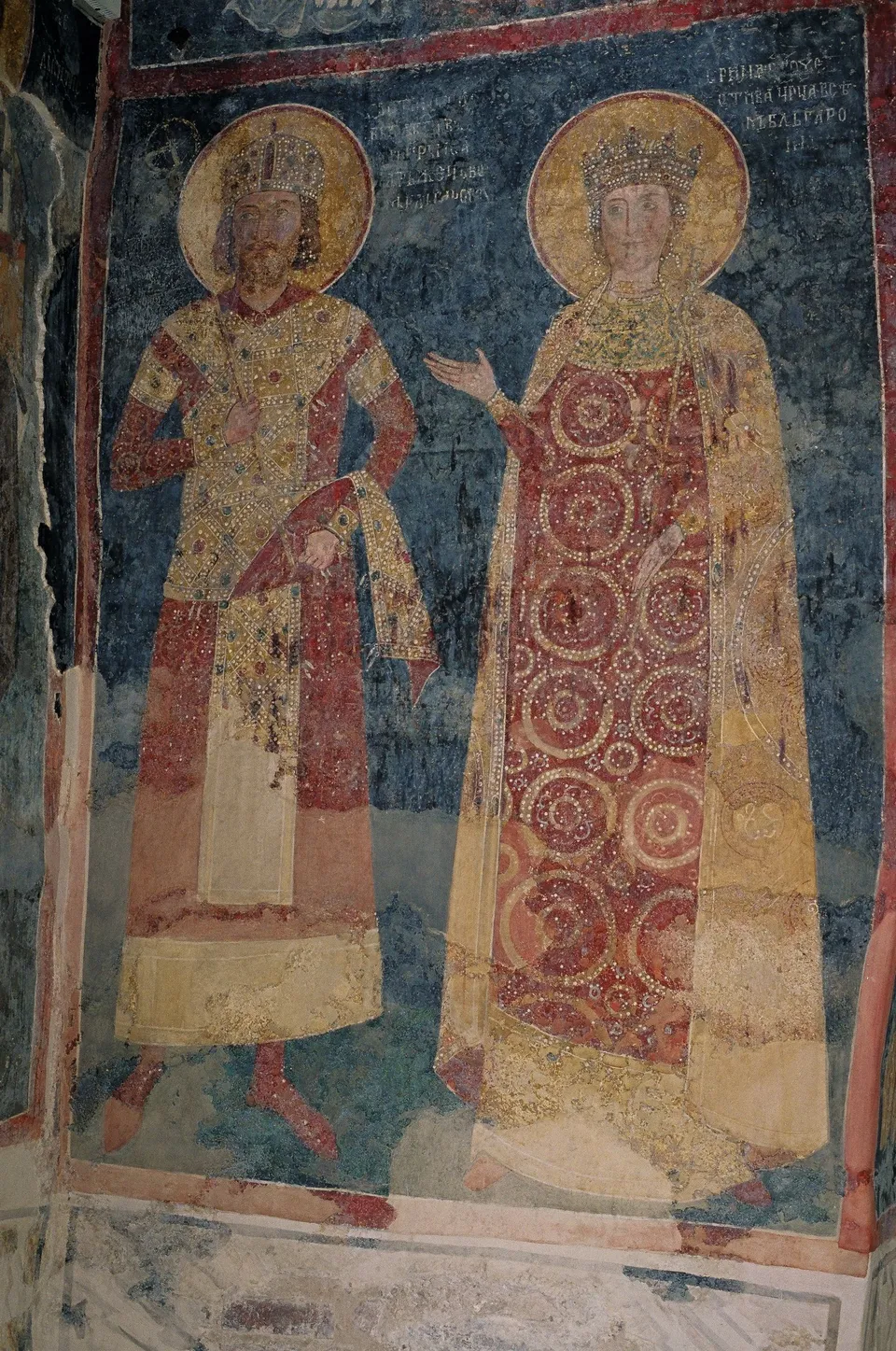
Facing the donors are Tsar Konstantin Tih and Tsaritsa Irina. Your eye moves from their faces to crowns and richly decorated robes. Both couples occupy the same space, but their roles differ. Kaloyan and Desislava are the donors; Konstantin and Irina are the ruling couple.
The authors of the study on medieval patronage read clothing as a language of power, connected with Byzantine court insignia. A portrait can therefore tell us about the rank being displayed without revealing the sitter’s character. We do not know what Irina is thinking. We can see how she was chosen to be represented on the church wall.
- 1 · Konstantin Tih
- The tsar stands on the left in this photograph; Kaloyan appears in the other portrait.
- 2 · Tsaritsa Irina
- Irina stands on the right in the ruling couple’s portrait.
- 3 · Clothing and rank
- Researchers interpret the decorated robes as signs of power and rank.
Sources · 3
- Emmanuel Moutafov; Margarita Kuyumdzhieva; Ivan Vanev; Alexander Kuyumdzhiev; Maya Zaharieva; Tereza Bacheva; Anna Shoyleva-Chomakova Visual testimonies of élite Patronage from the 13th to the 15th century in Bulgaria PDF
- Национален исторически музей Боянска църква „Св. Никола и св. Пантелеймон“
- Национален исторически музей; Фондация „Балканско наследство“ БОЯНСКАТА ЦЪРКВА / THE BOYANA CHURCH
Part 5 · Second Tsardom
Activity: donors and rulers
Which pair is represented as donors in the portrait we examined?
Why is that?
Kaloyan and Desislava are the donor pair. Kaloyan holds the church model.
Correct · Kaloyan and Desislava
- Emmanuel Moutafov; Margarita Kuyumdzhieva; Ivan Vanev; Alexander Kuyumdzhiev; Maya Zaharieva; Tereza Bacheva; Anna Shoyleva-Chomakova Visual testimonies of élite Patronage from the 13th to the 15th century in Bulgaria PDF
- Национален исторически музей Боянска църква „Св. Никола и св. Пантелеймон“
Sources · 2
- Emmanuel Moutafov; Margarita Kuyumdzhieva; Ivan Vanev; Alexander Kuyumdzhiev; Maya Zaharieva; Tereza Bacheva; Anna Shoyleva-Chomakova Visual testimonies of élite Patronage from the 13th to the 15th century in Bulgaria PDF
- Национален исторически музей Боянска църква „Св. Никола и св. Пантелеймон“
Part 6 · Second Tsardom
Bread on the table
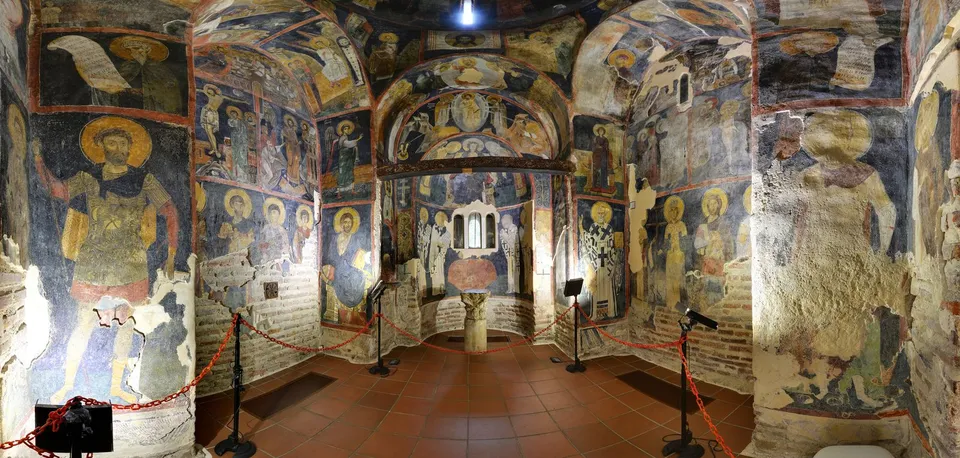
Food offers another way for the painted world to feel familiar. In the Last Supper the museum site identifies pieces of bread, turnips, spring onions and garlic. Christ is at the left end of the table; Judas, without a halo, reaches towards a tall bowl.
The site interprets this food as a customary Bulgarian spring meal of the thirteenth century. This is a proposed reading of the details, not a surviving menu. Painted bread cannot tell us its recipe. It does show how a religious subject can accommodate everyday objects. Faces are not the only place where the artists provide something concrete to examine.
Sources · 1
- Национален исторически музей; Фондация „Балканско наследство“ БОЯНСКАТА ЦЪРКВА / THE BOYANA CHURCH
Part 7 · Second Tsardom
Activity: put in time order
Arrange from earliest to latest.
Why is that?
The eastern church predates the paintings of 1259; the final western addition is nineteenth-century, and World Heritage inscription came in 1979.
Correct order
- The old eastern church
- Painting the donor portraits
- The final western addition
- World Heritage inscription
- Emmanuel Moutafov; Margarita Kuyumdzhieva; Ivan Vanev; Alexander Kuyumdzhiev; Maya Zaharieva; Tereza Bacheva; Anna Shoyleva-Chomakova Visual testimonies of élite Patronage from the 13th to the 15th century in Bulgaria PDF
- Национален исторически музей Боянска църква „Св. Никола и св. Пантелеймон“
- UNESCO World Heritage Centre Boyana Church (World Heritage List, no. 42bis)
Sources · 3
- Emmanuel Moutafov; Margarita Kuyumdzhieva; Ivan Vanev; Alexander Kuyumdzhiev; Maya Zaharieva; Tereza Bacheva; Anna Shoyleva-Chomakova Visual testimonies of élite Patronage from the 13th to the 15th century in Bulgaria PDF
- Национален исторически музей Боянска църква „Св. Никола и св. Пантелеймон“
- UNESCO World Heritage Centre Boyana Church (World Heritage List, no. 42bis)
Part 8 · Second Tsardom
What remains before our eyes
Boyana brings together religious narrative, named contemporaries and details of everyday life. Its expressive faces do not require us to declare the beginning of the entire European Renaissance here. It is more useful to distinguish what we see, what the inscription says and what researchers interpret.
The church’s website uses “Boyana Master” as a collective name for a group of painters. Sources disagree on whether their names are established. In 1979 the church entered the World Heritage List. Choose a gesture, a face or a detail of clothing in the photographs. What can you see for yourself in your chosen detail, and what needs a source?
Sources · 5
- UNESCO World Heritage Centre Boyana Church (World Heritage List, no. 42bis)
- Национален исторически музей; Фондация „Балканско наследство“ БОЯНСКАТА ЦЪРКВА / THE BOYANA CHURCH
- Национален исторически музей; Фондация „Балканско наследство“ Visitors Information
- Национален исторически музей Боянска църква „Св. Никола и св. Пантелеймон“
- Ministry of Tourism of the Republic of Bulgaria Boyana Church
Part 9 · Second Tsardom
Activity: match
Match each name or piece of evidence to its description.
Why is that?
Kaloyan holds the model; Irina belongs to the royal pair; the museum dates the paintings from the inscription; the bread belongs to the meal.
- Emmanuel Moutafov; Margarita Kuyumdzhieva; Ivan Vanev; Alexander Kuyumdzhiev; Maya Zaharieva; Tereza Bacheva; Anna Shoyleva-Chomakova Visual testimonies of élite Patronage from the 13th to the 15th century in Bulgaria PDF
- Национален исторически музей Боянска църква „Св. Никола и св. Пантелеймон“
- Национален исторически музей; Фондация „Балканско наследство“ БОЯНСКАТА ЦЪРКВА / THE BOYANA CHURCH
- Wikimedia Commons contributors; individual creators recorded per asset Boyana Church: photographs
Sources · 4
- Emmanuel Moutafov; Margarita Kuyumdzhieva; Ivan Vanev; Alexander Kuyumdzhiev; Maya Zaharieva; Tereza Bacheva; Anna Shoyleva-Chomakova Visual testimonies of élite Patronage from the 13th to the 15th century in Bulgaria PDF
- Национален исторически музей Боянска църква „Св. Никола и св. Пантелеймон“
- Национален исторически музей; Фондация „Балканско наследство“ БОЯНСКАТА ЦЪРКВА / THE BOYANA CHURCH
- Wikimedia Commons contributors; individual creators recorded per asset Boyana Church: photographs
A new find for your collection
At Boyana, named donors and rulers appear among religious images; gestures and clothing reward close looking, while interpretations remain distinct from the inscription and visible evidence.
People in this story
Sources
- Emmanuel Moutafov; Margarita Kuyumdzhieva; Ivan Vanev; Alexander Kuyumdzhiev; Maya Zaharieva; Tereza Bacheva; Anna Shoyleva-Chomakova Visual testimonies of élite Patronage from the 13th to the 15th century in Bulgaria PDF
- Wikimedia Commons contributors; individual creators recorded per asset Boyana Church: photographs
- Национален исторически музей; Фондация „Балканско наследство“ БОЯНСКАТА ЦЪРКВА / THE BOYANA CHURCH
- Национален исторически музей; Фондация „Балканско наследство“ Боянската църква / Boyana church
- Sebastian Kempgen Remarks on the Patron’s Inscription of the Boyana Church: Reproductions and Unicode-based Wikipedia Representation
- Национален исторически музей Боянска църква „Св. Никола и св. Пантелеймон“
- Ministry of Tourism of the Republic of Bulgaria Boyana Church
- UNESCO World Heritage Centre Boyana Church (World Heritage List, no. 42bis)
- Национален исторически музей; Фондация „Балканско наследство“ Visitors Information
Images
Photo
Aleksander Dragnes · CC BY 2.0 · Wikimedia Commons
Full attribution
Source: Aleksander Dragnes / Wikimedia Commons, CC BY 2.0 Processed image. Site today
Photo
Anonymous medieval painter · Public domain · Wikimedia Commons
Kaloyan and Desislava, a mural dated to 1259 by the museum. Photographic reproduction of the original painting.
Full attribution
Source: Anonymous medieval painter(s); reproduction uploaded by bg:Потребител:Kandi (photographer not identified) / Wikimedia Commons, Public domain Processed image. Original mural
Photo
Unknown author · CC0 · Wikimedia Commons
Full attribution
Source: Unknown author (Commons metadata); medieval painter(s) anonymous / Wikimedia Commons, CC0 Processed image. Original mural
Photo
Interact-Bulgaria · CC BY-SA 4.0 · Wikimedia Commons
Full attribution
Source: Interact-Bulgaria / Wikimedia Commons, CC BY-SA 4.0 Processed image. Site today
Geographic context, without historical borders
Tom Patterson · Nathaniel Vaughn Kelso · Public domain · Natural Earth
Full attribution
Tom Patterson · Nathaniel Vaughn Kelso