 History of Bulgaria

WangHao · CC BY-SA 4.0 · Wikimedia Commons
Displayed cannon barrel. The barrel’s date and provenance are unverified.
Full attribution
Photo: WangHao, Wikimedia Commons, CC BY-SA 4.0. Unmodified. Cut-out detail; background removed.
Baba Vida fortress · Second Tsardom
The castle beside the Danube
How does the castle change after the tsar?
Baba Vida is a castle in Vidin, Ivan Sratsimir’s capital. The story connects Vida’s legend, the tsar’s capture and later alterations.
Part 1 · Second Tsardom
The legend of Vida
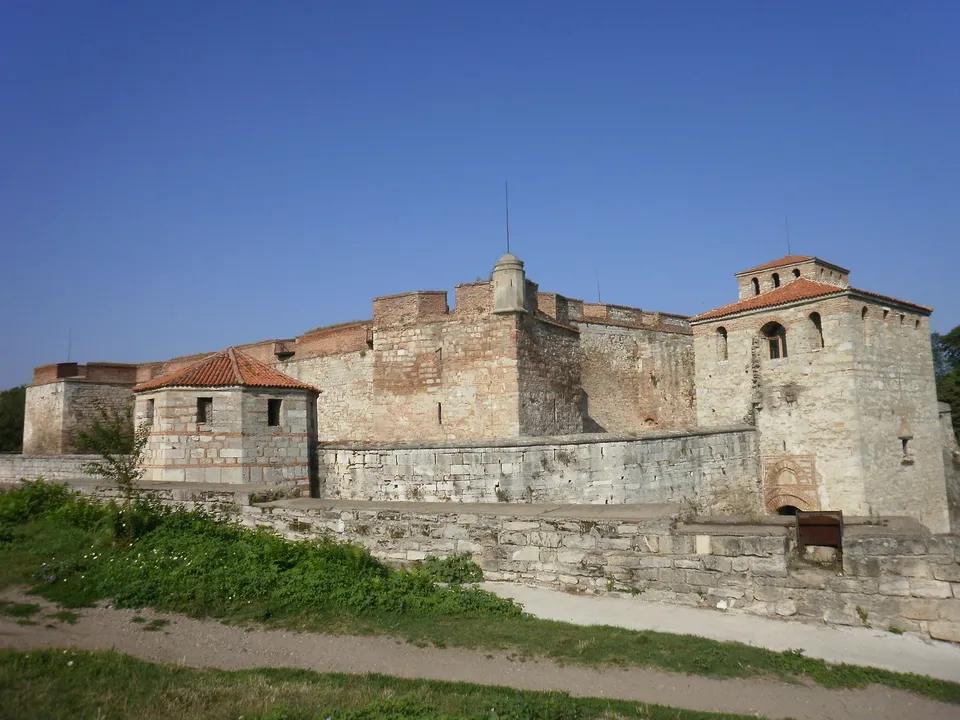
Before you are the stone walls and towers of Baba Vida. The museum calls it one of Bulgaria’s best-preserved medieval fortresses. A legend tells how the castle got its name.
Vida was the daughter of a boyar, a nobleman. Her sisters Kula and Gamza had unhappy marriages. Vida refused to marry, built the castle and stayed there. This is a legend, not a proven life story.
Sources · 4
- Регионален исторически музей – Видин Крепост „Баба Вида“
- Министерство на туризма на Република България Baba Vida Fortress
- Български туристически съюз Крепост „Баба Вида“
- Областна администрация Видин Забележителности


Part 2 · Second Tsardom
The tsar loses and regains Vidin
Find Vidin beside the Danube on the map. It was the capital of the Tsardom of Vidin, a state ruled by a tsar. A tsar is a ruler’s title. According to the encyclopedia used here, Ivan Sratsimir received the Vidin region and tsar’s title in 1356.
But his rule was interrupted. In 1365 the Hungarian king captured Vidin and took Sratsimir prisoner. In 1369 the tsar ruled here again. Farther down the Danube lies Nikopol.
- Vidin · Approximate location
- Baba Vida fortress · Approximate location
- Nikopol · Approximate location
Sources · 2
- Синиша Мишић Видинско царство
- Иван Билярски 1396: Царете, кръстоносците, османците и краят на средновековната българска държава
Part 3 · Second Tsardom
The moat and nine towers
A castle is a ruler’s fortified home. Baba Vida served as both home and defence. A moat, a deep ditch, surrounds it. Once, Danube water filled it. A movable wooden bridge led to the entrance.
The castle has two rows of defensive walls. The older, inner row has nine towers. Living quarters faced the central courtyard.
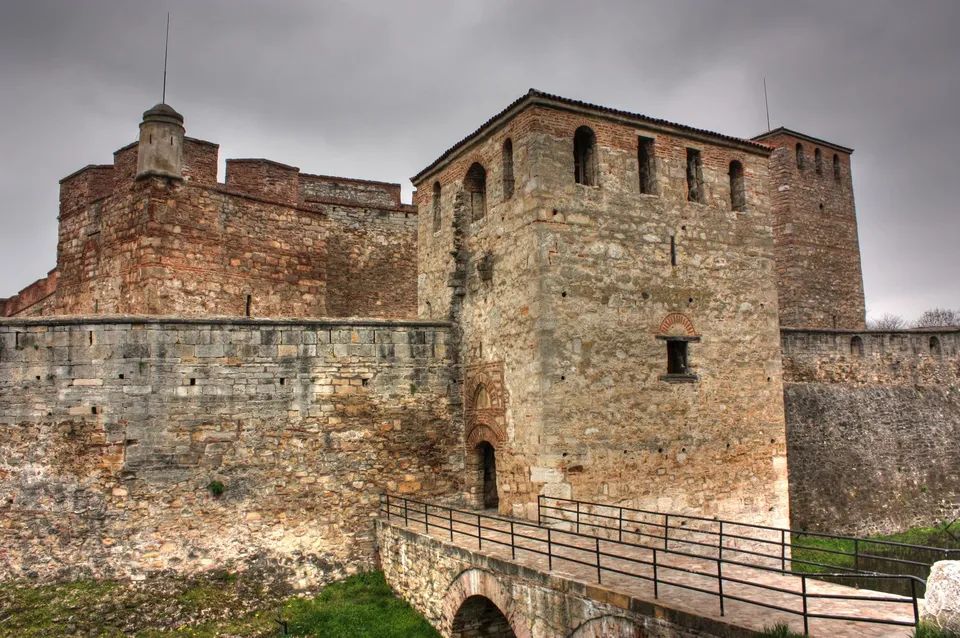
Look at the photograph. Today’s bridge and visible walls include later changes. This is not an untouched castle from the tsar’s lifetime.
- 1 · The entrance
- The entrance is low on the right in this photograph. Access was once protected by a movable wooden bridge. Today’s bridge is not that medieval original.
- 2 · Outer circuit
- The lower wall stands before the taller parts of the castle. The source describes the outer circuit as later than the inner one. We do not date individual stones from the photograph.
- 3 · Tower
- The tower rises above the entrance. The photograph alone cannot tell us who built it.
Sources · 3
- Областна администрация Видин Забележителности
- Български туристически съюз Крепост „Баба Вида“
- Спасимир File:Baba Vida Fortress.jpg
Part 4 · Second Tsardom
Activity: two roles
Which two roles did Baba Vida have?
Why is that?
The castle combined a fortified residence and defence. The moat, bridge and walls made access difficult.
Correct · Ruler’s home and defence
- Български туристически съюз Крепост „Баба Вида“
- Областна администрация Видин Забележителности
Sources · 2
- Български туристически съюз Крепост „Баба Вида“
- Областна администрация Видин Забележителности
Part 5 · Second Tsardom
Defeat near Nikopol
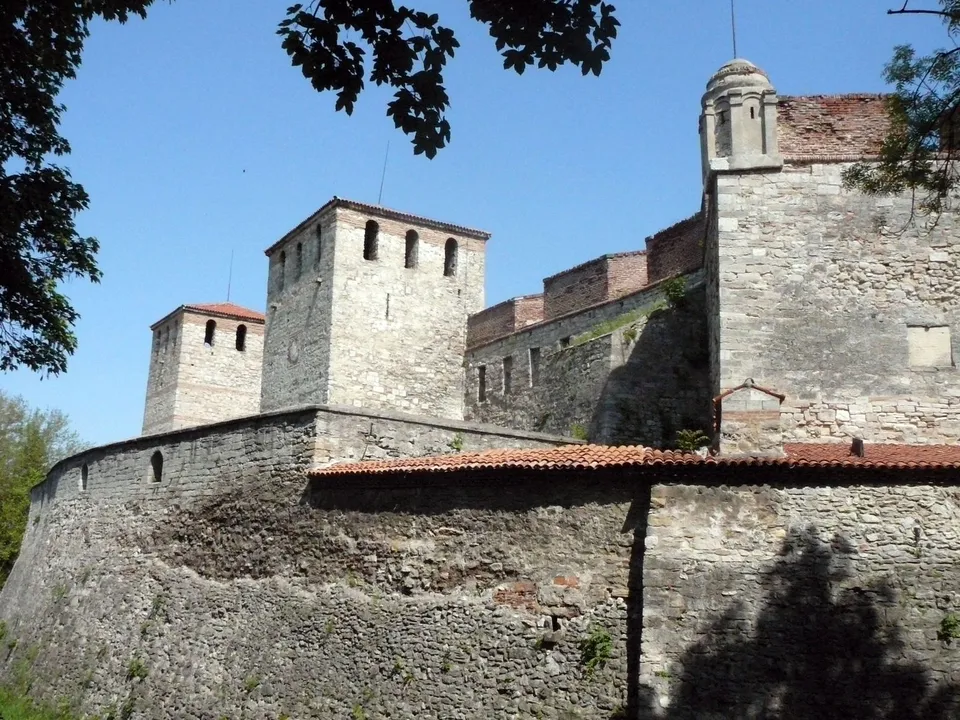
In 1396 a crusading army advanced along the Danube. This was a Christian army marching against the Ottoman Empire. On 25 September the crusaders were defeated near Nikopol.
In the traditional account, Ottoman ruler Bayezid then took Vidin and captured Sratsimir. Another suggestion is that royal rule continued under Sratsimir’s son Constantine until 1422. So calling Sratsimir the last tsar needs a qualification.
Sources · 3
- Синиша Мишић Видинско царство
- Иван Билярски 1396: Царете, кръстоносците, османците и краят на средновековната българска държава
- Иван Асенов Тютюнджиев; Пламен Христов Павлов Българската държава и османската експанзия 1369–1422
Part 6 · Second Tsardom
Gunpowder changes the castle
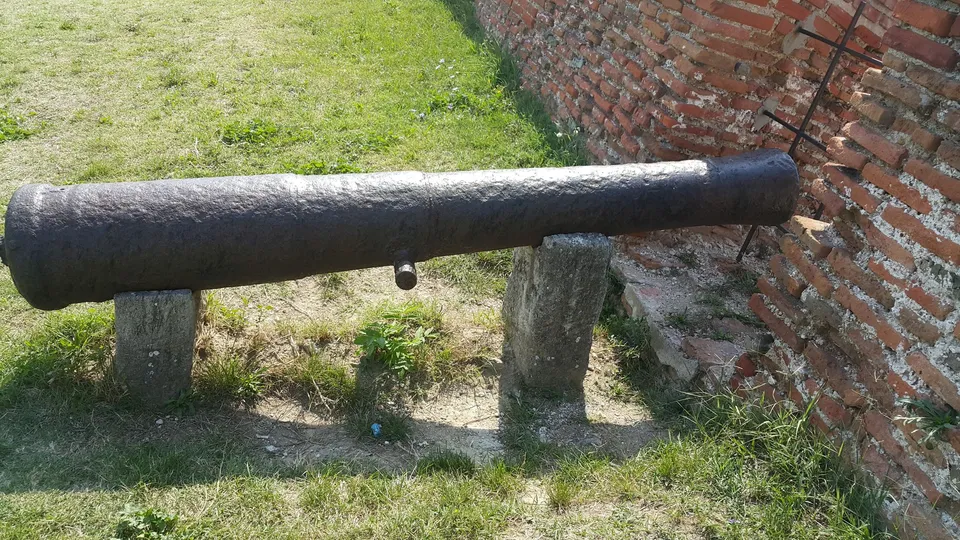
Look at the cannon’s metal tube, called its barrel. A long metal body rests on two stone supports.
Under Ottoman rule, the castle was adapted for weapons that fired using gunpowder. The museum dates these changes from the late seventeenth to the early nineteenth century. There were stores and rooms for guards. The municipality describes a tunnel to a firing terrace, a platform for shooting.
- 1 · The narrow end
- The metal body narrows on the right. Its manufacturing date is unconfirmed.
- 2 · The metal barrel
- The long metal body rests on modern supports. It illustrates a cannon but does not prove what weapon was used here in 1396.
Sources · 4
- Регионален исторически музей – Видин Крепост „Баба Вида“
- Община Видин Забележителности — Крепостта „Баба Вида“
- Министерство на туризма на Република България Baba Vida Fortress
- WangHao File:Крепостта Баба Вида - оръдие.jpg
Part 7 · Second Tsardom
Activity: order the events
Put the earliest event first.
Why is that?
The title came before the Hungarian captivity. The return followed captivity. Nikopol came after all three.
Correct order
- Sratsimir gains Vidin and tsar’s title
- The Hungarian king captures Sratsimir
- Sratsimir rules Vidin again
- The crusaders lose near Nikopol
- Синиша Мишић Видинско царство
Sources · 1
- Синиша Мишић Видинско царство
Part 8 · Second Tsardom
The bridge and courtyard
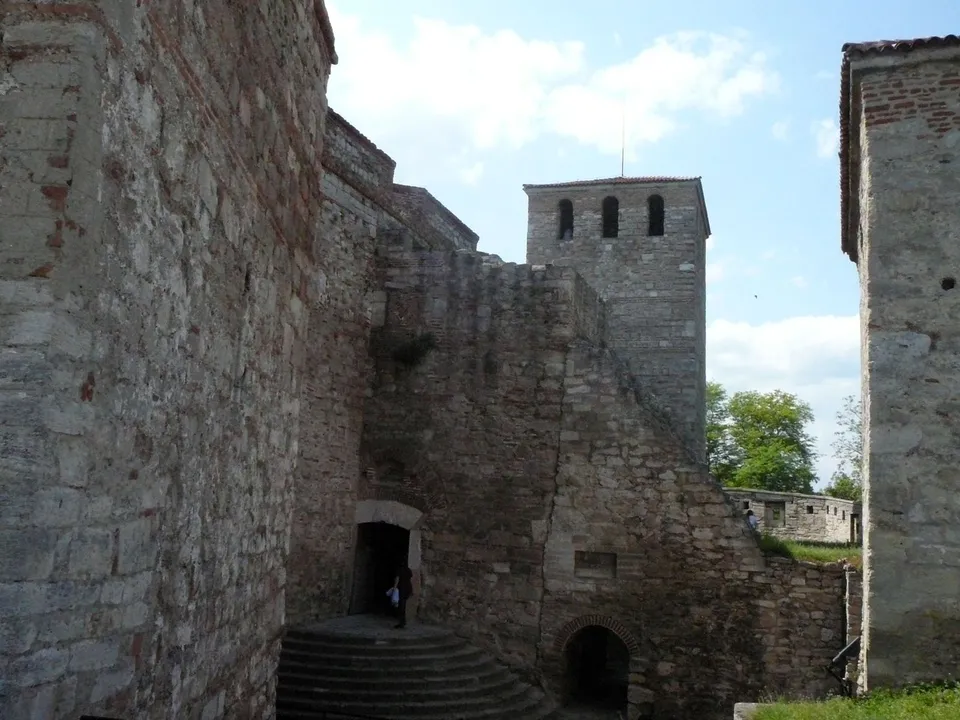
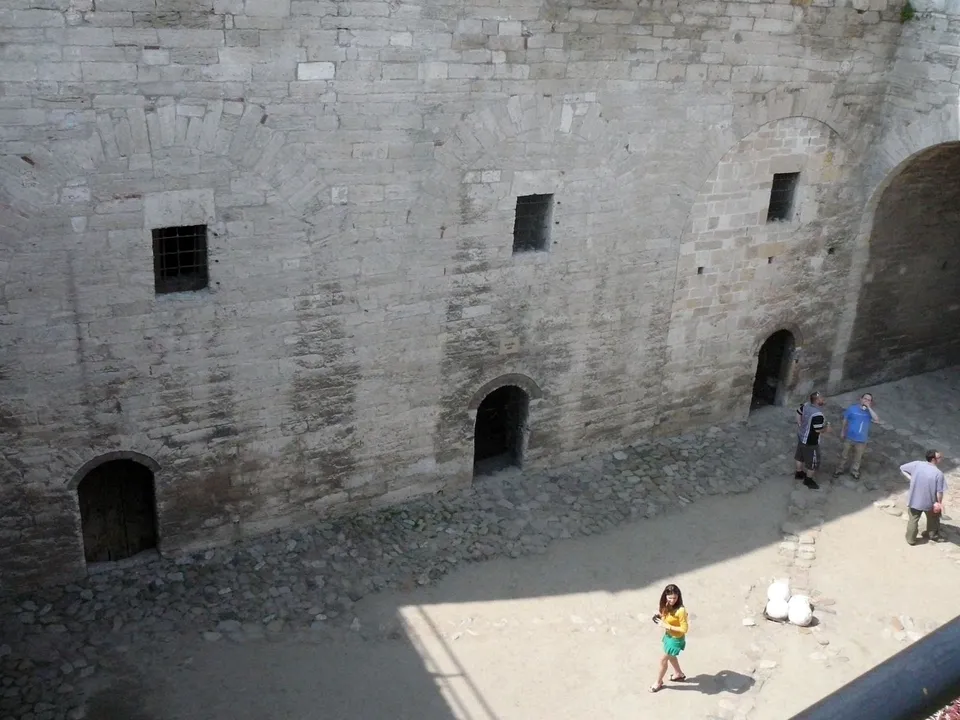
The present bridge is not the medieval wooden original. The photographs show the entrance bridge, stone towers and inner courtyard. Doorways in the courtyard lead into rooms.
Sources · 6
- Областна администрация Видин Забележителности
- Регионален исторически музей – Видин Крепост „Баба Вида“
- Klearchos Kapoutsis from Wrocław, Poland File:Baba Vida Klearchos 4.jpg
- Elena Chochkova File:Baba Vida E12.JPG
- Спасимир File:Baba Vida Fortress - Museum.jpg
- Спасимир File:Baba Vida Fortress - Museum2.jpg
Part 9 · Second Tsardom
Activity: match
Match each name or place to its description.
Why is that?
Vida belongs to the legend. Sratsimir is a historical ruler. The defeat happened at Nikopol. The terrace is a structure for firing.
- Министерство на туризма на Република България Baba Vida Fortress
- Синиша Мишић Видинско царство
- Община Видин Забележителности — Крепостта „Баба Вида“
Sources · 3
- Министерство на туризма на Република България Baba Vida Fortress
- Синиша Мишић Видинско царство
- Община Видин Забележителности — Крепостта „Баба Вида“
A new find for your collection
The castle preserves traces of several periods; the legend of its name is a different kind of story from historical evidence.
People in this story
Sources
- Иван Билярски 1396: Царете, кръстоносците, османците и краят на средновековната българска държава
- Български туристически съюз Крепост „Баба Вида“
- Областна администрация Видин Забележителности
- Синиша Мишић Видинско царство
- Община Видин Забележителности — Крепостта „Баба Вида“
- Регионален исторически музей – Видин Крепост „Баба Вида“
- Klearchos Kapoutsis from Wrocław, Poland File:Baba Vida Klearchos 4.jpg
- WangHao File:Крепостта Баба Вида - оръдие.jpg
- Elena Chochkova File:Baba Vida E12.JPG
- Спасимир File:Baba Vida Fortress - Museum2.jpg
- Спасимир File:Baba Vida Fortress - Museum.jpg
- Спасимир File:Baba Vida Fortress.jpg
- Министерство на туризма на Република България Baba Vida Fortress
- Иван Асенов Тютюнджиев; Пламен Христов Павлов Българската държава и османската експанзия 1369–1422
Images
WangHao · CC BY-SA 4.0 · Wikimedia Commons
Displayed cannon barrel. The barrel’s date and provenance are unverified.
Full attribution
Photo: WangHao, Wikimedia Commons, CC BY-SA 4.0. Unmodified. Cut-out detail; background removed.
Спасимир · CC BY 3.0 · Wikimedia Commons
Baba Vida: exterior. The site today, including later rebuilding and restoration.
Full attribution
Photo: Спасимир, Wikimedia Commons, CC BY 3.0. Unmodified. Processed image.
Elena Chochkova · CC BY-SA 3.0 · Wikimedia Commons
Outer walls and towers. The site today, including later rebuilding and restoration.
Full attribution
Photo: Elena Chochkova, Wikimedia Commons, CC BY-SA 3.0. Unmodified. Processed image.
WangHao · CC BY-SA 4.0 · Wikimedia Commons
Displayed cannon barrel. The barrel’s date and provenance are unverified.
Full attribution
Photo: WangHao, Wikimedia Commons, CC BY-SA 4.0. Unmodified. Processed image.
Klearchos Kapoutsis from Wrocław, Poland · CC BY 2.0 · Wikimedia Commons
The bridge before the entrance today. The site today, including later rebuilding and restoration.
Full attribution
Photo: Klearchos Kapoutsis from Wrocław, Poland, Wikimedia Commons, CC BY 2.0. Unmodified. Processed image.
Elena Chochkova · CC BY-SA 3.0 · Wikimedia Commons
Inner walls and tower. The site today, including later rebuilding and restoration.
Full attribution
Photo: Elena Chochkova, Wikimedia Commons, CC BY-SA 3.0. Unmodified. Processed image.
Elena Chochkova · CC BY-SA 3.0 · Wikimedia Commons
Courtyard with doorways. The site today, including later rebuilding and restoration.
Full attribution
Photo: Elena Chochkova, Wikimedia Commons, CC BY-SA 3.0. Unmodified. Processed image.
Geographic context, without historical borders
Tom Patterson · Nathaniel Vaughn Kelso · Public domain · Natural Earth
Full attribution
Tom Patterson · Nathaniel Vaughn Kelso