 History of Bulgaria
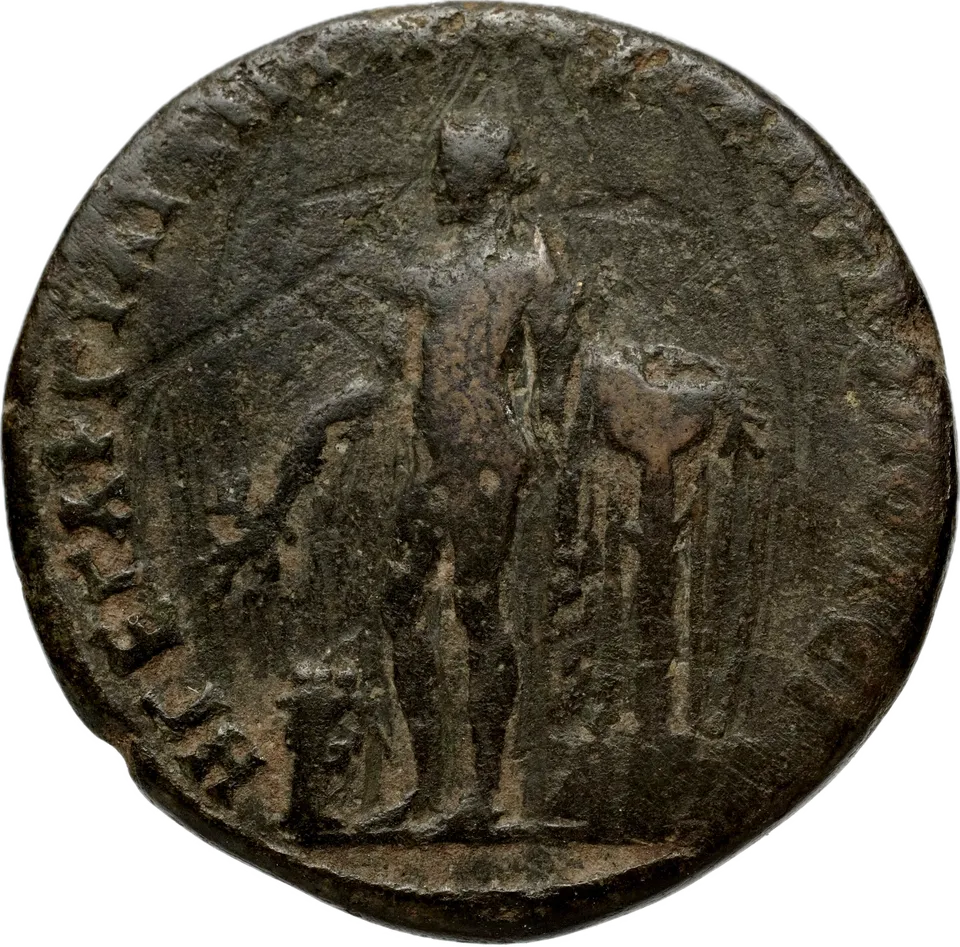
National Library of France · Public domain · National Library of France / Wikimedia Commons
Full attribution
Image: National Library of France, via Wikimedia Commons. Public domain. Unmodified. Cut-out detail; background removed.
A stadium lies hidden beneath Plovdiv’s main street. A stage, a mosaic floor and the city’s names lead us to distinguish evidence from tradition.
Part 1 · Antiquity
Below the shop windows
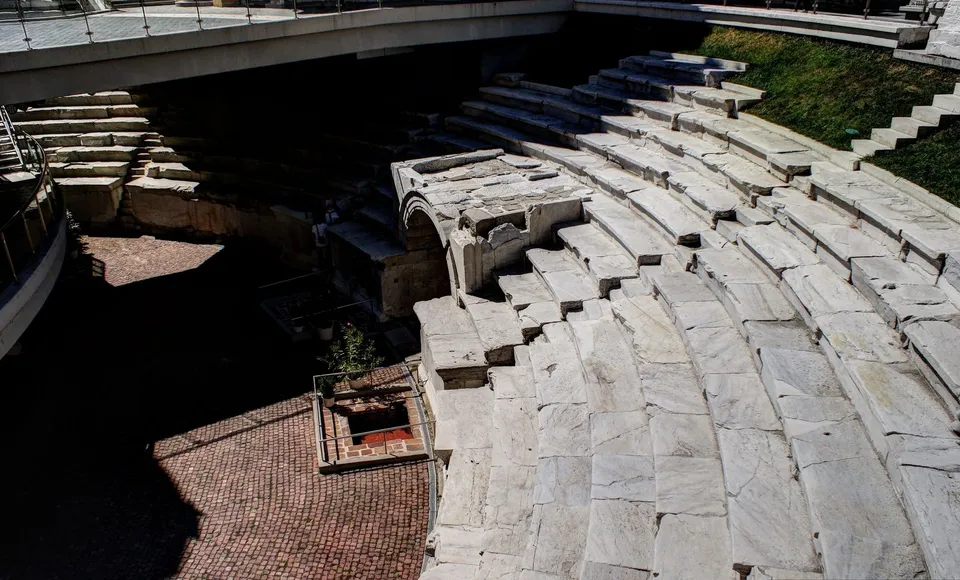
Part of ancient Philippopolis’s stadium survives beneath the modern street. Most remains under the buildings. Marble seats survive in some basements.
Rows curve around the northern end of the ancient track. The track was the space for competitions. Today’s city passes above; below is where spectators once sat.
The stadium was first discovered in 1923. Later building work revealed more sections. In 2004 work at a former cinema uncovered five rows of seats.
Sources · 3
- Regional Administration Plovdiv, project BG 0041 Visit the Ancient Stadium
- Regional Administration Plovdiv, project BG 0041 Archaeological Research and Exhibition of the Stadium
- Регионален археологически музей – Пловдив Римски стадион


Part 2 · Antiquity
Three names for one city
Today we call it Plovdiv. Philippopolis means “city of Philip”. It is linked to the Macedonian ruler Philip II. In the fourth century BCE, Philip conquered an older Thracian settlement.
Not every founder story is fact. A tradition says Philip gathered scoundrels here, explaining the mocking nickname Poneropolis. It does not establish who lived here.
The Roman name Trimontium points to three hills: Nebet, Dzhambaz and Taksim. Different names were sometimes used together.
- Ancient Stadium, Dzhumaya Square · Approximate location
- Ancient Theatre · Approximate location
- House of Eirene · Approximate location
Sources · 6
- Nicholas Geoffrey Lemprière Hammond Philippopolis
- Iris von Bredow; Johannes Niehoff (Der Neue Pauly entry) Philippopolis (Der Neue Pauly), reproduced in Tabula Peutingeriana entry 1093
- Suda; Ioannis Doukas (translator); Suda On Line, University of Kentucky Ponêropolis, Adler π 2039
- Община Пловдив Ancient Plovdiv
- Plovdiv Invest / Община Пловдив Culture and tourism
- Visit Plovdiv / Municipality of Plovdiv The Antique Plovdiv
Part 3 · Antiquity
A paw beside the step
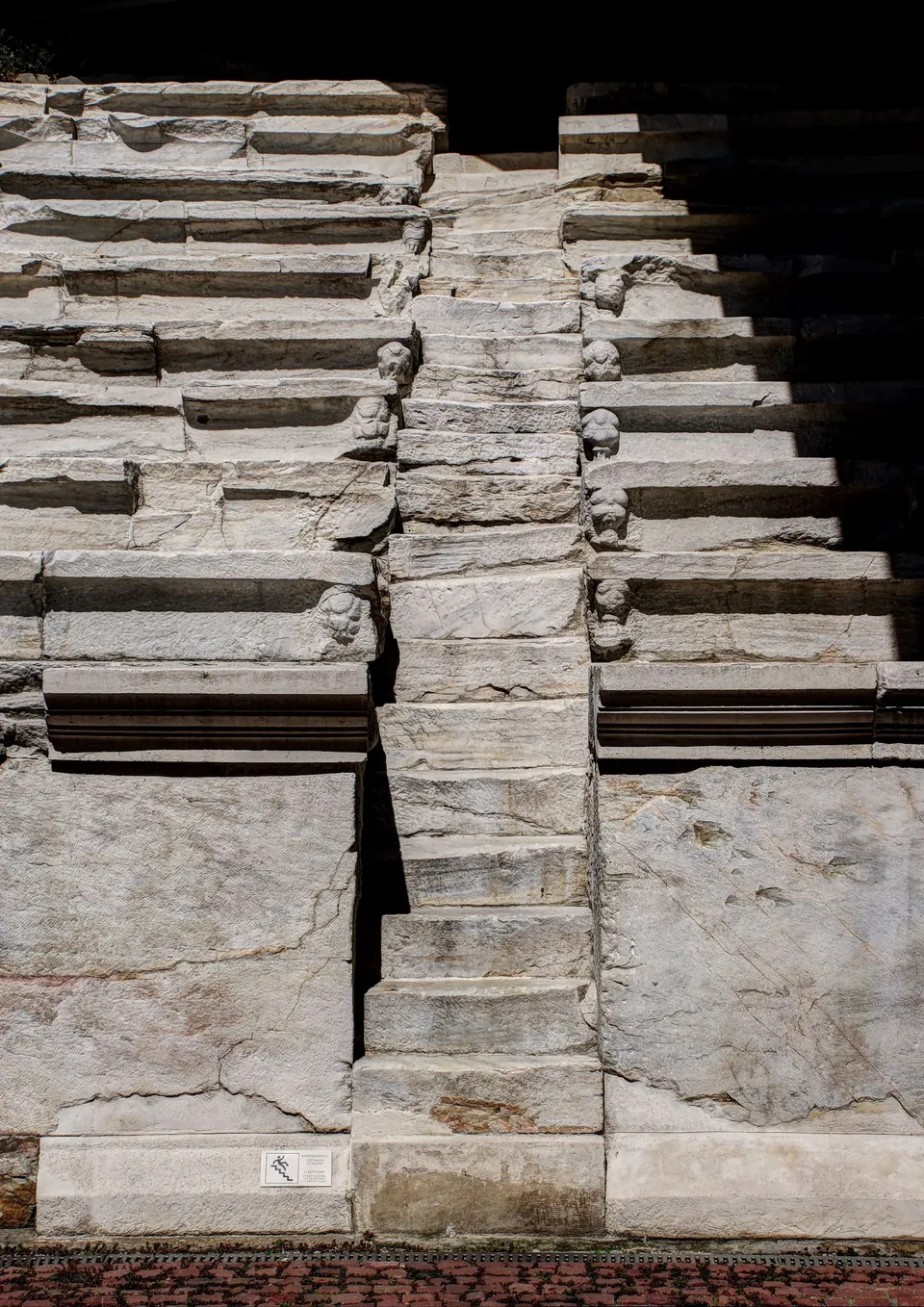
Look at the seat end beside the stairway. The stone ends in a lion paw. Steps between the rows lead down towards the track.
The stadium was built in the early second century, under Emperor Hadrian. It was over two hundred metres long and about fifty wide. Fourteen rows of marble seats surrounded the track. Its capacity is estimated at about thirty thousand spectators.
There were seats of honour too. Greek inscriptions reserved them for people of high public status.
- 1 · A path between the rows
- These steps gave spectators access to their seats.
- 2 · Lion paw
- The seat end is decorated with a carved lion paw.
- 3 · Marble block
- The seats are carved from solid marble blocks.
Sources · 3
- Maya Martinova-Kjutova; Regional Administration Plovdiv, project BG 0041 Ancient Stadium of Philippopolis
- Регионален археологически музей – Пловдив Римски стадион
- Община Пловдив Археологически забележителности
Part 4 · Antiquity
Activity: below the street
What lies beneath the main pedestrian street?
Why is that?
The stadium lies below the street. Its northern end is displayed at Dzhumaya Square.
Correct · The ancient stadium
- Regional Administration Plovdiv, project BG 0041 Visit the Ancient Stadium
- Regional Administration Plovdiv, project BG 0041 Ancient Theatre
- Общински институт „Старинен Пловдив“ Late antique Irene (Eiphnh) building
Sources · 3
- Regional Administration Plovdiv, project BG 0041 Visit the Ancient Stadium
- Regional Administration Plovdiv, project BG 0041 Ancient Theatre
- Общински институт „Старинен Пловдив“ Late antique Irene (Eiphnh) building
Part 5 · Antiquity
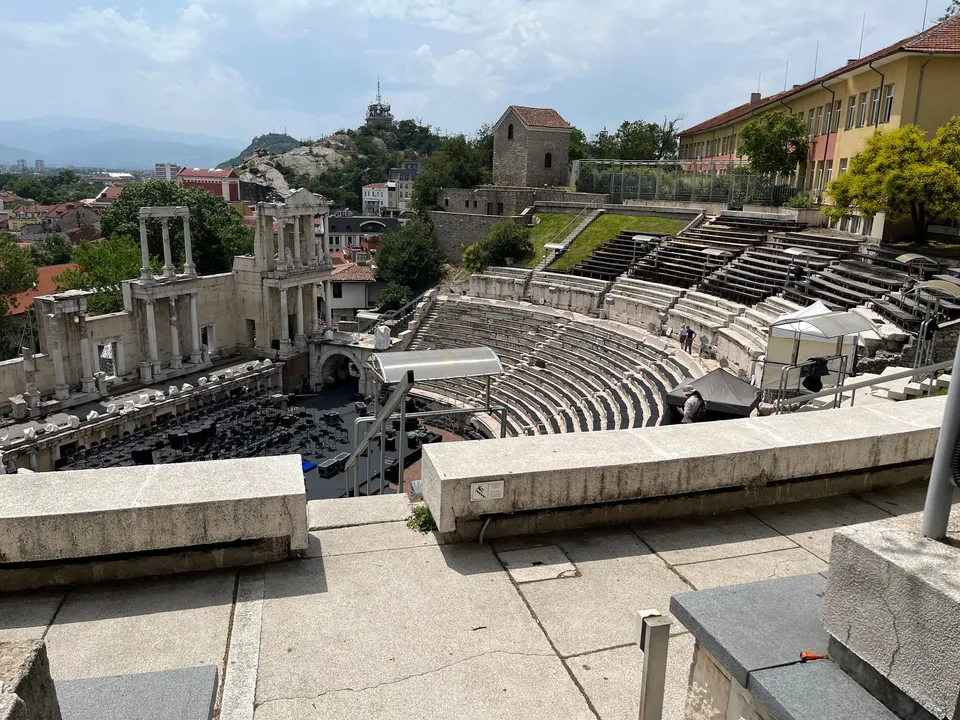
Columns above the stage
The theatre stands on the slope between Taksim and Dzhambaz hills. Here the rows form a semicircle before a stage, rather than a long track. Restored sections are part of what we see today.
The theatre dates from Roman times. Its precise date remains disputed.
Today the re-erected columns face an audience again: concerts and performances take place here.
- 1 · Spectator seats
- The curved rows face the space before the stage.
- 2 · Stage columns
- The columns belong to the restored front wall of the stage building. The photograph shows the site today.
- 3 · Modern chairs
- The black chairs and equipment serve modern performances. They are not Roman finds.
Sources · 3
- Общински институт „Старинен Пловдив“ The Ancient Theatre
- Regional Administration Plovdiv, project BG 0041 Ancient Theatre
- Plovdiv City Card Ancient Theatre
Part 6 · Antiquity
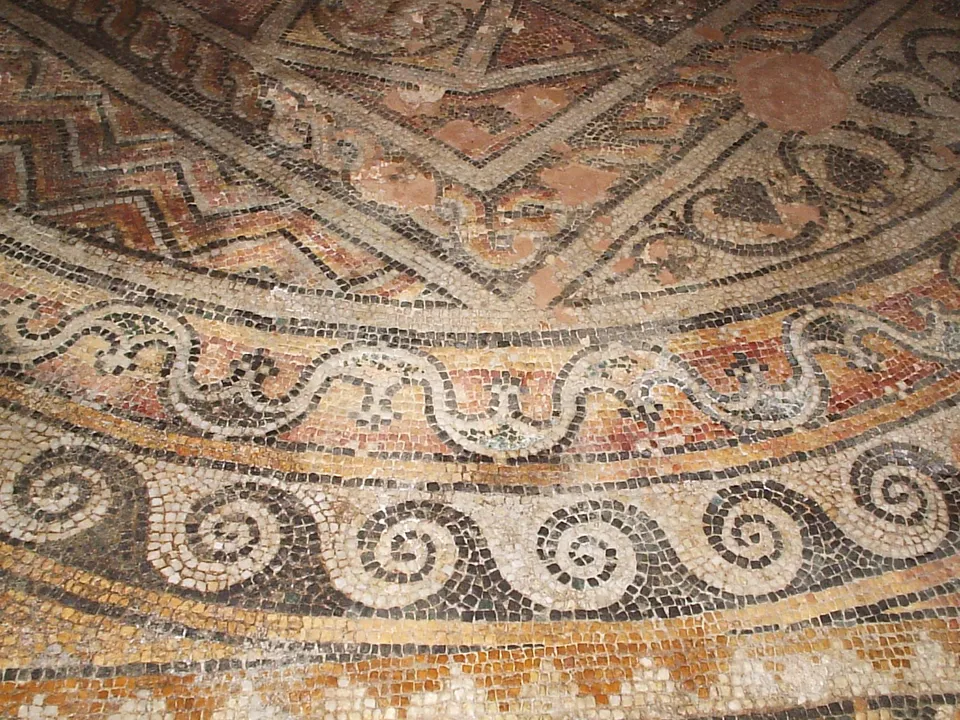
Little stones in the floor
At the House of Eirene, look down. A mosaic is a design of small coloured pieces called tesserae. The photo shows stones and curling lines. Elsewhere in this house, a Greek inscription names a female image: Eirene.
The figure is interpreted as peace shown as a person. We cannot establish whether it portrays a woman who lived here. One interpretation sees a wish for peace after wars.
The house was uncovered in 1983–1984.
- 1 · Tesserae
- A mosaic is a design made from many small coloured pieces called tesserae.
- 2 · Curling lines
- Light and dark pieces form a curling pattern. We do not see the female image here.
- 3 · Missing patch
- The design is interrupted in this patch. The photograph does not reconstruct what is missing.
Sources · 3
- Общински институт „Старинен Пловдив“ Late antique Irene (Eiphnh) building
- Ivo Topalilov On the Eirene Mosaic from Philippopolis, Thrace
- Republic of Bulgaria, Ministry of Culture; hosted by UNESCO World Heritage Centre Bishop's Basilica and Late-Antique Mosaics of Philippopolis, Roman Province of Thrace
Part 7 · Antiquity
Activity: three discoveries
Put the discoveries in order, earliest first.
Why is that?
The dates establish the order: 1923, then 1983–1984, then 2004.
Correct order
- Stadium discovered
- House of Eirene uncovered
- Seats at the cinema
- Regional Administration Plovdiv, project BG 0041 Archaeological Research and Exhibition of the Stadium
- Общински институт „Старинен Пловдив“ Late antique Irene (Eiphnh) building
Sources · 2
- Regional Administration Plovdiv, project BG 0041 Archaeological Research and Exhibition of the Stadium
- Общински институт „Старинен Пловдив“ Late antique Irene (Eiphnh) building
Part 8 · Antiquity
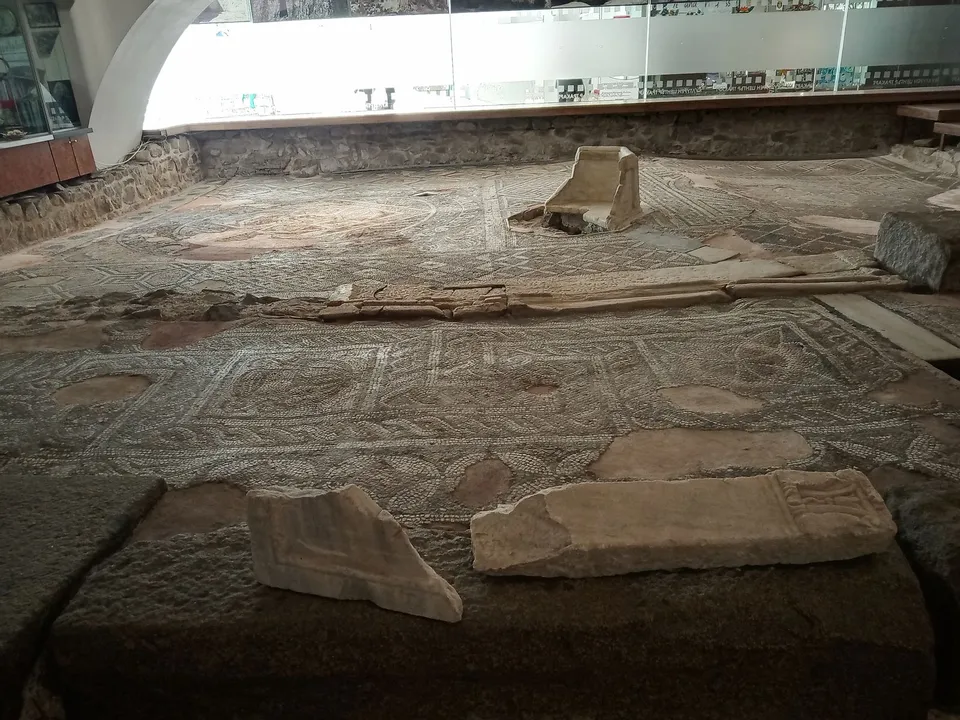
Rows, columns and floors
What can you see today? At Dzhumaya Square, go down to the stadium’s exposed northern curve. Look for the rows and passage with a curved stone ceiling. Do not expect the whole track to be uncovered.
At the theatre, compare marble seats with modern chairs and performance equipment. This surviving, restored building is used again.
The House of Eirene and ancient street sections are displayed in place in the Archaeological underpass. The underpass is modern; the house was not underground.
- Ancient Stadium, Dzhumaya Square · Approximate location
- Ancient Theatre · Approximate location
- House of Eirene · Approximate location
Sources · 4
- Regional Administration Plovdiv, project BG 0041 Visit the Ancient Stadium
- Общински институт „Старинен Пловдив“ Late antique Irene (Eiphnh) building
- Общински институт „Старинен Пловдив“ The Ancient Theatre
- Maya Martinova-Kjutova; Regional Administration Plovdiv, project BG 0041 Ancient Stadium of Philippopolis
Part 9 · Antiquity
Activity: place and trace
Match each place to its trace.
Why is that?
In this story the paws belong to the stadium, the stage to the theatre, and the female image to the house.
- Maya Martinova-Kjutova; Regional Administration Plovdiv, project BG 0041 Ancient Stadium of Philippopolis
- Общински институт „Старинен Пловдив“ The Ancient Theatre
- Ivo Topalilov On the Eirene Mosaic from Philippopolis, Thrace
Sources · 3
- Maya Martinova-Kjutova; Regional Administration Plovdiv, project BG 0041 Ancient Stadium of Philippopolis
- Общински институт „Старинен Пловдив“ The Ancient Theatre
- Ivo Topalilov On the Eirene Mosaic from Philippopolis, Thrace
A new find for your collection
The stadium, theatre and house show different sides of life in one city; its names and traditions need separate scrutiny.
People in this story
Sources
- Община Пловдив Археологически забележителности
- Общински институт „Старинен Пловдив“ Late antique Irene (Eiphnh) building
- Ivo Topalilov On the Eirene Mosaic from Philippopolis, Thrace
- Republic of Bulgaria, Ministry of Culture; hosted by UNESCO World Heritage Centre Bishop's Basilica and Late-Antique Mosaics of Philippopolis, Roman Province of Thrace
- Plovdiv Invest / Община Пловдив Culture and tourism
- Iris von Bredow; Johannes Niehoff (Der Neue Pauly entry) Philippopolis (Der Neue Pauly), reproduced in Tabula Peutingeriana entry 1093
- Община Пловдив Ancient Plovdiv
- Nicholas Geoffrey Lemprière Hammond Philippopolis
- Suda; Ioannis Doukas (translator); Suda On Line, University of Kentucky Ponêropolis, Adler π 2039
- Visit Plovdiv / Municipality of Plovdiv The Antique Plovdiv
- Maya Martinova-Kjutova; Regional Administration Plovdiv, project BG 0041 Ancient Stadium of Philippopolis
- Регионален археологически музей – Пловдив Римски стадион
- Regional Administration Plovdiv, project BG 0041 Archaeological Research and Exhibition of the Stadium
- Regional Administration Plovdiv, project BG 0041 Visit the Ancient Stadium
- Regional Administration Plovdiv, project BG 0041 Ancient Theatre
- Plovdiv City Card Ancient Theatre
- Общински институт „Старинен Пловдив“ The Ancient Theatre
Images
National Library of France · Public domain · National Library of France / Wikimedia Commons
Full attribution
Image: National Library of France, via Wikimedia Commons. Public domain. Unmodified. Cut-out detail; background removed.
Gitanes232 · CC BY-SA 4.0 · Wikimedia Commons
Full attribution
Photo: Gitanes232, Wikimedia Commons, CC BY-SA 4.0. Unmodified. Processed image.
Gitanes232 · CC BY-SA 4.0 · Wikimedia Commons
Full attribution
Photo: Gitanes232, Wikimedia Commons, CC BY-SA 4.0. Unmodified. Processed image.
CivArmy · CC BY 4.0 · Wikimedia Commons
Full attribution
Photo: CivArmy, Wikimedia Commons, CC BY 4.0. Unmodified. Processed image.
Realsteel007 · CC BY-SA 4.0 · Wikimedia Commons
Full attribution
Photo: Realsteel007, Wikimedia Commons, CC BY-SA 4.0. Unmodified. Processed image.
Gitanes232 · CC BY-SA 4.0 · Wikimedia Commons
Full attribution
Photo: Gitanes232, Wikimedia Commons, CC BY-SA 4.0. Unmodified. Processed image.
Geographic context, without historical borders
Tom Patterson · Nathaniel Vaughn Kelso · Public domain · Natural Earth
Full attribution
Tom Patterson · Nathaniel Vaughn Kelso