 History of Bulgaria
Interact-Bulgaria · CC BY-SA 4.0 · Wikimedia Commons
Full attribution
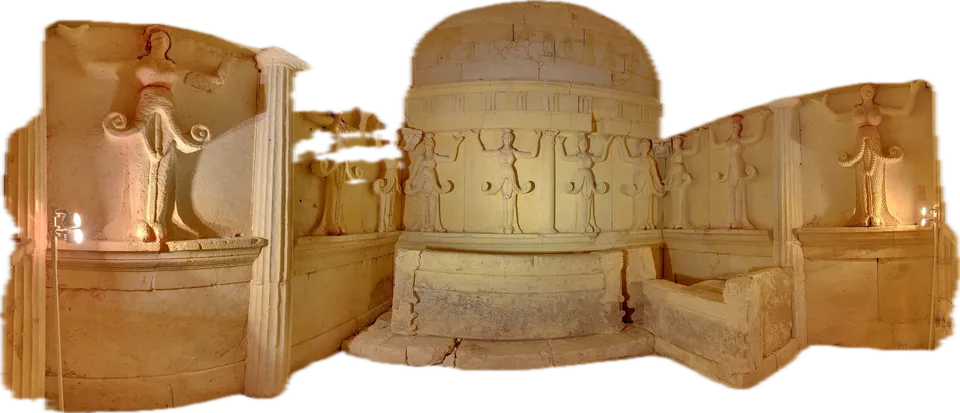
Photo: Interact-Bulgaria. Wikimedia Commons, CC BY-SA 4.0. The original burial chamber in its present setting: stone female figures, beds and a faint painting above them. Lighting is modern. Cut-out detail; background removed.
Stone hands, leaf-like dresses and a wreath above a rider. Explore a tomb of the Getae and distinguish what we see from how we interpret it.
Part 1 · Antiquity
Ten women in stone
Ten stone women stand with raised arms in a tomb near Sveshtari. Above them is a curved stone ceiling. They seem to have held it up for about 2,300 years. The women form part of the walls.
UNESCO dates the tomb to the third century BC. It is linked to the Getae, a Thracian people. Today the site is in northeastern Bulgaria. The place was intended for burial. What do the raised hands mean?
Sources · 2
- UNESCO World Heritage Centre Thracian Tomb of Sveshtari
- Исторически музей — Исперих Тракийска царска гробница


Part 2 · Antiquity
The mound and its neighbours
The tomb lies beneath Ginina Mogila, recorded by archaeologists as Mound 7. It belongs to the eastern necropolis of Sboryanovo. Necropolis means cemetery. Separate mounds cover different burial places.
The gold treasure discovered in 2012 came from another mound: the Great Sveshtari Mound. The map also marks Demir Baba Teke, a sixteenth-century tomb. It is much later than the tomb with the stone women. The two points help us distinguish the places. They do not outline an ancient kingdom.
- Ginina Mogila — Sveshtari Tomb · Approximate location
- Demir Baba Teke · Approximate location
Sources · 4
- Исторически музей — Исперих Тракийска царска гробница
- Археологически резерват Сборяново, project website The Sveshtari Tomb with the Karyatids
- Археологически резерват Сборяново, project website Demir baba teke
- Археологически резерват Сборяново, project website Sveshtari treasure
Part 3 · Antiquity
Look at the hands
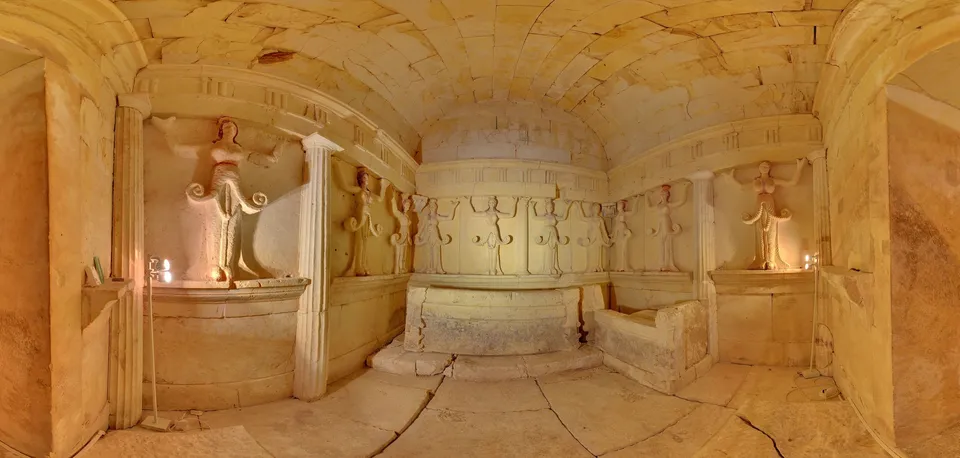
Dromos means entrance corridor. It leads to three rooms, called chambers. Their curved ceilings are called vaults. The central room holds ten women. They project from the walls: this is relief. They are called caryatids: female figures shown as supports.
Four face the entrance. Three stand on each of the opposing walls. Look at their hands reaching the stone band above them. Their faces differ, while their clothes end in leaf-like curves. Paint also survives on the decoration. There were once more colours here.
- 1 · Raised hand
- The hand reaches the stone band. Caryatids are female figures shown as architectural supports.
- 2 · Leaf-like dress
- The curves of the dress resemble leaves. Human figure and plant form share one relief.
- 3 · Stone bed
- The chamber contains two stone funerary beds. One is visible here.
Sources · 2
- UNESCO World Heritage Centre Thracian Tomb of Sveshtari
- Теодора Василева Преглед на резултатите от интердисциплинарните изследвания на тракийската гробница при с. Свещари (по повод 40 г. от откриването ѝ) PDF
Part 4 · Antiquity
The wreath above the rider
Above the four women facing the entrance is a semicircular field beneath the vault. It is called a lunette. A horseman is drawn there. Opposite him a woman extends a wreath. A wreath is a ring of branches and leaves.
One interpretation sees the wreath as honouring the ruler after death. Another sees it as receiving royal power. We see the gesture, but its meaning remains uncertain. The black-charcoal drawing was left unfinished. The lines are faint in the photograph; enlarge the image.
- 1 · Horseman
- The horseman belongs to the unfinished black-charcoal drawing.
- 2 · Offered wreath
- The woman offers a wreath. One interpretation sees the gesture as honouring the ruler after death. Another sees it as receiving royal power.
Part 5 · Antiquity
Activity: seen or interpreted
Which can we describe without choosing an interpretation of the painting?
Why is that?
First describe the rider, woman and wreath. Then compare explanations of the gesture.
Correct · A woman extends a wreath towards a horseman
Part 6 · Antiquity
Two stone beds
Below the female figures are two stone funerary beds. The dead were laid on beds like these. Who was buried here?
The Getic ruler Dromichaetes may have been buried here. His name, however, is not securely established. The stone beds show what the room was used for. They do not tell us the name of the person buried here.
Sources · 3
- Археологически резерват Сборяново, project website The Sveshtari Tomb with the Karyatids
- Теодора Василева Преглед на резултатите от интердисциплинарните изследвания на тракийската гробница при с. Свещари (по повод 40 г. от откриването ѝ) PDF
- Исторически музей — Исперих Тракийска царска гробница
Part 7 · Antiquity
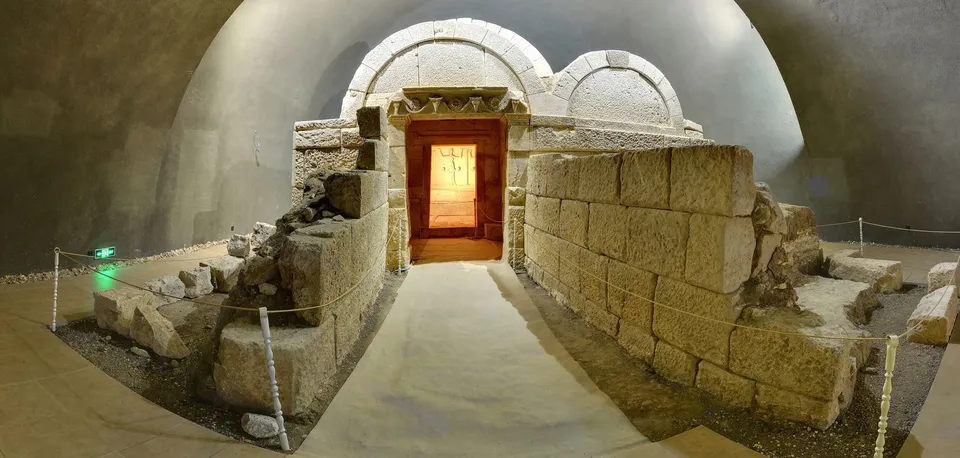
The entrance beneath the mound
Archaeologists discovered the tomb in 1982. In 1985 it joined UNESCO’s World Heritage List. Today a protective shell and a rebuilt mound cover it. This layer of earth covers the tomb again. This helps preserve the stone women and the faint drawing.
Sources · 3
- Исторически музей — Исперих Тракийска царска гробница
- UNESCO World Heritage Centre Thracian Tomb of Sveshtari
- Теодора Василева Преглед на резултатите от интердисциплинарните изследвания на тракийската гробница при с. Свещари (по повод 40 г. от откриването ѝ) PDF
Part 8 · Antiquity
Activity: put events in order
Put the events from earliest to latest.
Why is that?
The tomb was built first: UNESCO dates it to the third century BC. Archaeologists discovered it in 1982. UNESCO inscription followed in 1985. Discovery comes after construction, and inscription comes after discovery.
Correct order
- Building the tomb
- Discovery by archaeologists
- UNESCO inscription
- UNESCO World Heritage Centre Thracian Tomb of Sveshtari
- Исторически музей — Исперих Тракийска царска гробница
Sources · 2
- UNESCO World Heritage Centre Thracian Tomb of Sveshtari
- Исторически музей — Исперих Тракийска царска гробница
Part 9 · Antiquity
Activity: match the word to its place
Match the three words to their descriptions in this tomb.
Why is that?
The dromos is a passage, so it is neither a figure nor a field for a painting. A caryatid is a figure, so it is neither corridor nor lunette. The lunette is a field beneath the vault, so it is neither corridor nor female support.
- Исторически музей — Исперих Тракийска царска гробница
- Теодора Василева Преглед на резултатите от интердисциплинарните изследвания на тракийската гробница при с. Свещари (по повод 40 г. от откриването ѝ) PDF
Sources · 2
- Исторически музей — Исперих Тракийска царска гробница
- Теодора Василева Преглед на резултатите от интердисциплинарните изследвания на тракийската гробница при с. Свещари (по повод 40 г. от откриването ѝ) PDF
A new find for your collection
Inside the tomb we see ten stone women and a painted wreath. The name of the deceased and the meaning of the gesture are not securely established.
People in this story
Sources
- Археологически резерват Сборяново, project website Demir baba teke
- Исторически музей — Исперих Тракийска царска гробница
- Археологически резерват Сборяново, project website The Sveshtari Tomb with the Karyatids
- Археологически резерват Сборяново, project website Sveshtari treasure
- UNESCO World Heritage Centre Thracian Tomb of Sveshtari
- Теодора Василева Преглед на резултатите от интердисциплинарните изследвания на тракийската гробница при с. Свещари (по повод 40 г. от откриването ѝ) PDF
Images
Interact-Bulgaria · CC BY-SA 4.0 · Wikimedia Commons
Full attribution
Photo: Interact-Bulgaria. Wikimedia Commons, CC BY-SA 4.0. The original burial chamber in its present setting: stone female figures, beds and a faint painting above them. Lighting is modern. Cut-out detail; background removed.
Interact-Bulgaria · CC BY-SA 4.0 · Wikimedia Commons
Full attribution
Photo: Interact-Bulgaria. Wikimedia Commons, CC BY-SA 4.0. The original burial chamber in its present setting: stone female figures, beds and a faint painting above them. Lighting is modern. Processed image.
Interact-Bulgaria · CC BY-SA 4.0 · Wikimedia Commons
Full attribution
Photo: Interact-Bulgaria. Wikimedia Commons, CC BY-SA 4.0. Stone corridor and facade inside the protective shell Processed image.
Geographic context, without historical borders
Tom Patterson · Nathaniel Vaughn Kelso · Public domain · Natural Earth
Full attribution
Tom Patterson · Nathaniel Vaughn Kelso