 History of Bulgaria
Photographer uncredited · Public domain · National Library of France / Wikimedia Commons
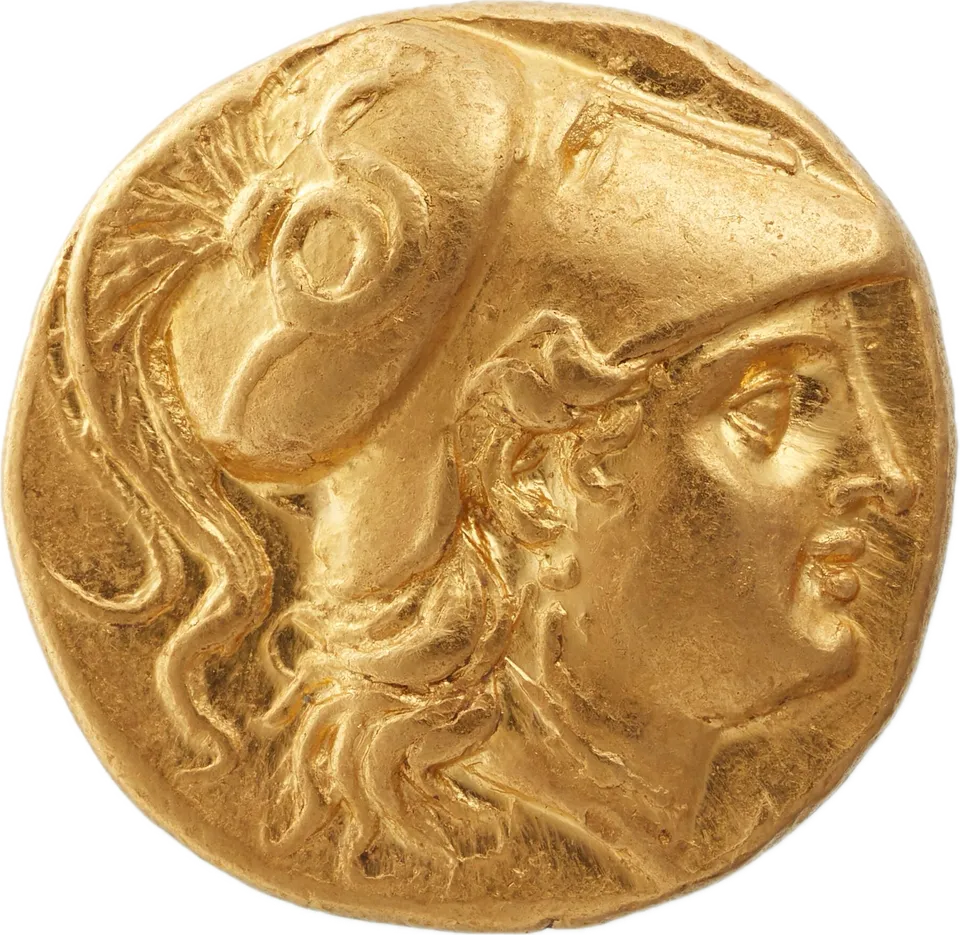
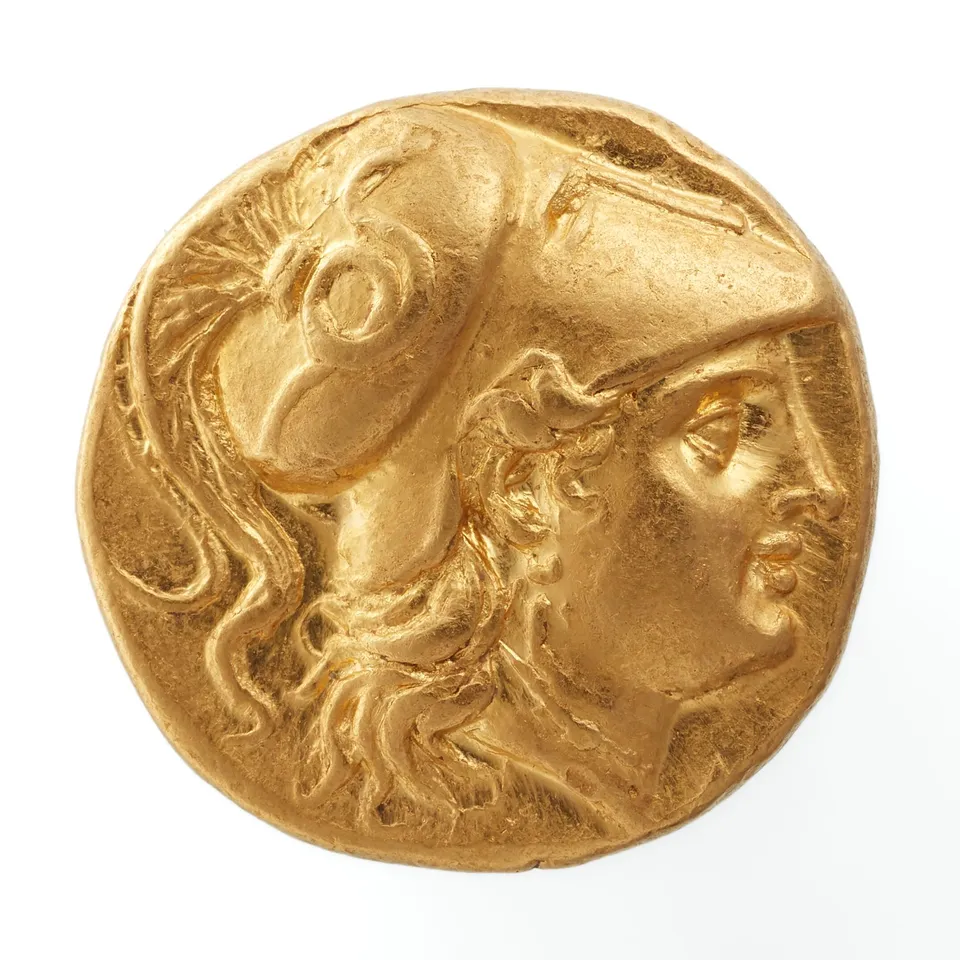
The front of a gold coin from Mesambria, called a stater. It shows the goddess Athena wearing a helmet. The coin follows a design of Alexander the Great.
Full attribution
Digitisation: National Library of France, via Wikimedia Commons. Public domain. Photographer uncredited. Cut-out detail; background removed.
Nessebar · Main period: Antiquity
The town on the narrow isthmus
What do Nessebar’s coins and walls preserve?
A helmet on a coin, repaired walls and roofless churches: evidence from different periods of Mesambria.
Part 1 · Main period: Antiquity
The path along the isthmus
You enter Old Nessebar along the isthmus. This narrow strip of land joins the peninsula to the mainland. The site is more than 3,000 years old.
People lived here before the Greeks. Later came the Dorians, a group of ancient Greeks. They formed a polis: a town with its own government. Their exact arrival date is disputed. Along the way, you will see traces from different centuries.
- Old Nessebar · Approximate location
Sources · 4
- UNESCO World Heritage Centre Ancient City of Nessebar, World Heritage List no. 217
- Museum Ancient Nessebar History of Nessebar
- Corpus Nummorum project (institutional numismatic research portal; no individual byline on page) Coin Typology of Mesembria
- Japus; watermark removal by Beao Nesebar-panorama-day.JPG


Part 2 · Main period: Antiquity
The museum and three churches
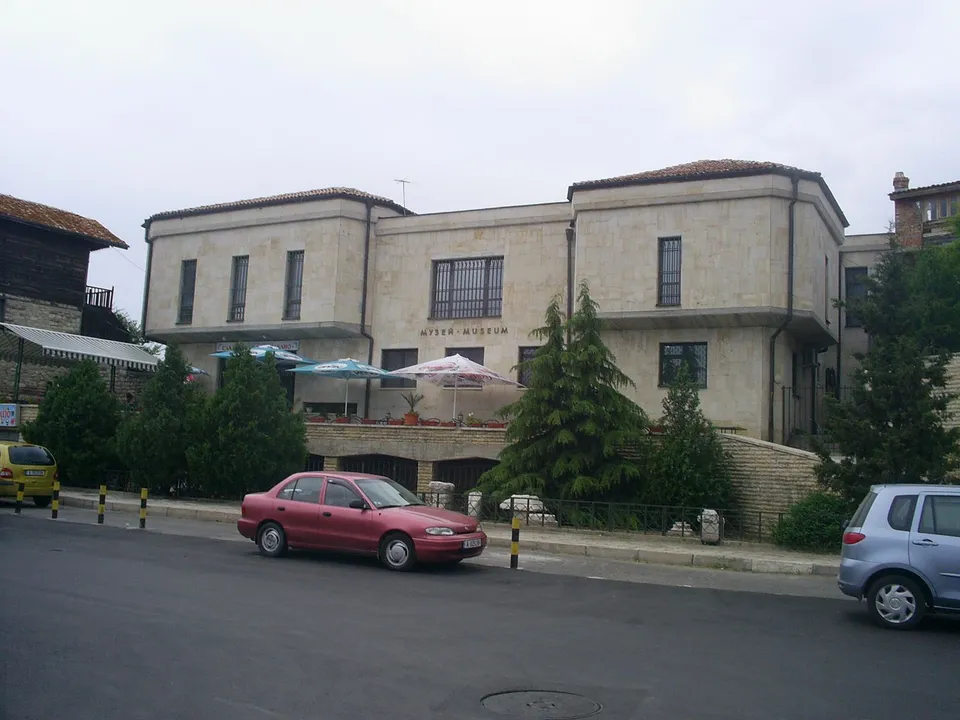
The archaeological collection and the church buildings preserve evidence from different periods. Small finds inside complement the large walls outside. The museum has occupied its specially built home since 1994.
The map links it with three churches: Christ Pantocrator, St Sophia and St Stephen. These places exist today. Each building represents a different period. Coins, stonework and decoration provide different kinds of evidence. Start with something small enough to hold between two fingers.
- Nessebar Archaeological Museum · Approximate location
- Christ Pantocrator · Approximate location
- St Sophia — the Old Bishopric · Approximate location
- St Stephen — the New Bishopric · Approximate location
Sources · 9
- Museum Ancient Nessebar The Archaeological Museum
- Museum Ancient Nessebar Fortification Walls
- Museum Ancient Nessebar Basilica Saint Sofia
- Museum Ancient Nessebar The Christ Pantokrator Church
- Museum Ancient Nessebar The Saint Stephen Church
- Wikimedia geographical database contributors Nessebar Archaeological Museum
- Wikimedia geographical database contributors Christ Pantocrator
- Wikimedia geographical database contributors St Sophia — the Old Bishopric
- Wikimedia geographical database contributors St Stephen — the New Bishopric
Part 3 · Main period: Antiquity
A town on a coin
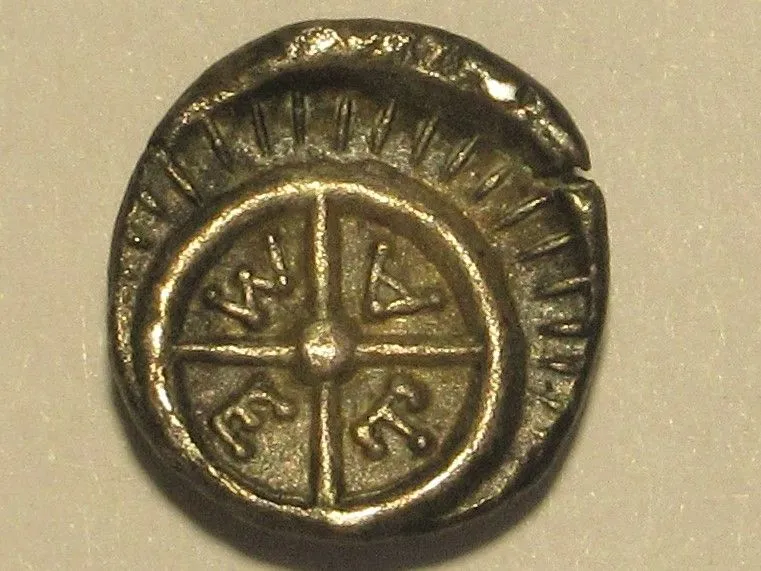
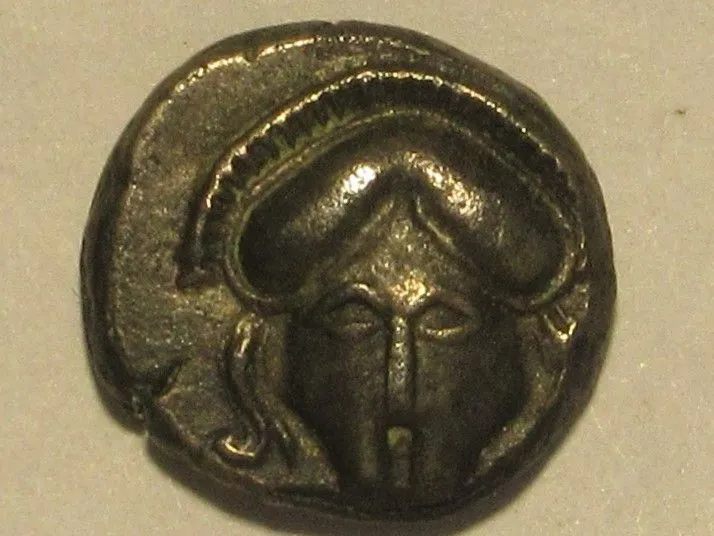
Mesambria, ancient Nessebar, minted its own coins in the fifth century BCE. The illustrated silver diobol has a helmet on the front and a wheel on the back. Diobol names a small coin. The helmet resembles a metal mask with eye openings.
Turn it over. Four spokes divide the wheel. Letters from the town’s name sit between them. One interpretation connects the wheel with Apollo, a Greek god. Another suggests the god Ares. Its meaning is uncertain.
- 1 · Four spokes
- Four spokes meet at the wheel’s centre.
- 2 · The town’s letters
- M-E-T-A abbreviates the town’s name. The coin is rotated in this photograph.
- 3 · Rays around the wheel
- Short rays surround the wheel. Its shape is visible; a connection with a particular god is an interpretation.
- 4 · The legend of Melsas
- A legend says Melsas founded the town and gave it his name. The coin does not prove that he lived.
Sources · 7
- Museum Ancient Nessebar History of Nessebar
- Corpus Nummorum project (institutional numismatic research portal; no individual byline on page) Coin Typology of Mesembria
- Emanuel Petac; Aurel Vîlcu About the Diobols Hoard of Apollonia Pontica and Mesembria Discovered in 1911 in Constanţa (Ancient Tomis) PDF
- Museum Ancient Nessebar The Archaeological Museum: Hall Two — Messambria, the Pontic Polis
- Hermann Junghans Mesembria Rv.JPG
- Hermann Junghans Mesembria Diobol Av.JPG
- Photographer uncredited; ancient object: Mesambria mint, Alexander type Monnaie - Statère aux types d'Alexandre le grand, Mesembria, Thrace - btv1b10060926f (1 of 2).jpg
Part 4 · Main period: Antiquity
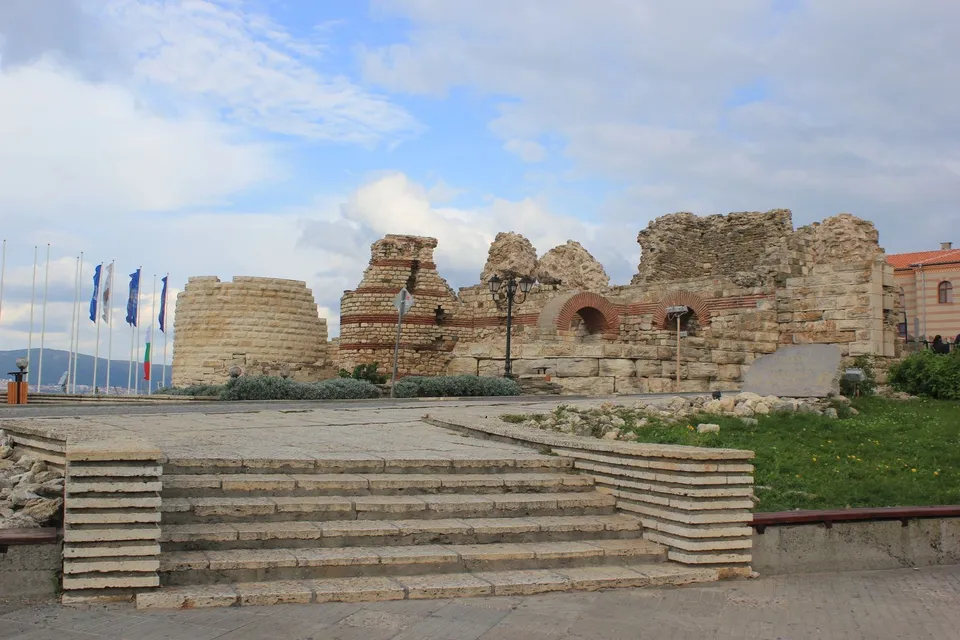
A repaired wall
At the entrance, look at the stone and red brick. Greek builders used large stone blocks. Romans conquered the town in 72 BCE and kept its defences.
In the mid-fifth century CE, Byzantine builders raised a new wall. They alternated stone and brick. Byzantium is the name we now use for the Eastern Roman Empire. Repairs continued through the Middle Ages. The visible wall was not built all at once. Materials alone cannot tell us the age of every stone.
Sources · 3
- Museum Ancient Nessebar Fortification Walls
- Museum Ancient Nessebar History of Nessebar
- Sarah T. Brooks Byzantium (ca. 330–1453)
Part 5 · Main period: Antiquity
Activity: what can we see?
What can we point to directly on the back of the illustrated diobol?
Why is that?
The wheel and spokes are visible. The symbol’s meaning is a separate research question.
Correct · A wheel with four spokes.
- Emanuel Petac; Aurel Vîlcu About the Diobols Hoard of Apollonia Pontica and Mesembria Discovered in 1911 in Constanţa (Ancient Tomis) PDF
- Corpus Nummorum project (institutional numismatic research portal; no individual byline on page) Coin Typology of Mesembria
- Hermann Junghans Mesembria Rv.JPG
Sources · 3
- Emanuel Petac; Aurel Vîlcu About the Diobols Hoard of Apollonia Pontica and Mesembria Discovered in 1911 in Constanţa (Ancient Tomis) PDF
- Corpus Nummorum project (institutional numismatic research portal; no individual byline on page) Coin Typology of Mesembria
- Hermann Junghans Mesembria Rv.JPG
Part 6 · Main period: Antiquity
The roofless church
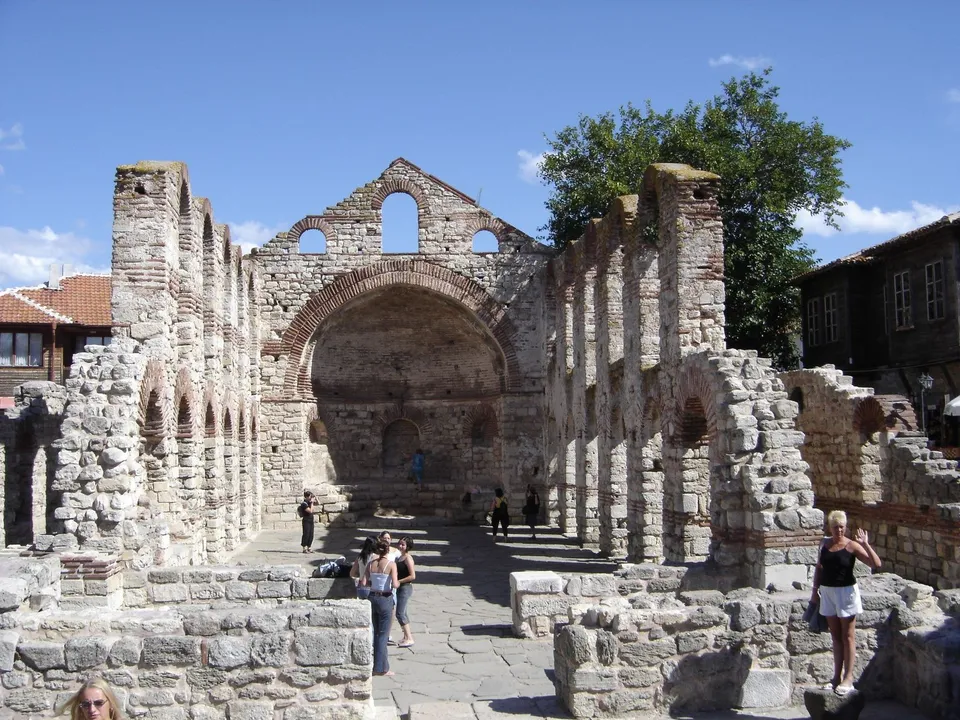
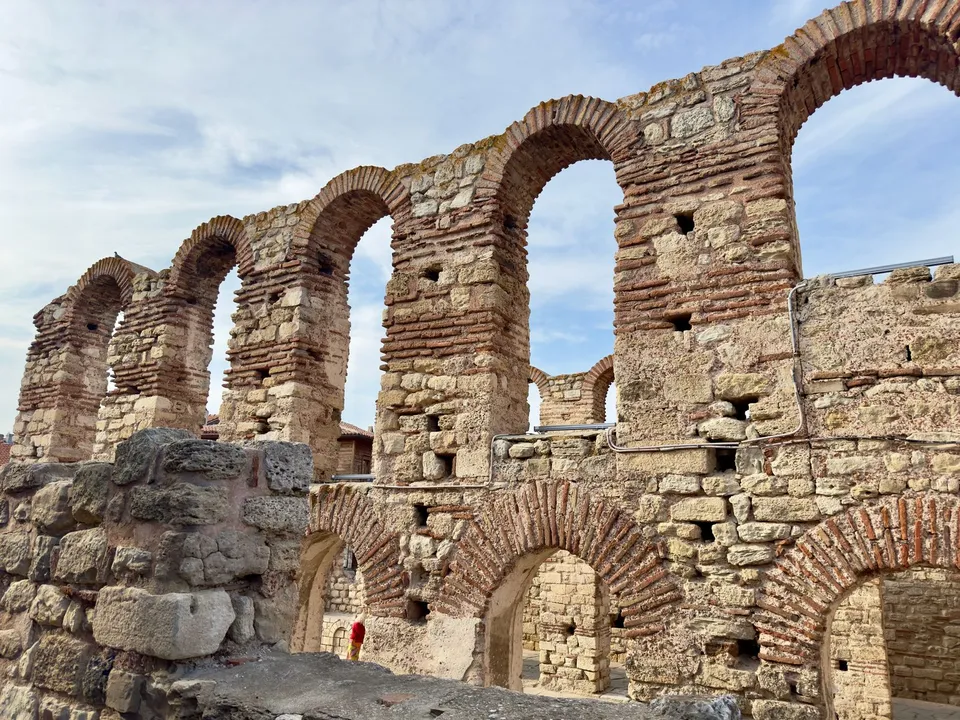
At St Sophia, sky replaces the old roof. Building began in the late fifth and early sixth centuries CE. It is a basilica: a long church with three lengthwise spaces, called naves. Arches separate them. The semicircular part at the eastern end is called an apse.
It is called the Old Bishopric: the main church of the local church leader. The church was altered after it was first built.
- St Sophia — the Old Bishopric · Approximate location
Sources · 3
- Museum Ancient Nessebar Basilica Saint Sofia
- Museum Ancient Nessebar History of Nessebar
- Balkan Heritage Foundation (project with Bulgarian Centre for Underwater Archaeology) Submerged Heritage of Nessebar Excavation Project
Part 7 · Main period: Antiquity
Activity: put events in order
Put the events in order from earliest to latest.
Why is that?
Fifth-century BCE coinage precedes the Roman conquest; the basilica belongs to later centuries; Krum’s capture comes after its construction.
Correct order
- The city starts minting coins
- Roman troops take the city
- Building St Sophia
- Krum captures the town
- Museum Ancient Nessebar History of Nessebar
- Museum Ancient Nessebar Basilica Saint Sofia
- Corpus Nummorum project (institutional numismatic research portal; no individual byline on page) Coin Typology of Mesembria
Sources · 3
- Museum Ancient Nessebar History of Nessebar
- Museum Ancient Nessebar Basilica Saint Sofia
- Corpus Nummorum project (institutional numismatic research portal; no individual byline on page) Coin Typology of Mesembria
Part 8 · Main period: Antiquity
Saucers and paintings on walls
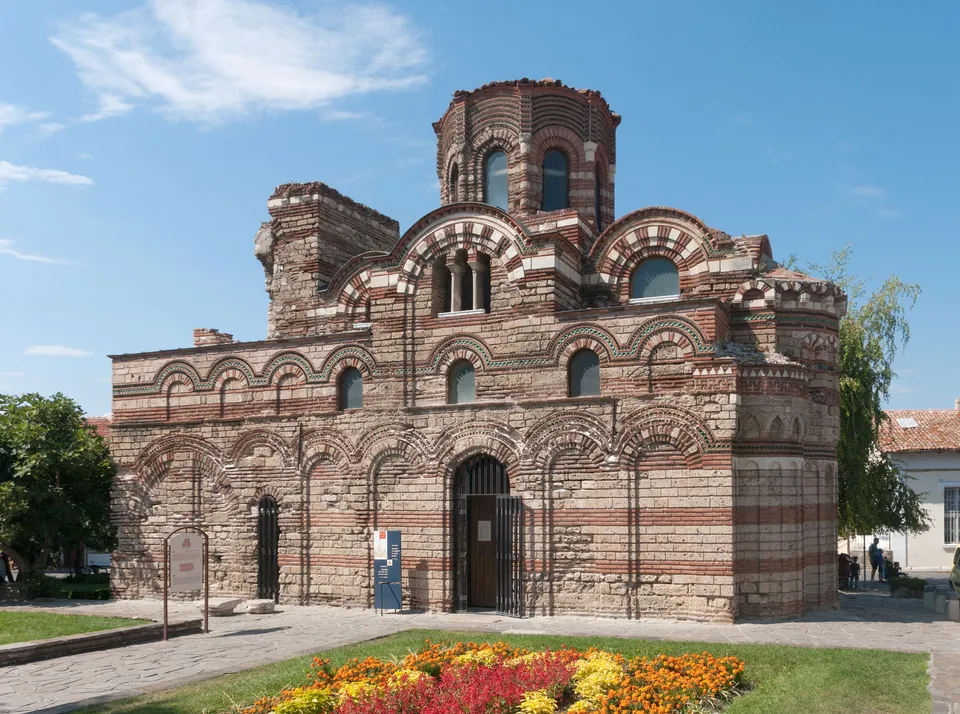
At Christ Pantocrator, look above the arches. Ceramic saucers and four-leaf shapes decorate the facade, the outside wall. Pantocrator means Almighty: Christ, who rules over everything. The church dates to the thirteenth–fourteenth centuries.
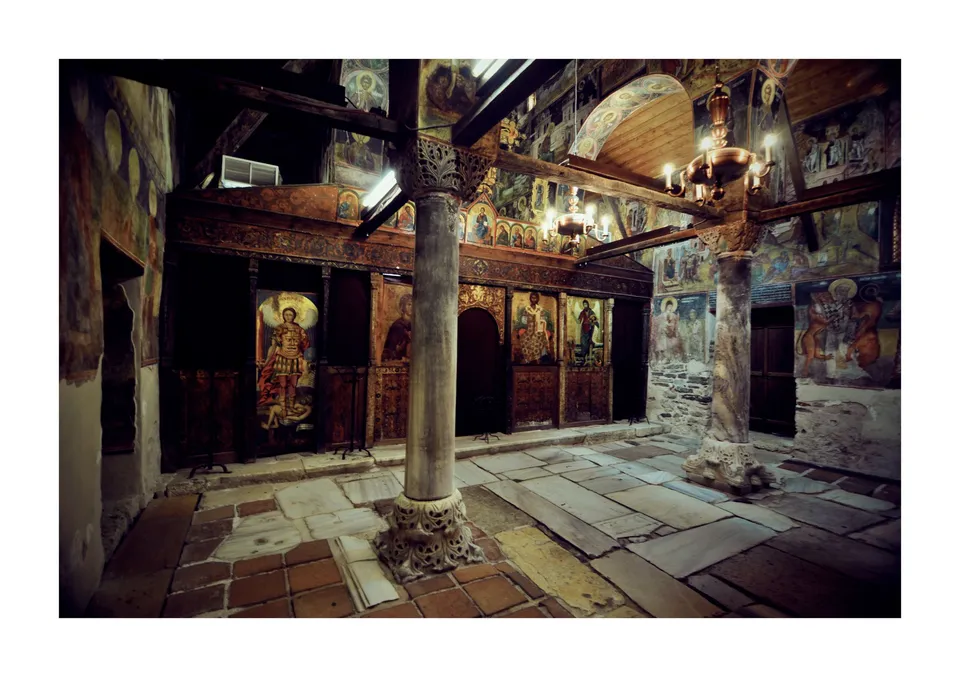
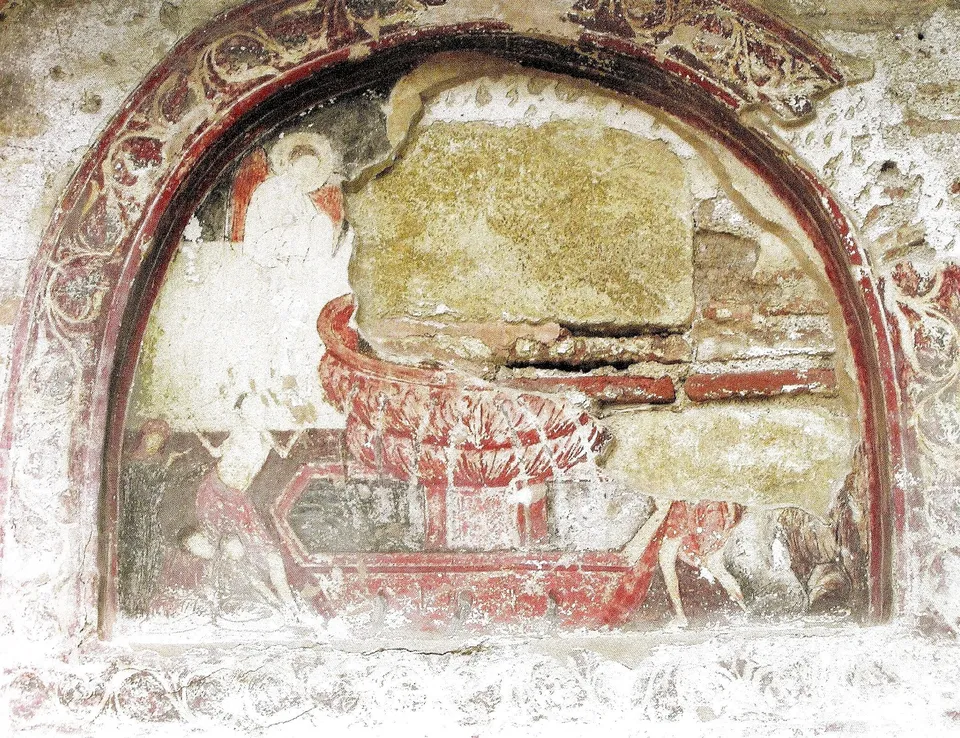
Inside St Stephen, the New Bishopric, look at the wall paintings. It was built in the eleventh–thirteenth centuries. But an inscription dates its mural decoration to 1599. A mural is a painting on a wall. The building and its paintings have different ages.
- 1 · Ceramics on the wall
- Green ceramic saucers follow the curve above the arch.
- 2 · An arch in the wall
- A recessed arch decorates the facade. It is not a passage.
- 3 · A window below the dome
- A window in the drum: the raised part beneath the dome.
- Christ Pantocrator · Approximate location
- St Stephen — the New Bishopric · Approximate location
Sources · 4
- Museum Ancient Nessebar The Christ Pantokrator Church
- Museum Ancient Nessebar The Saint Stephen Church
- UNESCO World Heritage Centre Ancient City of Nessebar, World Heritage List no. 217
- Chrumps; sharpening by Jacek Halicki Church of Christ Pantocrator Nesebar.jpg
Part 9 · Main period: Antiquity
Activity: match the clues
Match each object or place with its clue in the story.
Why is that?
The coin carries civic symbols; St Sophia is a basilica; we examined exterior ceramics at Christ Pantocrator and distinguished building from painting at St Stephen.
- Emanuel Petac; Aurel Vîlcu About the Diobols Hoard of Apollonia Pontica and Mesembria Discovered in 1911 in Constanţa (Ancient Tomis) PDF
- Museum Ancient Nessebar Basilica Saint Sofia
- Museum Ancient Nessebar The Christ Pantokrator Church
- Museum Ancient Nessebar The Saint Stephen Church
Sources · 4
- Emanuel Petac; Aurel Vîlcu About the Diobols Hoard of Apollonia Pontica and Mesembria Discovered in 1911 in Constanţa (Ancient Tomis) PDF
- Museum Ancient Nessebar Basilica Saint Sofia
- Museum Ancient Nessebar The Christ Pantokrator Church
- Museum Ancient Nessebar The Saint Stephen Church
A new find for your collection
A wall, a coin and a church preserve different parts of the past of the same place.
People in this story
Sources
- Sarah T. Brooks Byzantium (ca. 330–1453)
- Corpus Nummorum project (institutional numismatic research portal; no individual byline on page) Coin Typology of Mesembria
- Wikimedia geographical database contributors Nessebar Archaeological Museum
- Wikimedia geographical database contributors Christ Pantocrator
- Wikimedia geographical database contributors St Sophia — the Old Bishopric
- Wikimedia geographical database contributors St Stephen — the New Bishopric
- Museum Ancient Nessebar History of Nessebar
- Museum Ancient Nessebar The Archaeological Museum
- Museum Ancient Nessebar The Christ Pantokrator Church
- Emanuel Petac; Aurel Vîlcu About the Diobols Hoard of Apollonia Pontica and Mesembria Discovered in 1911 in Constanţa (Ancient Tomis) PDF
- Photographer uncredited; ancient object: Mesambria mint, Alexander type Monnaie - Statère aux types d'Alexandre le grand, Mesembria, Thrace - btv1b10060926f (1 of 2).jpg
- Hermann Junghans Mesembria Diobol Av.JPG
- Hermann Junghans Mesembria Rv.JPG
- Japus; watermark removal by Beao Nesebar-panorama-day.JPG
- Chrumps; sharpening by Jacek Halicki Church of Christ Pantocrator Nesebar.jpg
- Museum Ancient Nessebar The Archaeological Museum: Hall Two — Messambria, the Pontic Polis
- Museum Ancient Nessebar Basilica Saint Sofia
- Museum Ancient Nessebar The Saint Stephen Church
- Balkan Heritage Foundation (project with Bulgarian Centre for Underwater Archaeology) Submerged Heritage of Nessebar Excavation Project
- UNESCO World Heritage Centre Ancient City of Nessebar, World Heritage List no. 217
- Museum Ancient Nessebar Fortification Walls
Images
Photographer uncredited · Public domain · National Library of France / Wikimedia Commons
The front of a gold coin from Mesambria, called a stater. It shows the goddess Athena wearing a helmet. The coin follows a design of Alexander the Great.
Full attribution
Digitisation: National Library of France, via Wikimedia Commons. Public domain. Photographer uncredited. Cut-out detail; background removed.
User:Japus · CC BY 2.5 · Wikimedia Commons
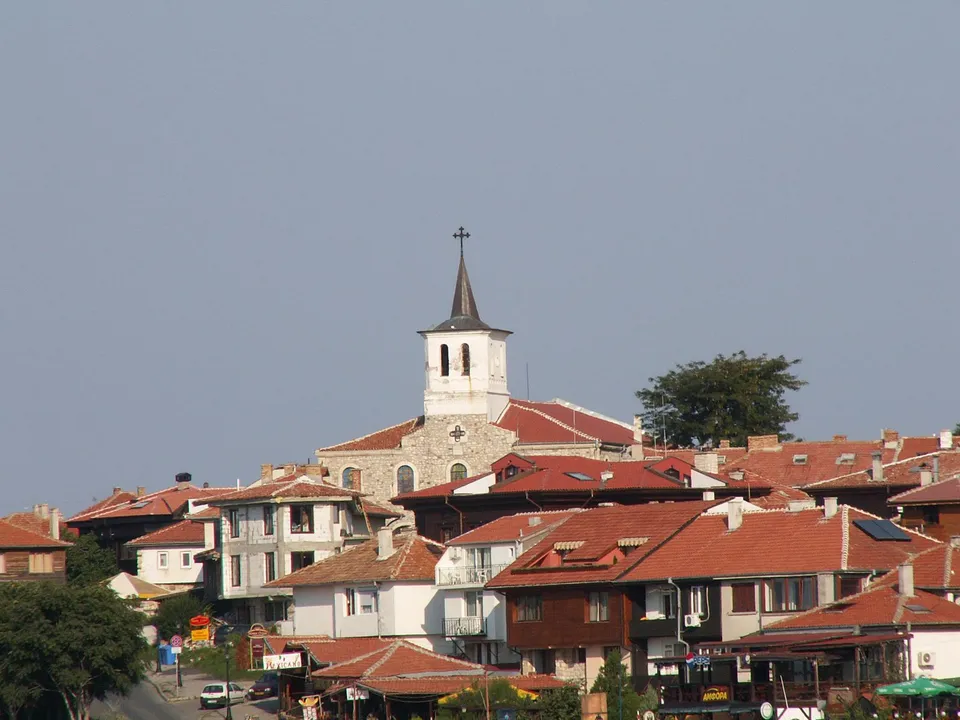
A present-day view of roofs and a church tower. In 1983, Old Nessebar was inscribed on UNESCO’s World Heritage List.
Full attribution
Photo: Japus; watermark removal: Beao. Wikimedia Commons, CC BY 2.5. Processed image.
Svik at Bulgarian Wikipedia · CC BY-SA 3.0 · Wikimedia Commons
The modern Archaeological Museum building in Nessebar; not an ancient structure.
Full attribution
Photo: Svik at Bulgarian Wikipedia. Wikimedia Commons. CC BY-SA 3.0. Processed image.
Julian Nyča · CC BY-SA 4.0 · Wikimedia Commons
Stone walls with brick bands at the entrance to Old Nessebar. Present-day view with repaired sections.
Full attribution
Photo: Julian Nyča. Wikimedia Commons. CC BY-SA 4.0. Processed image.
Hermann Junghans · CC BY-SA 3.0 de · Wikimedia Commons
Reverse of a Mesambrian diobol: four-spoked wheel, letters and outer rays. Small image.
Full attribution
Photo: Hermann Junghans. Wikimedia Commons. CC BY-SA 3.0 de. Processed image.
Hermann Junghans · CC BY-SA 3.0 de · Wikimedia Commons
The front of a diobol with a helmet covering the face, with eye openings.
Full attribution
Photo: Hermann Junghans. Wikimedia Commons. CC BY-SA 3.0 de. Processed image.
Photographer uncredited · Public domain · National Library of France / Wikimedia Commons
The front of a gold coin from Mesambria, called a stater. It shows the goddess Athena wearing a helmet. The coin follows a design of Alexander the Great.
Full attribution
Digitisation: National Library of France, via Wikimedia Commons. Public domain. Photographer uncredited. Processed image.
Gérard Janot · CC BY-SA 3.0 · Wikimedia Commons
View along the central space of St Sophia towards the semicircular apse, with sky above the ruins.
Full attribution
Photo: Gérard Janot, Wikimedia Commons, CC BY-SA 3.0. Processed image.
Oleg Yunakov · CC BY-SA 4.0 · Wikimedia Commons
Two tiers of brick arches within stone walls. Present-day photograph of the ruins of St Sophia.
Full attribution
Photo: Oleg Yunakov. Wikimedia Commons. CC BY-SA 4.0. Processed image.
Chrumps · CC BY-SA 4.0 · Wikimedia Commons
The facade of Christ Pantocrator with arches, green ceramic decoration and a drum below the dome.
Full attribution
Photo: Chrumps; sharpening: Jacek Halicki. Wikimedia Commons, CC BY-SA 4.0. Processed image.
fusion-of-horizons · CC BY 2.0 · Wikimedia Commons
St Stephen’s interior with murals, columns and an iconostasis. The photograph includes a white border.
Full attribution
Photo: fusion-of-horizons. Wikimedia Commons. CC BY 2.0. Processed image.
Pierre André Leclercq · CC BY-SA 4.0 · Wikimedia Commons
A damaged painted fragment with exposed masonry at St Stephen. The date of this fragment is unverified.
Full attribution
Photo: Pierre André Leclercq. Wikimedia Commons. CC BY-SA 4.0. Processed image.
Geographic context, without historical borders
Tom Patterson · Nathaniel Vaughn Kelso · Public domain · Natural Earth
Full attribution
Tom Patterson · Nathaniel Vaughn Kelso