 History of Bulgaria
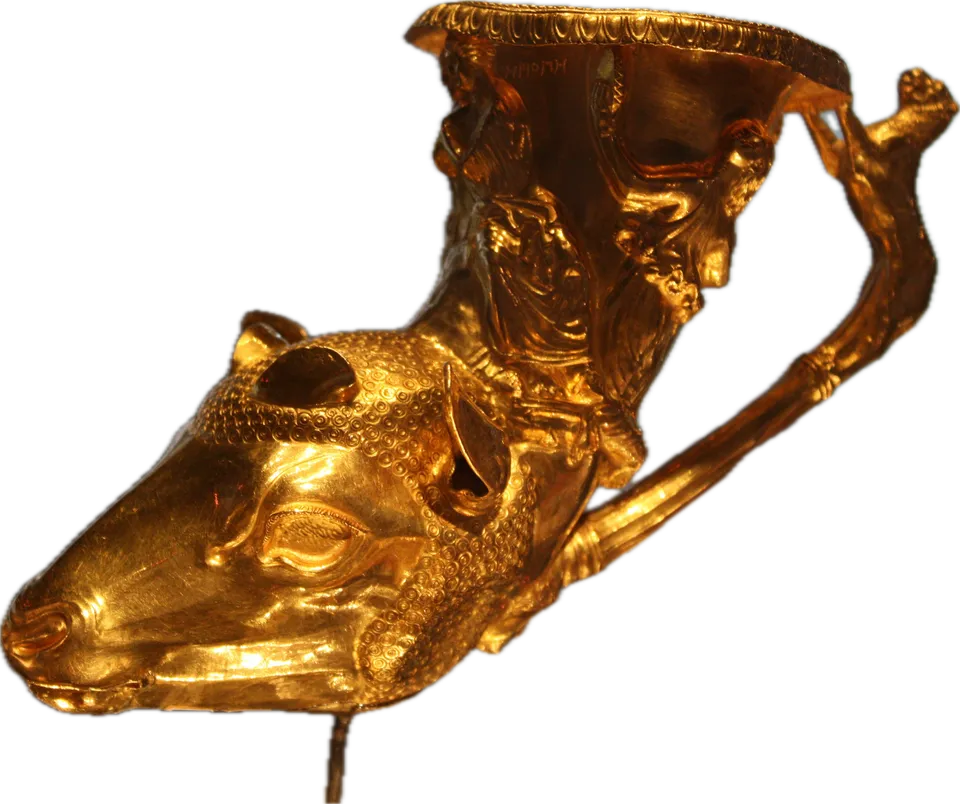
Photo
Apostoloff · CC BY-SA 3.0 · Wikimedia Commons
Ram-head rhyton. Dionysos, Eriope and two maenads are depicted on the neck. Museum display. It has not been confirmed whether the photographed object is the original or a museum replica.
Full attribution
Photo: Apostoloff, Wikimedia Commons, CC BY-SA 3.0 Cut-out detail; background removed. Museum display; original or replica unconfirmed
Nine vessels emerge from clay in 1949. Explore a deer rhyton, a centaur-handled amphora and a phiale, separating visible evidence from disputed readings.
Part 1 · Antiquity
Clay and gold vessels
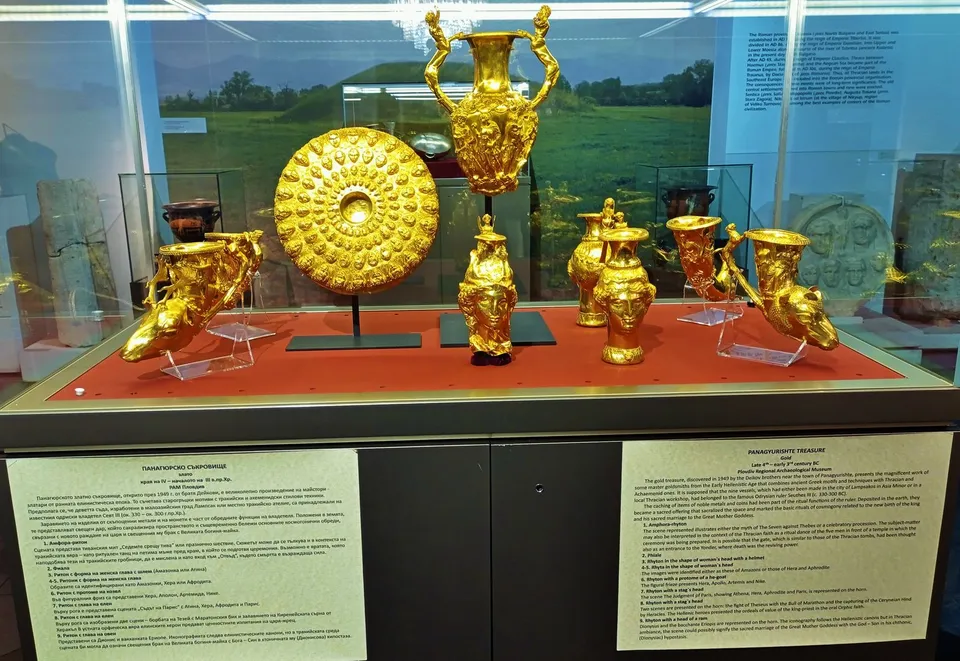
On 8 December 1949, Pavel, Petko and Mihail Deikov are working at the tile factory near Panagyurishte. They are digging clay. Out of the ground come nine gold vessels weighing more than six kilograms altogether. Not coins, but vessels with faces, animal muzzles and tiny human figures.
The brothers clean them and hand them to the district head, Stefan Kalpakov. The vessels are then displayed in the windows of a towel factory on the main street. The vessels remain there for a few days so that the people of Panagyurishte can see them. But who held them before the brothers, and what did they pour into them?
Sources · 2
- Исторически музей Панагюрище Панагюрско златно съкровище
- Asher Ovadiah A New Look at the Mythological Representations of the Panagyurishte Gold Treasure, Bulgaria


Part 2 · Antiquity
One place, two times
On the map we begin with modern Panagyurishte. The scholarly description places the find about two kilometres south of the town. We show an approximate area, not the exact trench.
The vessels are much older than the factory. The Panagyurishte museum dates the vessels to the late fourth or early third century BCE. Ovadiah gives the second half of the fourth or early third century BCE, while the Ministry of Tourism gives the broad fourth–third century BCE range. This is a Thracian set from antiquity, rather than medieval Bulgarian treasure. After their first display in Panagyurishte, the vessels went to Plovdiv and later to Sofia. The original is kept at the National History Museum and travels for exhibitions.
- Panagyurishte — discovery area · Approximate location
- National History Museum, Sofia · Approximate location
Sources · 5
- Исторически музей Панагюрище Панагюрско златно съкровище
- Asher Ovadiah A New Look at the Mythological Representations of the Panagyurishte Gold Treasure, Bulgaria
- Министерство на туризма, Република България The Panagyurishte Museum of History. Ministry of Tourism, Republic of Bulgaria, website
- Wikimedia contributors; P625 statement attributed to BG State e-Government Agency Panagyurishte: geographical record
- Wikimedia contributors National History Museum, Sofia: geographical record
Part 3 · Antiquity
Drinking from an animal head
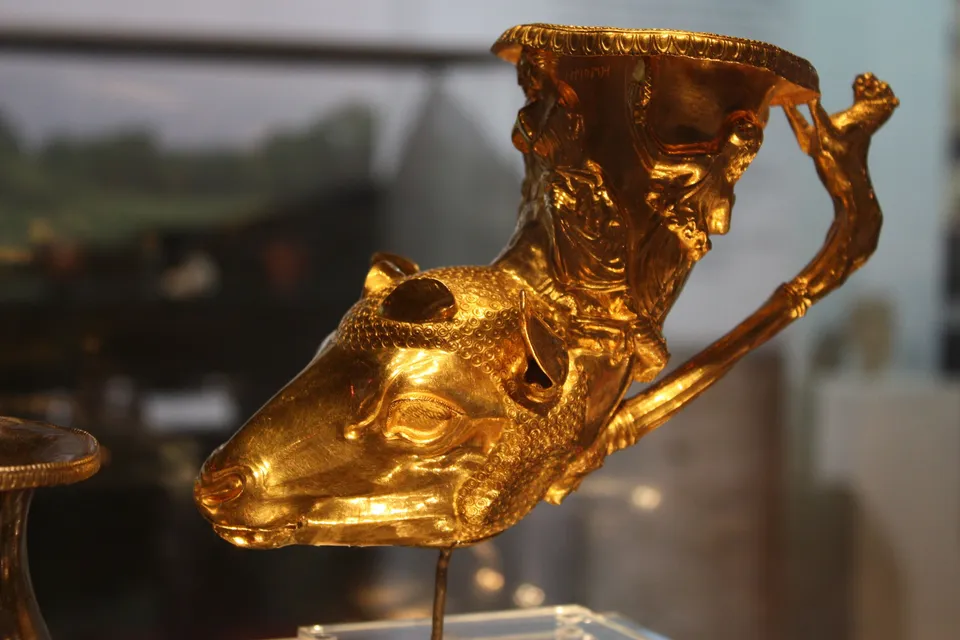
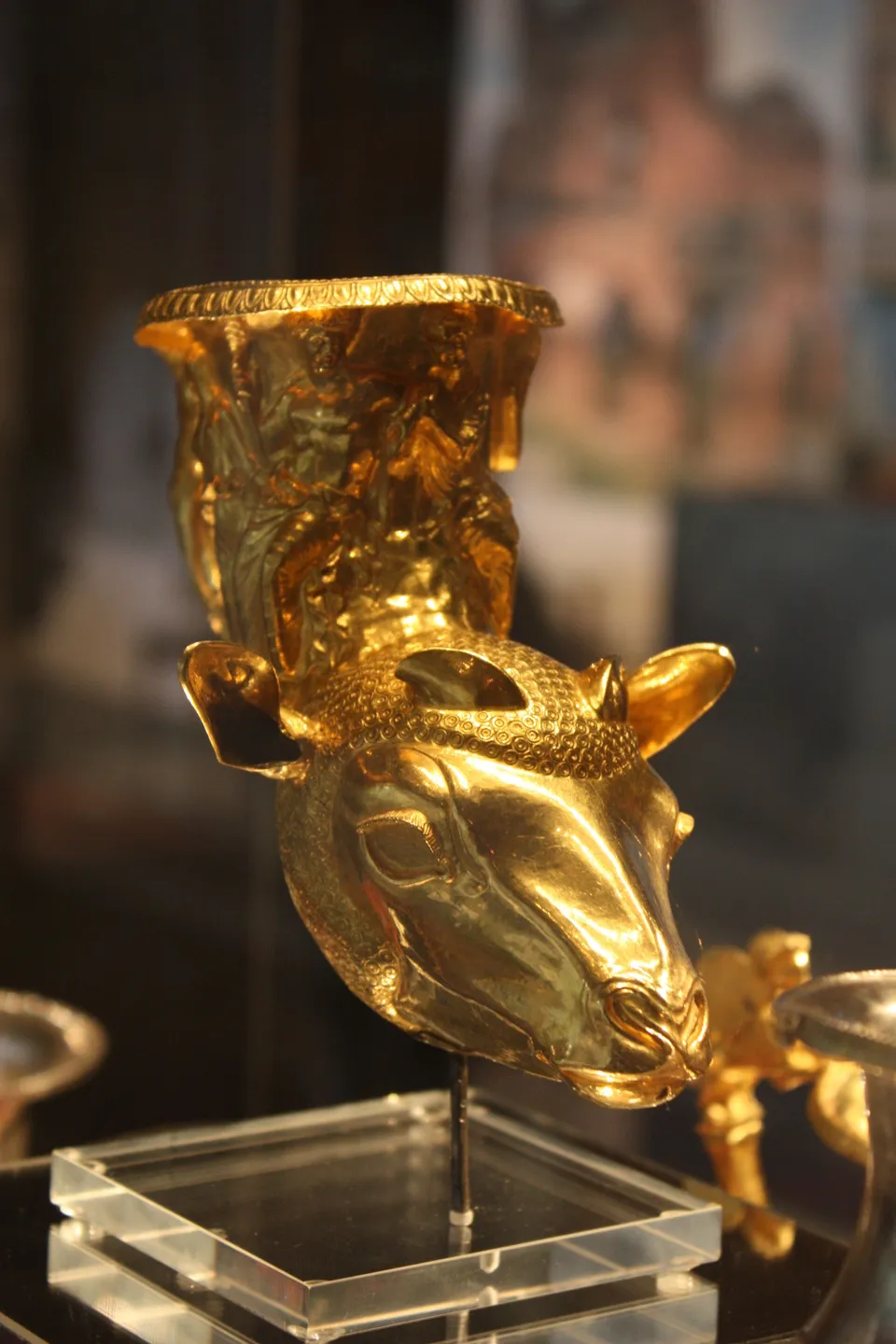
Look closely at the ram head. A neck covered in relief figures rises above it, and the handle ends in a lion. This is a rhyton: liquid flows through a small hole or spout. Its shape also determines how it is used for drinking.
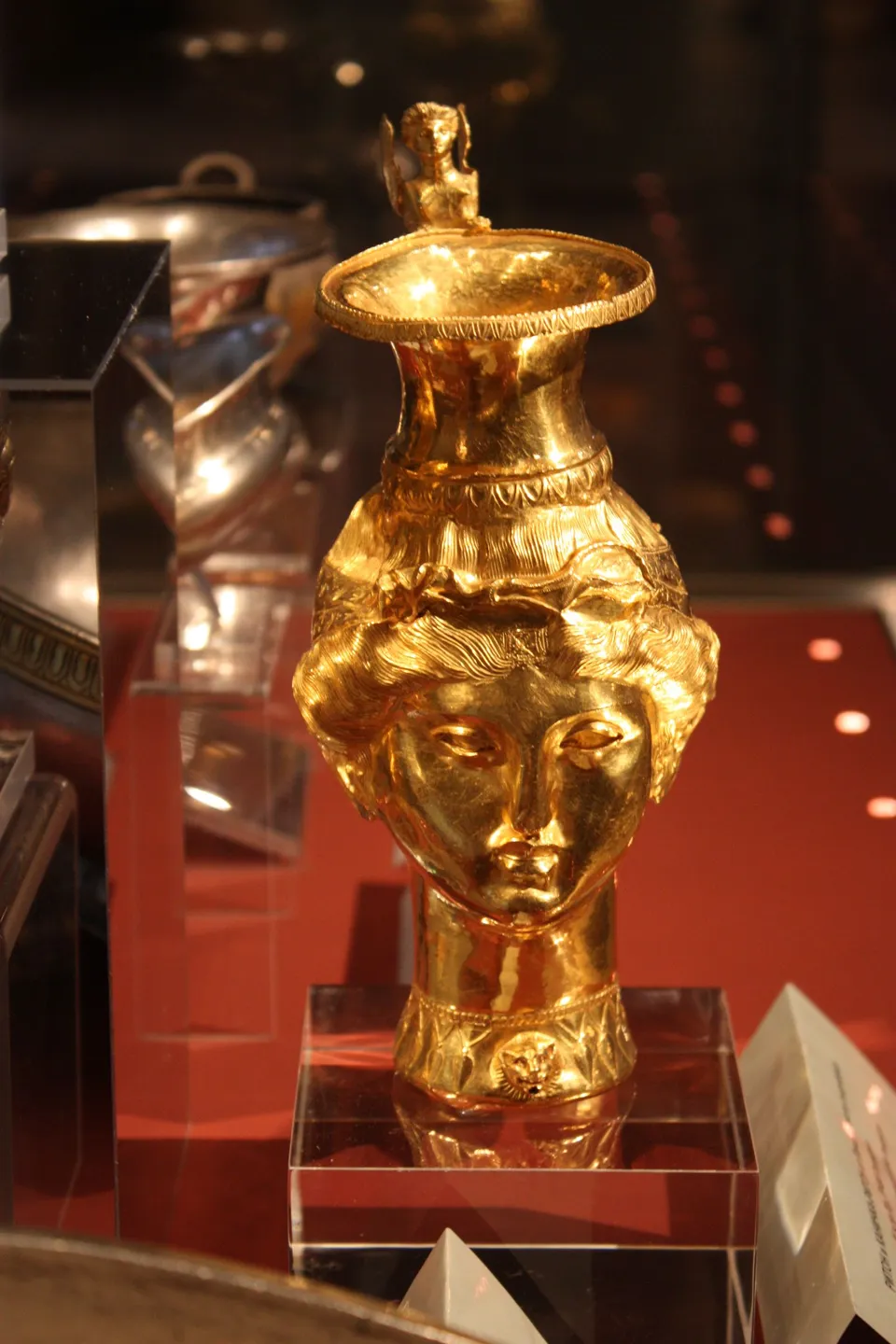
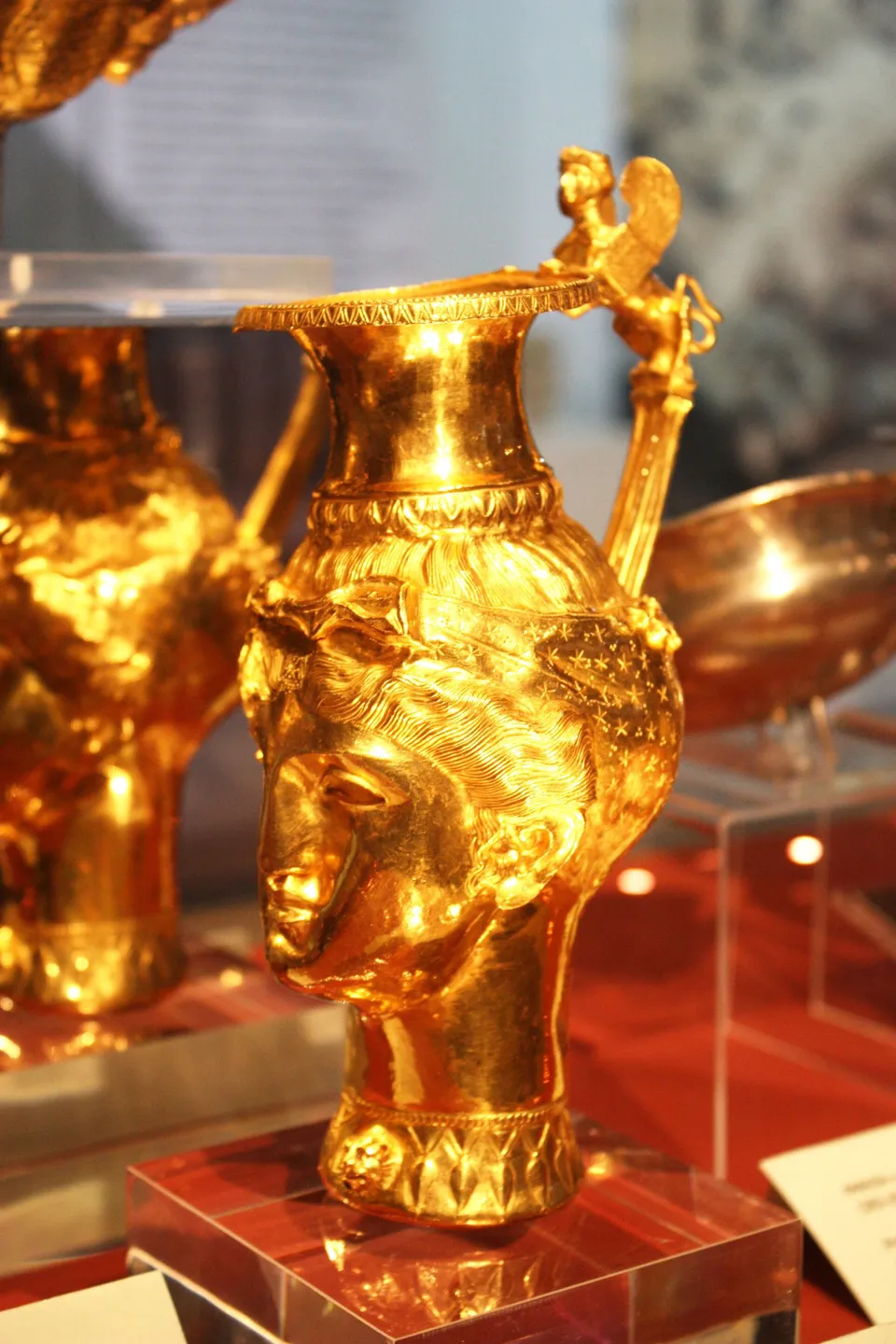
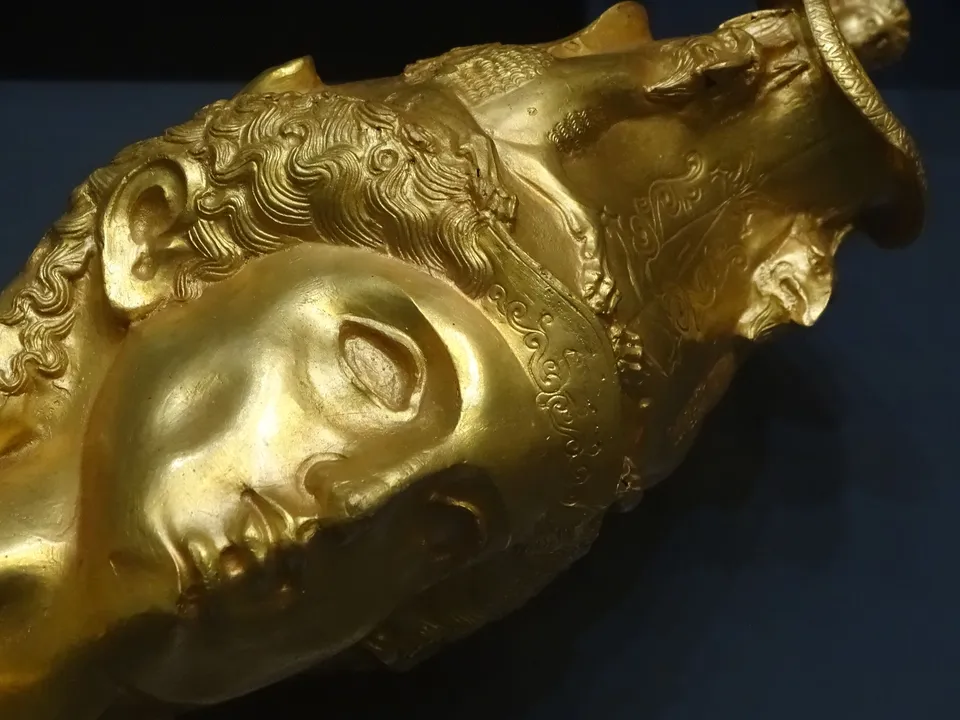
The set includes four rhyta with animal heads or foreparts: two deer, a ram and a goat. Three other vessels take the shape of female heads. The ram rhyton shown here depicts Dionysos, Eriope and two maenads. A different vessel, one of the deer rhyta, shows Paris, Hera, Athena and Aphrodite. The Greek inscriptions name the goddesses and Alexandros, the other name of Paris in the myth. The deer rhyton tells the myth of Paris choosing between the goddesses. The image is real, but the contest belongs to myth.
- 1 · Ram head
- The lower part is shaped as a ram head.
- 2 · Lion on the rim
- The handle ends in a lion with its front paws on the rim.
- 3 · A story on the neck
- This ram rhyton shows Dionysos, Eriope and two maenads. The Judgment of Paris is on one deer rhyton; the exploits of Herakles and Theseus are on the other.
Sources · 2
Part 4 · Antiquity
The gate without a label
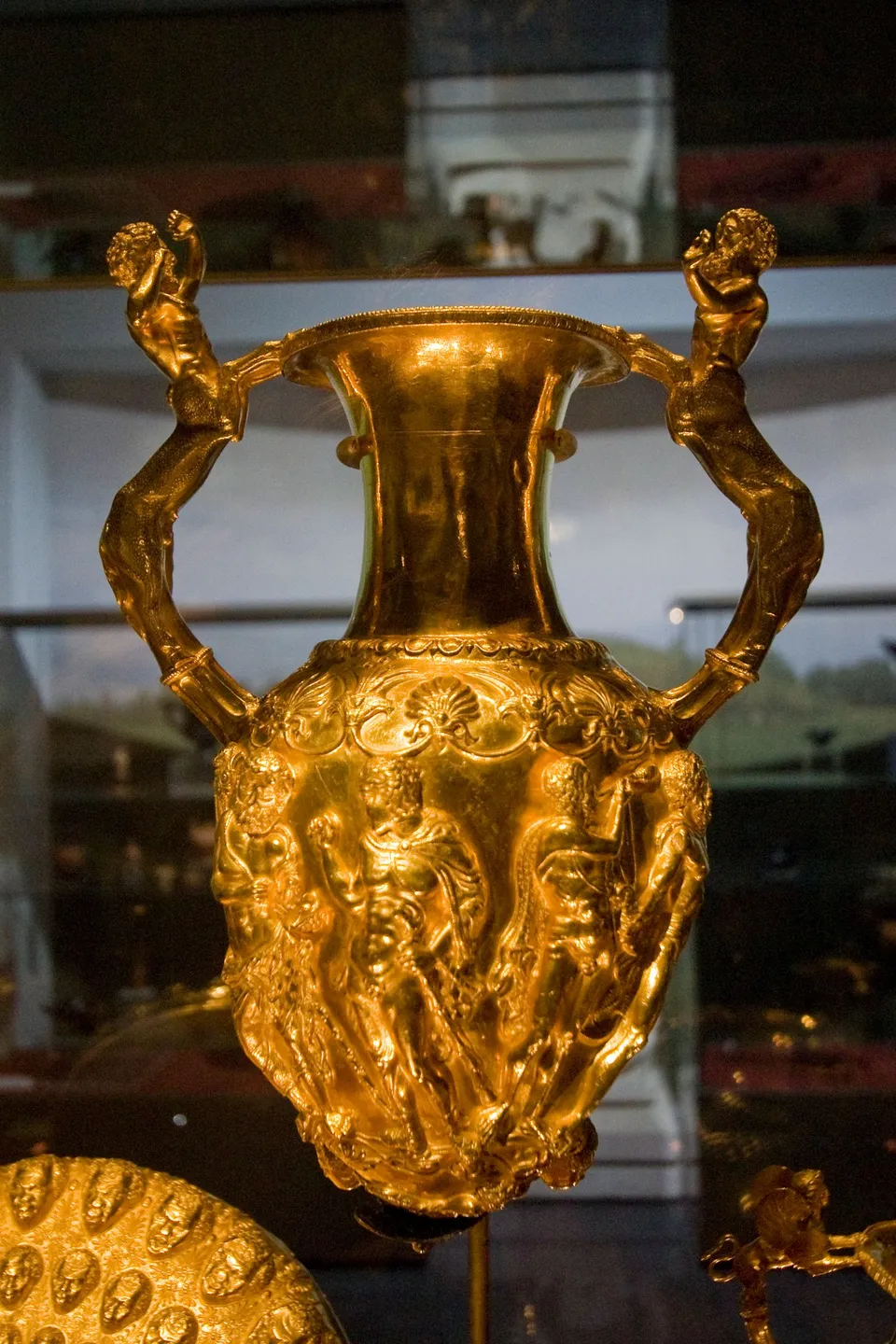
The largest and heaviest vessel resembles an amphora. Its two handles are centaurs, creatures with human upper bodies and horse bodies. Yet it is also a rhyton: there are two outlets in its base. They are hidden from this angle.
On the other side of the vessel are figures beside a double-leaf gate. What story are they acting out? Kontoleon reads it as Seven against Thebes. Ovadiah proposes something else: an expedition to rescue Helen. These are competing scholarly interpretations of mythical narratives. Neither title is incised beside the gate. The vessel’s form is visible; the meaning of its scene remains under discussion.
- 1 · Centaur handle
- The handle combines a human upper body with a horse body: a centaur, a mythical creature.
- 2 · Figures without secure names
- Ovadiah identifies the two men as Herakles and Theseus. This is his interpretation, not an inscription on the vessel.
- 3 · The vessel neck
- The amphora-rhyton is the largest and heaviest vessel in the set. Its two bottom outlets are hidden from this angle.
Sources · 2
Part 5 · Antiquity
Activity: how the liquid flows
What distinguishes a rhyton in this story?
Why is that?
A rhyton lets liquid flow through a small hole or spout. Its shape can vary.
Correct · A small outlet or spout
- N. M. Kontoleon The Gold Treasure of Panagurischte PDF
Sources · 1
- N. M. Kontoleon The Gold Treasure of Panagurischte PDF
Part 6 · Antiquity
The vessel that is not a rhyton
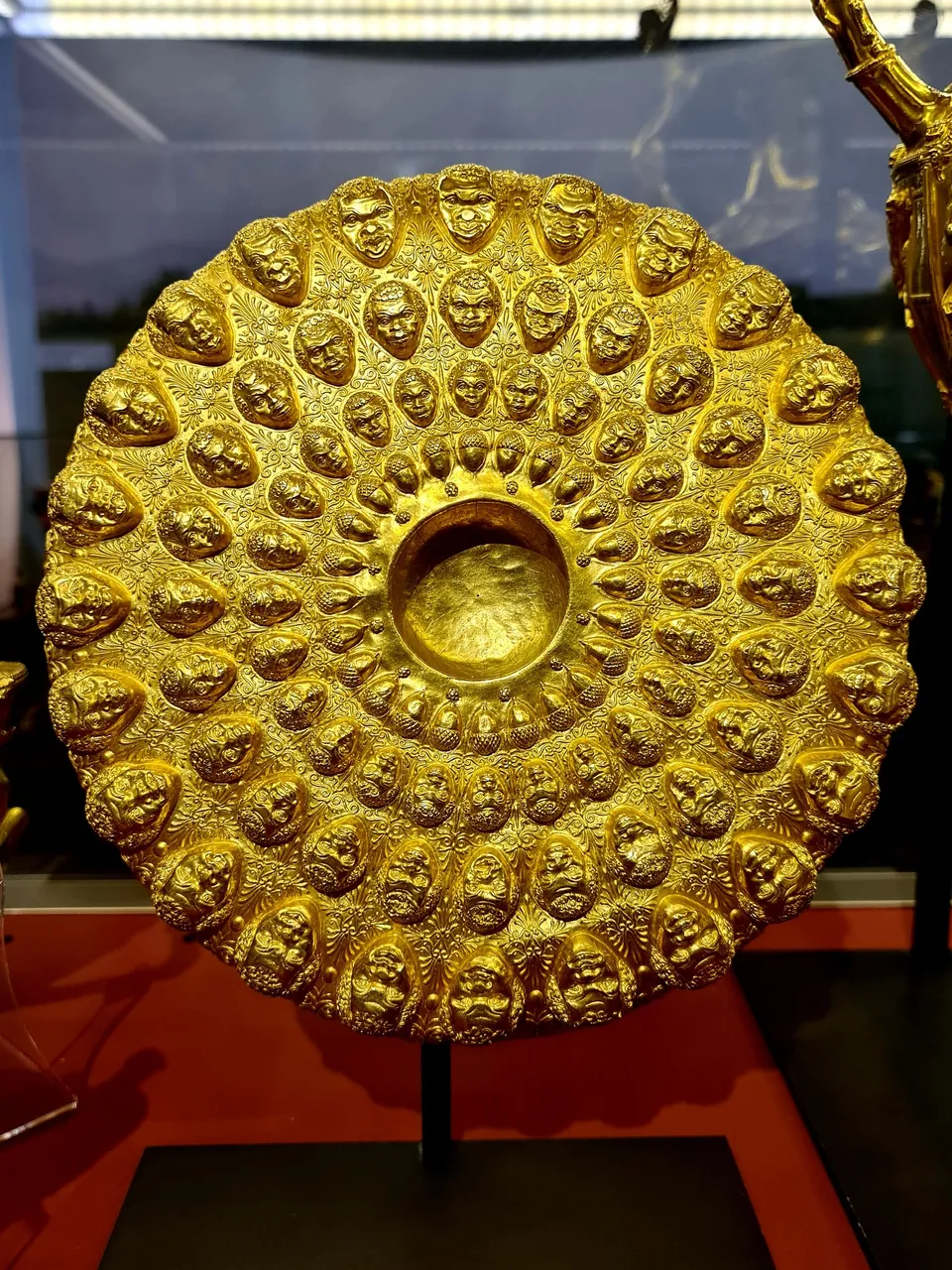
Among the tall vessels is a shallow bowl: the phiale. In the display it stands upright so its decoration can be seen. Do not mistake the museum support for the way it was used in antiquity.
Acorns surround the centre. Beyond them are rows of relief heads of African men, increasing in size towards the rim. There are incised weight marks too. These are evidence of measurement, not the signature of a securely named owner. The phiale differs from the other eight vessels, which function as rhyta. The nine objects form a set, but they are not nine identical cups. Look again at their outlines.
- 1 · The centre
- At the centre is the omphalos, the central boss, seen here as a hollow from the decorated side.
- 2 · Acorns
- A row of acorns surrounds the centre. Human heads follow farther out.
- 3 · Rows of heads
- The relief heads of African men increase in size towards the rim. The images do not establish who drank from the vessel.
Sources · 1
- N. M. Kontoleon The Gold Treasure of Panagurischte PDF
Part 7 · Antiquity
Activity: from discovery to museum
Arrange from earliest to latest.
Why is that?
According to the museum, the vessels date to the late fourth or early third century BCE. They were discovered in 1949, then displayed in the town and transferred to Plovdiv.
Correct order
- Manufacture in antiquity
- Discovery by the Deikov brothers
- First display in Panagyurishte
- Transfer to Plovdiv
- Исторически музей Панагюрище Панагюрско златно съкровище
Sources · 1
- Исторически музей Панагюрище Панагюрско златно съкровище
Part 8 · Antiquity
Wealth does not name the owner
Who drank from this gold? The British Museum suggests the set may have been a diplomatic gift for a Thracian king. That is a hypothesis, not evidence for one particular ruler. Its place of manufacture also remains disputed.
Greek myths do not automatically make the owner Greek. According to the British Museum, the set combines Persian, Greek and Anatolian styles, and possibly Thracian styles too. In a study published in 2014, Ovadiah proposes a different interpretation of the scenes. The vessels survive, but the sources used here do not establish their owner’s name. We can distinguish the vessels and their myths without inventing the name of the person who held them.
Sources · 3
- British Museum Luxury and power: Persia to Greece PDF
- Asher Ovadiah A New Look at the Mythological Representations of the Panagyurishte Gold Treasure, Bulgaria
- N. M. Kontoleon The Gold Treasure of Panagurischte PDF
Part 9 · Antiquity
Activity: recognise the form
Match each vessel to its distinguishing feature.
Why is that?
The phiale is the shallow vessel; the amphora-rhyton has two outlets; the deer rhyton has an animal head.
- N. M. Kontoleon The Gold Treasure of Panagurischte PDF
Sources · 1
- N. M. Kontoleon The Gold Treasure of Panagurischte PDF
A new find for your collection
Forms and inscriptions are evidence; ownership and the meaning of some scenes remain matters of interpretation.
People in this story
Sources
- British Museum Luxury and power: Persia to Greece PDF
- N. M. Kontoleon The Gold Treasure of Panagurischte PDF
- Исторически музей Панагюрище Панагюрско златно съкровище
- Asher Ovadiah A New Look at the Mythological Representations of the Panagyurishte Gold Treasure, Bulgaria
- Министерство на туризма, Република България The Panagyurishte Museum of History. Ministry of Tourism, Republic of Bulgaria, website
- Wikimedia contributors National History Museum, Sofia: geographical record
- Wikimedia contributors; P625 statement attributed to BG State e-Government Agency Panagyurishte: geographical record
Images
Photo
Apostoloff · CC BY-SA 3.0 · Wikimedia Commons
Ram-head rhyton. Dionysos, Eriope and two maenads are depicted on the neck. Museum display. It has not been confirmed whether the photographed object is the original or a museum replica.
Full attribution
Photo: Apostoloff, Wikimedia Commons, CC BY-SA 3.0 Cut-out detail; background removed. Museum display; original or replica unconfirmed
Photo
Ivano Giambattista · CC0 · Wikimedia Commons
The nine vessels in a museum case. Museum display. It has not been confirmed whether the photographed object is the original or a museum replica.
Full attribution
Photo: Ivano Giambattista, Wikimedia Commons, CC0 Processed image. Museum display; original or replica unconfirmed
Photo
Apostoloff · CC BY-SA 3.0 · Wikimedia Commons
Ram-head rhyton. Dionysos, Eriope and two maenads are depicted on the neck. Museum display. It has not been confirmed whether the photographed object is the original or a museum replica.
Full attribution
Photo: Apostoloff, Wikimedia Commons, CC BY-SA 3.0 Processed image. Museum display; original or replica unconfirmed
Photo
Apostoloff · CC BY-SA 3.0 · Wikimedia Commons
Deer rhyton, front view. Museum display. It has not been confirmed whether the photographed object is the original or a museum replica.
Full attribution
Photo: Apostoloff, Wikimedia Commons, CC BY-SA 3.0 Processed image. Museum display; original or replica unconfirmed
Photo
Apostoloff · CC BY-SA 3.0 · Wikimedia Commons
Female-head vessel, front view. Museum display. It has not been confirmed whether the photographed object is the original or a museum replica.
Full attribution
Photo: Apostoloff, Wikimedia Commons, CC BY-SA 3.0 Processed image. Museum display; original or replica unconfirmed
Photo
Apostoloff · CC BY-SA 3.0 · Wikimedia Commons
Female-head vessel, profile view. Museum display. It has not been confirmed whether the photographed object is the original or a museum replica.
Full attribution
Photo: Apostoloff, Wikimedia Commons, CC BY-SA 3.0 Processed image. Museum display; original or replica unconfirmed
Photo
Adam Jones from Kelowna, BC, Canada · CC BY-SA 2.0 · Wikimedia Commons
Detail of a female-head vessel. Museum display. It has not been confirmed whether the photographed object is the original or a museum replica.
Full attribution
Photo: Adam Jones from Kelowna, BC, Canada, Wikimedia Commons, CC BY-SA 2.0 Processed image. Museum display; original or replica unconfirmed
Photo
Ann Wuyts · CC BY 2.0 · Wikimedia Commons
The amphora-rhyton. Museum display. It has not been confirmed whether the photographed object is the original or a museum replica.
Full attribution
Photo: Ann Wuyts, Wikimedia Commons, CC BY 2.0 Processed image. Museum display; original or replica unconfirmed
Photo
Biser Todorov · CC BY 4.0 · Wikimedia Commons
Phiale with relief heads and acorns. Museum display. It has not been confirmed whether the photographed object is the original or a museum replica.
Full attribution
Photo: Biser Todorov, Wikimedia Commons, CC BY 4.0 Processed image. Museum display; original or replica unconfirmed
Geographic context, without historical borders
Tom Patterson · Nathaniel Vaughn Kelso · Public domain · Natural Earth
Full attribution
Tom Patterson · Nathaniel Vaughn Kelso