 History of Bulgaria
Kritzolina · CC BY-SA 4.0 · Wikimedia Commons
Full attribution
Photo: Kritzolina, Wikimedia Commons, CC BY-SA 4.0. Site today. Original file, unmodified. Cut-out detail; background removed.
Rooms cut into rock, water in a deep hollow and a disputed hypothesis. A close look at Perperikon from antiquity to the Middle Ages and the excavations begun in 2000.
Part 1 · Main period: Antiquity
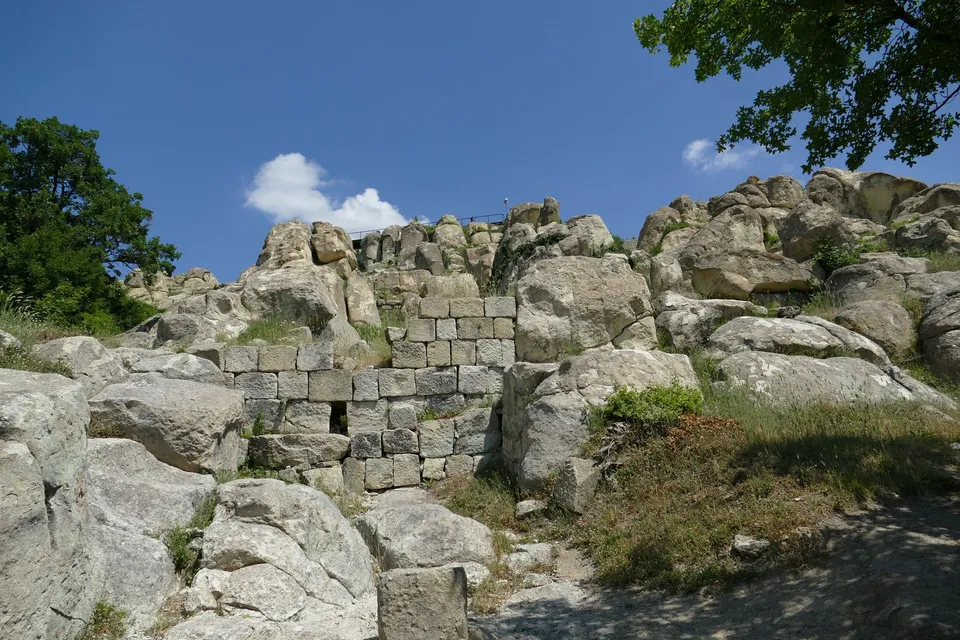
A room in the rock
The photograph shows rooms cut into rock. At Perperikon, people carved into the hill itself. They cut out rooms, streets and courtyards. Above the rock-cut lower floors, they raised walls and beams. Today the ruins look like houses with their upper halves removed.
Different generations changed the hill. Follow the edge of a room. Where does the rock end and the masonry begin?
Sources · 1
- Николай Овчаров; national tourism portal BulgariaTravel (host) От свещения Перперикон до царствения Търновград PDF


Part 2 · Main period: Antiquity
Steps on the hilltop
Find Perperikon on the map. The hill lies in the Eastern Rhodopes, near Gorna Krepost village and present-day Kardzhali. The point marks its approximate location, without ancient borders.
Traces here reach back to the Copper Age. People then used both stone and copper. Later, the place is associated with the Thracians, ancient Balkan communities. The modern excavation programme began in 2000. Archaeologists uncovered a fortified hilltop settlement. They found rock-cut steps, channels and niches, small recesses in stone. Who made them, and what were they for?
- Perperikon · Approximate location
Sources · 3
- Pia Guldager Bilde; Birgitte Bøgh; Søren Handberg; Jakob Munk Højte; Jens Nieling; Tatiana Smekalova; Vladimir Stolba Archaeology in the Black Sea Region in Classical Antiquity 1993–2007: Thracian inland sites PDF
- Georgi Nekhrizov; National Archaeological Institute with Museum, BAS Curriculum Vitae PDF
- Wikimedia geographical database contributors Perperikon
Part 3 · Main period: Antiquity
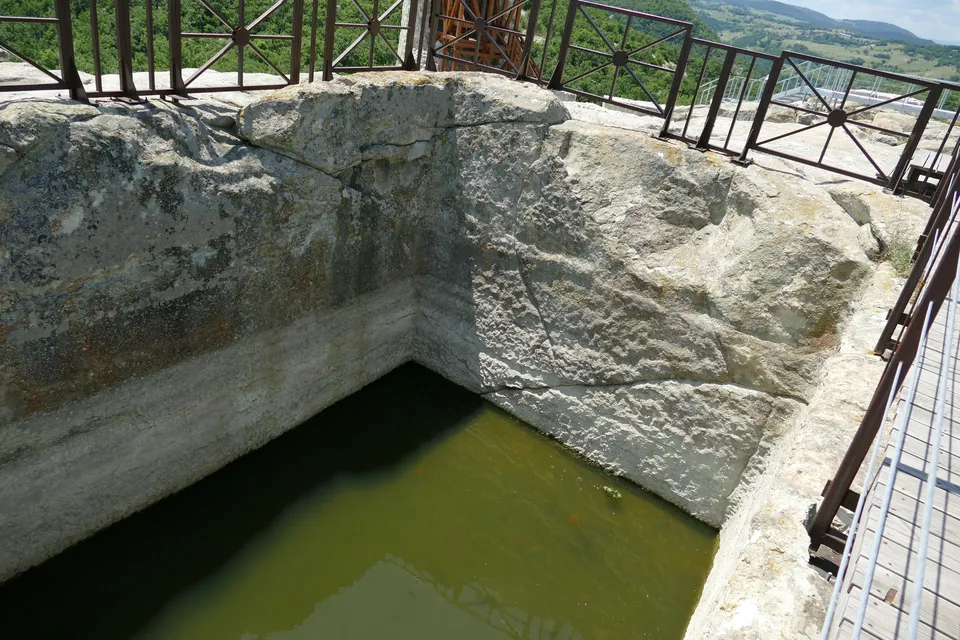
Water in the rock
The photograph shows a deep rock-cut hollow containing water. Above it stands a modern safety railing. The municipal portal describes a large cistern in the Acropolis, the fortified upper town. We have not confirmed that this photograph shows that cistern. A cistern is a structure for collecting and storing water.
The town also had drainage: channels carrying rainwater away. Water alone does not prove the hollow’s purpose. Not every hollow is an altar, a place for offerings or sacrifices. What can you see for certain?
- 1 · Rock wall
- The hollow is cut into bedrock.
- 2 · Water
- Water is visible below in the modern photograph. This does not date the structure.
- 3 · Modern railing
- The metal railing is a modern safety barrier, not an ancient wall.
Sources · 3
- Kritzolina Archaeological complex of Perperikon 10.jpg
- Община Кърджали / Municipality of Kardzhali Водохранилище / Water reservoir
- Николай Овчаров; national tourism portal BulgariaTravel (host) От свещения Перперикон до царствения Търновград PDF
Part 4 · Main period: Antiquity
Wine and flame
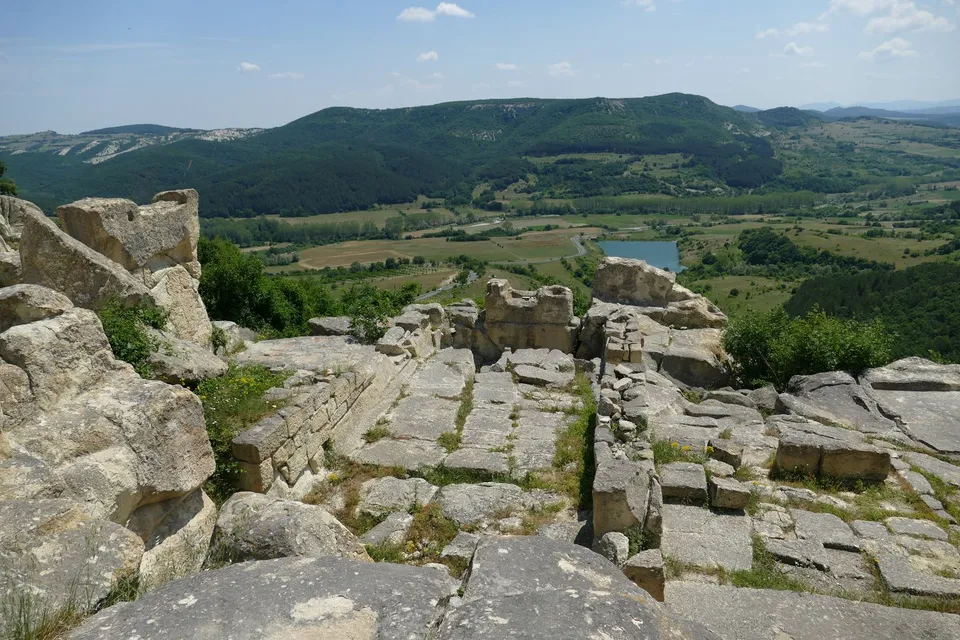
Archaeologists describe an oval hall with a round rock-cut altar, a place for offerings or sacrifices. A disputed proposal links it to the oracle of Dionysus, a god associated with wine. An oracle is a place where people sought predictions.
A legend tells of Gaius Octavius, father of the future emperor Augustus. Priests predict his son’s power from flames rising from wine on an altar. It compares the omen with Alexander the Great’s. But it never names Perperikon. It proves neither man visited this hill.
Sources · 4
- Pia Guldager Bilde; Birgitte Bøgh; Søren Handberg; Jakob Munk Højte; Jens Nieling; Tatiana Smekalova; Vladimir Stolba Archaeology in the Black Sea Region in Classical Antiquity 1993–2007: Thracian inland sites PDF
- Agence France-Presse; interview with excavation director Nikolay Ovcharov Oracle of Dionysus found in Bulgaria?
- Йордан Илиев Родопите и прорицалището на Дионис в Древна Тракия PDF
- Gaius Suetonius Tranquillus; English translation J. C. Rolfe The Lives of the Caesars, Volume I: Augustus
Part 5 · Main period: Antiquity
Activity: what do we know?
What can we say about the famous oracle?
Why is that?
Ovcharov proposes the connection; Iliev disputes its grounds. A rock-cut feature alone does not identify a deity.
Correct · The connection with Perperikon is a disputed hypothesis.
- Йордан Илиев Родопите и прорицалището на Дионис в Древна Тракия PDF
- Agence France-Presse; interview with excavation director Nikolay Ovcharov Oracle of Dionysus found in Bulgaria?
- Pia Guldager Bilde; Birgitte Bøgh; Søren Handberg; Jakob Munk Højte; Jens Nieling; Tatiana Smekalova; Vladimir Stolba Archaeology in the Black Sea Region in Classical Antiquity 1993–2007: Thracian inland sites PDF
- Gaius Suetonius Tranquillus; English translation J. C. Rolfe The Lives of the Caesars, Volume I: Augustus
Sources · 4
- Йордан Илиев Родопите и прорицалището на Дионис в Древна Тракия PDF
- Agence France-Presse; interview with excavation director Nikolay Ovcharov Oracle of Dionysus found in Bulgaria?
- Pia Guldager Bilde; Birgitte Bøgh; Søren Handberg; Jakob Munk Højte; Jens Nieling; Tatiana Smekalova; Vladimir Stolba Archaeology in the Black Sea Region in Classical Antiquity 1993–2007: Thracian inland sites PDF
- Gaius Suetonius Tranquillus; English translation J. C. Rolfe The Lives of the Caesars, Volume I: Augustus
Part 6 · Main period: Antiquity
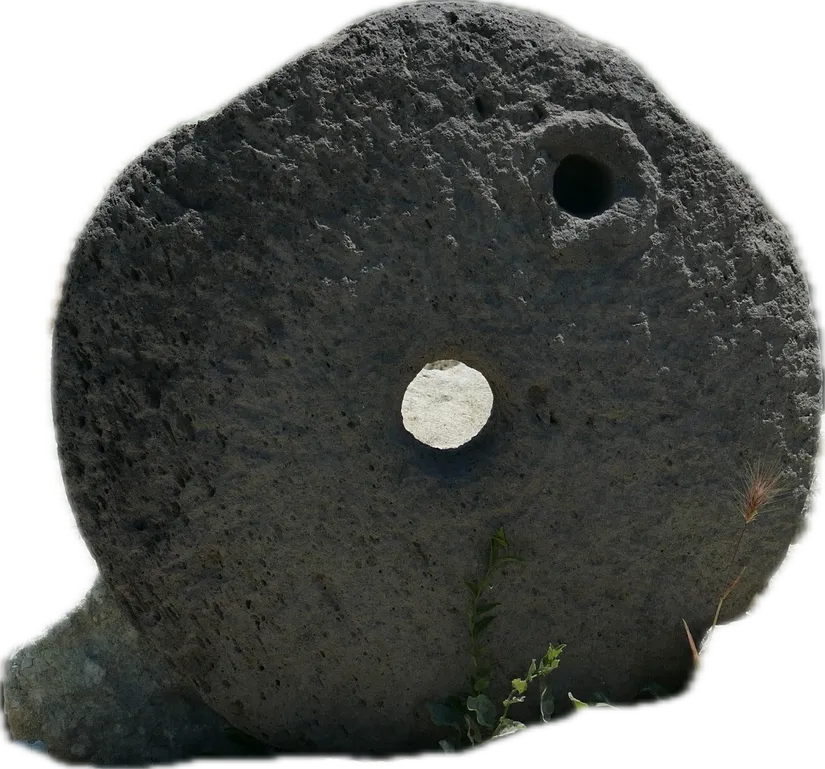
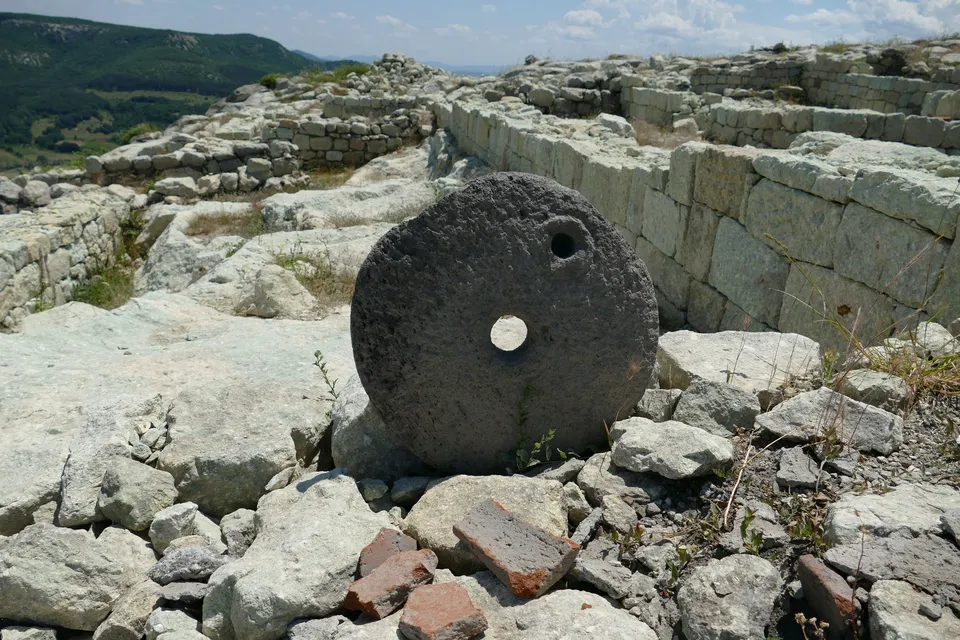
The stone disc with two holes
Here is a stone disc with two holes. One is near the middle, the other at the upper right. The photograph cannot date the disc or show whether it always stood here.
In 46 CE, the Thracian kingdom became a Roman province, an area under Roman rule. Public buildings and temples were built at Perperikon. That does not make every stone in the photograph Roman. Behind the disc stands a wall of separate blocks. Dating needs finds and their context during excavation.
- 1 · Central hole
- The pale surface behind the disc is visible through the hole.
- 2 · Second hole
- A second hole is visible at the upper right. Its function is unconfirmed.
- 3 · Block masonry
- Behind the disc is masonry made of separate stone blocks. This view does not establish its date.
Sources · 3
- Kritzolina Archaeological complex of Perperikon 08.jpg
- Николай Овчаров; national tourism portal BulgariaTravel (host) От свещения Перперикон до царствения Търновград PDF
- Taner Güler “The Rugged Jaw of The Sea”: A Coastal Settlement of Salmydessos in Eastern Thrace
Part 7 · Main period: Antiquity
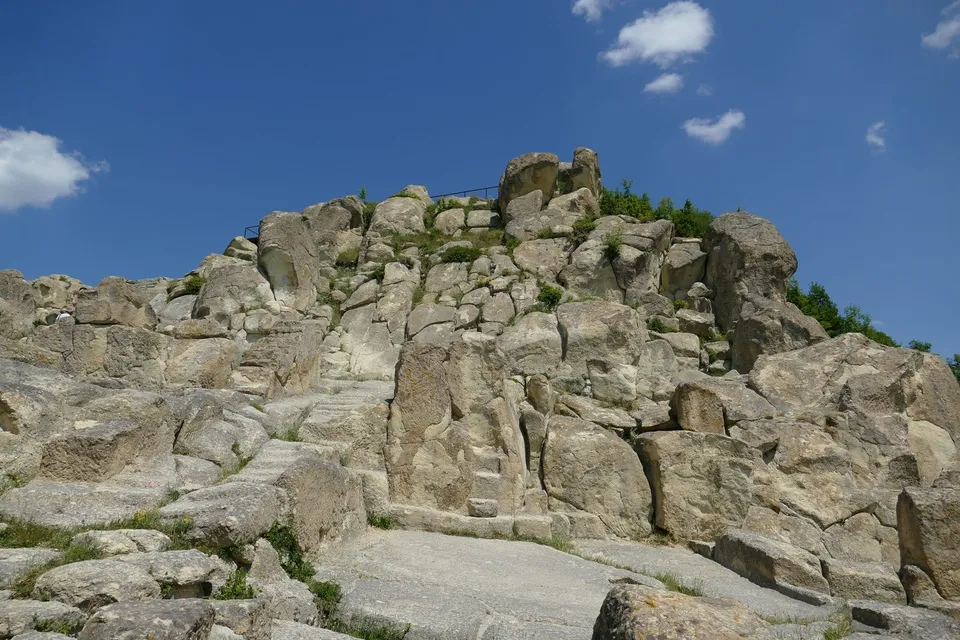
Churches and fortress
In Late Antiquity, people built Christian churches here. In 2016, excavators uncovered a large basilica in the South Quarter. This basilica is a church with three long sections: a nave and two side aisles.
People used the hill for centuries afterwards. A scholarly article places the Ottoman conquest, early 1360s. The exact year is disputed. It reports a heavy siege. Afterwards, soldiers guarded the fortress until the early fifteenth century.
The photograph shows a carved room. Calling it a famous oracle requires further evidence.
Sources · 4
- Николай Овчаров; national tourism portal BulgariaTravel (host) От свещения Перперикон до царствения Търновград PDF
- Николай Овчаров Перперикон след Перперикон. Към историята на османското завоевание на Балканите / Perperikon after Perperikon. On the History of the Ottoman Conquest of the Balkans
- Българско национално радио; интервю с Николай Овчаров Перперикон – един от най-популярните български археологически обекти в чуждите медии
- Николай Димитров Овчаров; НАИМ–БАН Индивидуален отчет: резултати от научната дейност, §1.1 PDF
Part 8 · Main period: Antiquity
Activity: put time in order
Put these in order, earliest first.
Why is that?
First comes the Roman province. The churches described were built centuries later. The Ottoman conquest and the modern excavation programme follow.
Correct order
- Thrace becomes a Roman province
- Christian churches are built
- The Ottoman conquest
- Modern excavations begin
- Николай Овчаров; national tourism portal BulgariaTravel (host) От свещения Перперикон до царствения Търновград PDF
- Николай Овчаров Перперикон след Перперикон. Към историята на османското завоевание на Балканите / Perperikon after Perperikon. On the History of the Ottoman Conquest of the Balkans
- Pia Guldager Bilde; Birgitte Bøgh; Søren Handberg; Jakob Munk Højte; Jens Nieling; Tatiana Smekalova; Vladimir Stolba Archaeology in the Black Sea Region in Classical Antiquity 1993–2007: Thracian inland sites PDF
- Taner Güler “The Rugged Jaw of The Sea”: A Coastal Settlement of Salmydessos in Eastern Thrace
- Николай Димитров Овчаров; НАИМ–БАН Индивидуален отчет: резултати от научната дейност, §1.1 PDF
Sources · 5
- Николай Овчаров; national tourism portal BulgariaTravel (host) От свещения Перперикон до царствения Търновград PDF
- Николай Овчаров Перперикон след Перперикон. Към историята на османското завоевание на Балканите / Perperikon after Perperikon. On the History of the Ottoman Conquest of the Balkans
- Pia Guldager Bilde; Birgitte Bøgh; Søren Handberg; Jakob Munk Højte; Jens Nieling; Tatiana Smekalova; Vladimir Stolba Archaeology in the Black Sea Region in Classical Antiquity 1993–2007: Thracian inland sites PDF
- Taner Güler “The Rugged Jaw of The Sea”: A Coastal Settlement of Salmydessos in Eastern Thrace
- Николай Димитров Овчаров; НАИМ–БАН Индивидуален отчет: резултати от научната дейност, §1.1 PDF
Part 9 · Main period: Antiquity
Activity: match the evidence
Match each piece of evidence to what it shows us.
Why is that?
The photograph shows water, but alone cannot prove the hollow’s purpose. The photograph shows holes but does not date the disc. The written account preserves a legend, not an address for the oracle.
- Kritzolina Archaeological complex of Perperikon 08.jpg
- Kritzolina Archaeological complex of Perperikon 10.jpg
- Община Кърджали / Municipality of Kardzhali Водохранилище / Water reservoir
- Gaius Suetonius Tranquillus; English translation J. C. Rolfe The Lives of the Caesars, Volume I: Augustus
Sources · 4
- Kritzolina Archaeological complex of Perperikon 08.jpg
- Kritzolina Archaeological complex of Perperikon 10.jpg
- Община Кърджали / Municipality of Kardzhali Водохранилище / Water reservoir
- Gaius Suetonius Tranquillus; English translation J. C. Rolfe The Lives of the Caesars, Volume I: Augustus
A new find for your collection
Visible remains and interpretations of them are different kinds of knowledge.
People in this story
Sources
- Agence France-Presse; interview with excavation director Nikolay Ovcharov Oracle of Dionysus found in Bulgaria?
- Pia Guldager Bilde; Birgitte Bøgh; Søren Handberg; Jakob Munk Højte; Jens Nieling; Tatiana Smekalova; Vladimir Stolba Archaeology in the Black Sea Region in Classical Antiquity 1993–2007: Thracian inland sites PDF
- Българско национално радио; интервю с Николай Овчаров Перперикон – един от най-популярните български археологически обекти в чуждите медии
- Община Кърджали / Municipality of Kardzhali Водохранилище / Water reservoir
- Taner Güler “The Rugged Jaw of The Sea”: A Coastal Settlement of Salmydessos in Eastern Thrace
- Йордан Илиев Родопите и прорицалището на Дионис в Древна Тракия PDF
- Николай Димитров Овчаров; НАИМ–БАН Индивидуален отчет: резултати от научната дейност, §1.1 PDF
- Georgi Nekhrizov; National Archaeological Institute with Museum, BAS Curriculum Vitae PDF
- Николай Овчаров Перперикон след Перперикон. Към историята на османското завоевание на Балканите / Perperikon after Perperikon. On the History of the Ottoman Conquest of the Balkans
- Kritzolina Archaeological complex of Perperikon 08.jpg
- Kritzolina Archaeological complex of Perperikon 10.jpg
- Gaius Suetonius Tranquillus; English translation J. C. Rolfe The Lives of the Caesars, Volume I: Augustus
- Николай Овчаров; national tourism portal BulgariaTravel (host) От свещения Перперикон до царствения Търновград PDF
- Wikimedia geographical database contributors Perperikon
Images
Kritzolina · CC BY-SA 4.0 · Wikimedia Commons
Full attribution
Photo: Kritzolina, Wikimedia Commons, CC BY-SA 4.0. Site today. Original file, unmodified. Cut-out detail; background removed.
Kritzolina · CC BY-SA 4.0 · Wikimedia Commons
Full attribution
Photo: Kritzolina, Wikimedia Commons, CC BY-SA 4.0. Site today. Original file, unmodified. Processed image.
Kritzolina · CC BY-SA 4.0 · Wikimedia Commons
Full attribution
Photo: Kritzolina, Wikimedia Commons, CC BY-SA 4.0. Site today. Original file, unmodified. Processed image.
Kritzolina · CC BY-SA 4.0 · Wikimedia Commons
Full attribution
Photo: Kritzolina, Wikimedia Commons, CC BY-SA 4.0. Site today. Original file, unmodified. Processed image.
Kritzolina · CC BY-SA 4.0 · Wikimedia Commons
Full attribution
Photo: Kritzolina, Wikimedia Commons, CC BY-SA 4.0. Site today. Original file, unmodified. Processed image.
Kritzolina · CC BY-SA 4.0 · Wikimedia Commons
Full attribution
Photo: Kritzolina, Wikimedia Commons, CC BY-SA 4.0. Site today. Original file, unmodified. Processed image.
Geographic context, without historical borders
Tom Patterson · Nathaniel Vaughn Kelso · Public domain · Natural Earth
Full attribution
Tom Patterson · Nathaniel Vaughn Kelso