 History of Bulgaria
Vislupus · CC BY-SA 4.0 · Wikimedia Commons
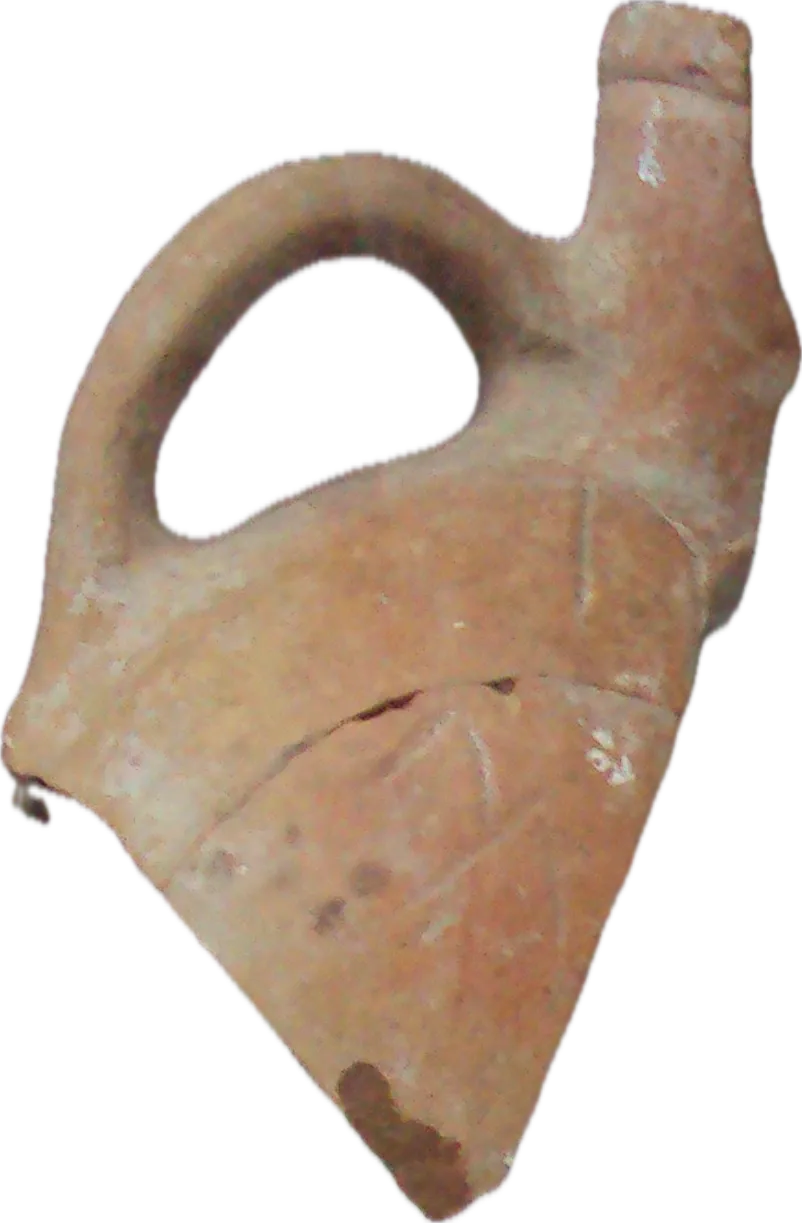
Museum case at Pliska: a broken handled vessel on the left and a ceramic fragment on the right. Exact dates and find contexts of individual objects have not been established.
Full attribution
Photo: Vislupus, Wikimedia Commons, CC BY-SA 4.0. Cut-out detail; background removed.
Fields conceal a vast enclosure. Walls, an inscription and a basilica reveal how Bulgaria’s first capital changed, and where reconstruction begins.
Part 1 · First Tsardom
What does the field conceal?
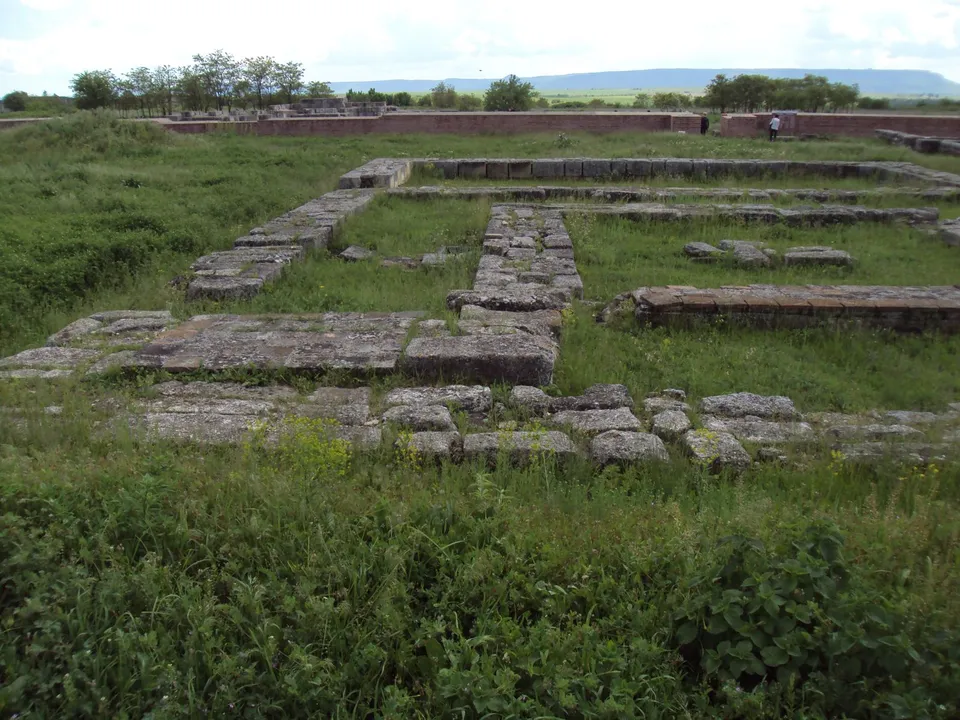
At first glance these are fields near Shumen. Beneath them lie traces of Pliska, the first capital of the early medieval Bulgarian state. An enormous earth rampart encloses about 22 square kilometres. A rampart is a long raised bank of earth. A ditch in front makes crossing harder.
In the areas studied, archaeologists find separate clusters of homes. The large enclosure does not mean the whole area was built over. Its size alone therefore cannot tell us how many people lived here.
Sources · 1
- Roland Filzwieser; Andrey Aladzhov; Jona Schlegel; Alois Hinterleitner; Nives Doneus; Hannes Schiel; Janko Dimitrov; Martin Gamon; Falko Daim; Wolfgang Neubauer Pliska – integrated geophysical prospection of the first Early Medieval Bulgarian capital


Part 2 · First Tsardom
An enclosure within an enclosure
The map marks two places: the palace centre and the Great Basilica. Both stand inside the great earth enclosure.
Near its middle stands a stone fortress. We call it the Inner City. Inside it is a smaller brick enclosure. This separates the citadel, the protected area containing the ruler’s homes.
Outside the stone fortress, but behind the earth rampart, there are more modest homes too. Some are sunken-floor houses: their floors are dug into the ground, with a stone stove in a corner.
- Pliska · Approximate location
- Pliska — Great Basilica · Approximate location
Sources · 1
- Roland Filzwieser; Andrey Aladzhov; Jona Schlegel; Alois Hinterleitner; Nives Doneus; Hannes Schiel; Janko Dimitrov; Martin Gamon; Falko Daim; Wolfgang Neubauer Pliska – integrated geophysical prospection of the first Early Medieval Bulgarian capital
Part 3 · First Tsardom
Who builds the new hall?
The Throne Palace, a hall for the ruler’s receptions, rose over part of an earlier palace. Its construction is traditionally associated with the ruler Omurtag. The hall has an apse, a semicircular recess for the throne.
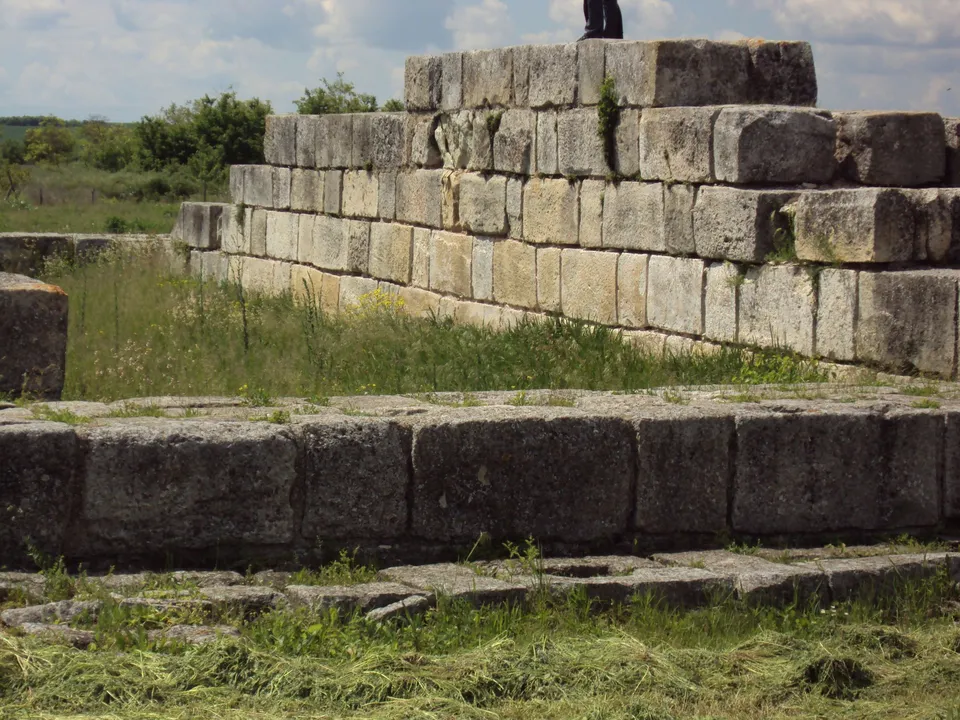
The earlier palace is often linked to the ruler Krum and the fire of 811. But accounts of the campaign do not name Pliska. The photograph shows masonry after conservation: work to protect remains from decay. The photograph alone cannot show who commissioned each wall.
- 1 · Dressed block
- The block has shaped faces. Dressed means worked with tools, rather than simply collected from the ground.
- 2 · Joint
- A joint is the narrow space between two stone blocks.
- 3 · Stone course
- The blocks form a horizontal course. Surviving walls do not all retain their original height.
Sources · 4
- Rasho Rashev; Yanko Dimitrov Pliska – 100 years of archaeological excavations
- Roland Filzwieser; Andrey Aladzhov; Jona Schlegel; Alois Hinterleitner; Nives Doneus; Hannes Schiel; Janko Dimitrov; Martin Gamon; Falko Daim; Wolfgang Neubauer Pliska – integrated geophysical prospection of the first Early Medieval Bulgarian capital
- Valentin Neikov The Grand Palace in Pliska: Conservation and Presentation PDF
- Vislupus Pliska Fortress 030.jpg
Part 4 · First Tsardom
Omurtag leaves words on stone
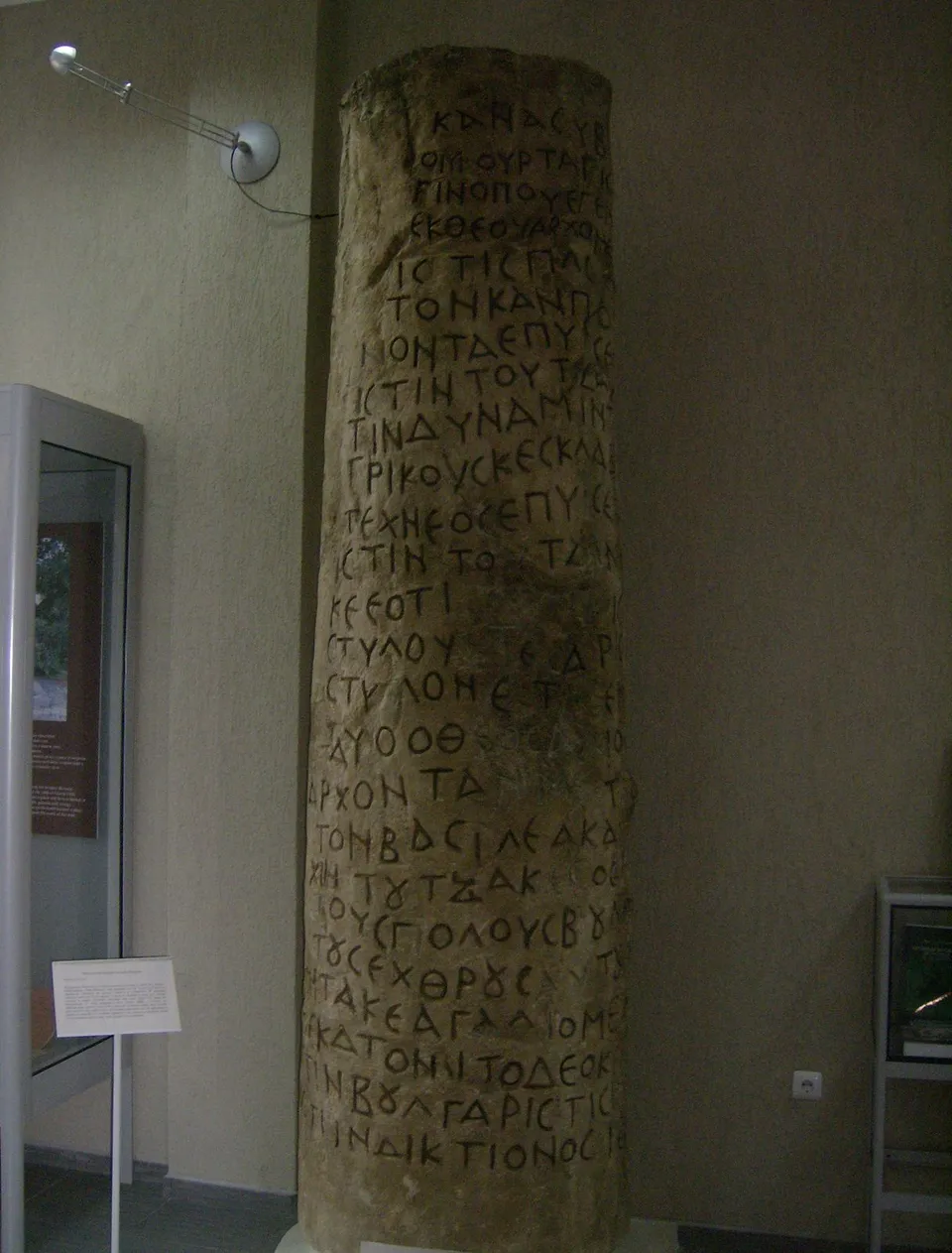
The Chatalar inscription names the ruler Omurtag. It is carved on a limestone column, in Greek. The museum catalogue dates it to about 822. It says the ruler lives in Pliska’s camp and builds another on the Ticha River. Here a camp means an enclosed place for the ruler and army.
This does not describe Pliska’s Throne Palace. The photograph shows a museum copy of the column. The original is at the National Archaeological Museum.
Sources · 2
- National Archaeological Institute with Museum, BAS; editors Metodi Daskalov, Snezhana Goryanova, Milena Raycheva, Galina Grozdanova; entry signed КК (initials as printed) Езическа България. Власт и общество / Pagan Bulgaria. Power and Society PDF
- Izvora Copy of Chatalar Inscription.jpg
Part 5 · First Tsardom
Activity: read the inscription
Where is the new camp mentioned in the inscription?
Why is that?
The ruler resides at Pliska and builds another camp on the Ticha.
Correct · On the Ticha River
- National Archaeological Institute with Museum, BAS; editors Metodi Daskalov, Snezhana Goryanova, Milena Raycheva, Galina Grozdanova; entry signed КК (initials as printed) Езическа България. Власт и общество / Pagan Bulgaria. Power and Society PDF
Sources · 1
- National Archaeological Institute with Museum, BAS; editors Metodi Daskalov, Snezhana Goryanova, Milena Raycheva, Galina Grozdanova; entry signed КК (initials as printed) Езическа България. Власт и общество / Pagan Bulgaria. Power and Society PDF
Part 6 · First Tsardom
A church above a cross-shaped building
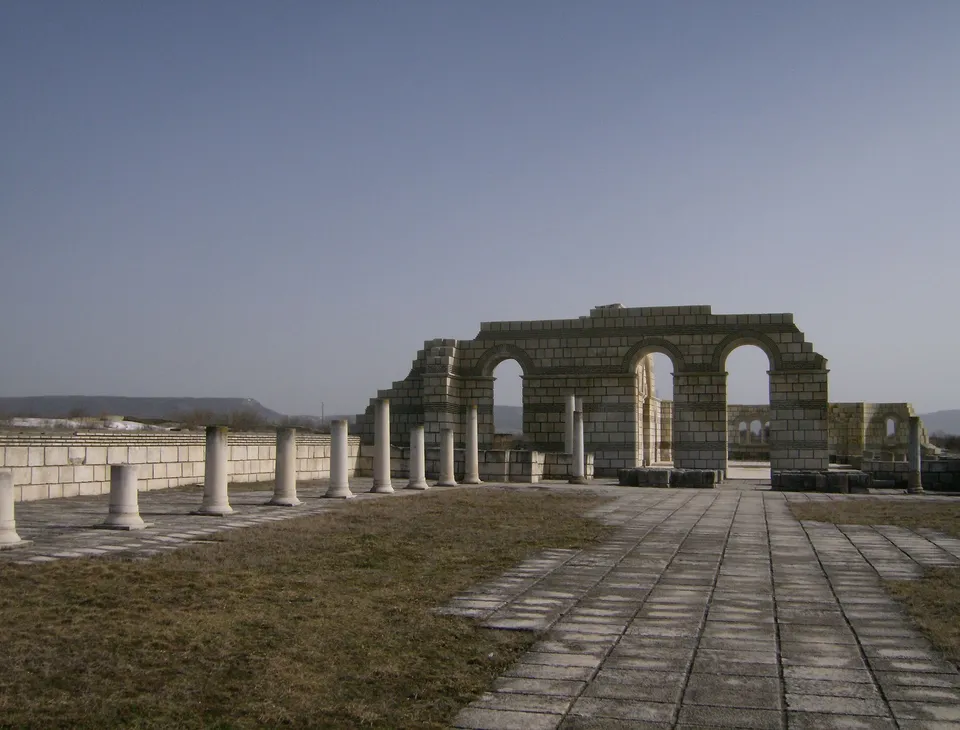
Under the ruler Boris, the state adopts Christianity. Here we use 864 as this period’s beginning. The Great Basilica stands outside the stone fortress, inside the earth enclosure. Here, basilica means a long church. Its spaces form a central nave and two side aisles. Nearby live monks, people devoted to their faith.
Beneath it, archaeologists find an earlier cross-shaped building. What was it for? Suggestions include a church, a temple for non-Christian gods or a building for burials. Its purpose remains disputed.
- 1 · Restored arch
- The tall arch belongs to the modern presentation of the basilica. The restoration project distinguishes ancient remains from new additions.
- 2 · Columns in a row
- The columns help explain the arrangement of space. They are shown after restoration, not as they were found in excavation.
- 3 · Low wall
- There are low walls in the photograph too. The age of each individual block cannot be established from appearance alone.
Sources · 4
- Roland Filzwieser; Andrey Aladzhov; Jona Schlegel; Alois Hinterleitner; Nives Doneus; Hannes Schiel; Janko Dimitrov; Martin Gamon; Falko Daim; Wolfgang Neubauer Pliska – integrated geophysical prospection of the first Early Medieval Bulgarian capital
- Rasho Rashev; Yanko Dimitrov Pliska – 100 years of archaeological excavations
- Théophile Théophilov La Grande Basilique de Pliska. Projet pour sa conservation et sa restauration PDF
- Izvora Old Basilika,Pliska 4.jpg
Part 7 · First Tsardom
Activity: put events in order
Order the events from earliest to latest.
Why is that?
Here we use 864 as the Christian period’s beginning. The inscription comes earlier; the capital’s move comes later.
Correct order
- Omurtag’s inscription
- Christian period begins
- Capital moves
- National Archaeological Institute with Museum, BAS; editors Metodi Daskalov, Snezhana Goryanova, Milena Raycheva, Galina Grozdanova; entry signed КК (initials as printed) Езическа България. Власт и общество / Pagan Bulgaria. Power and Society PDF
- Roland Filzwieser; Andrey Aladzhov; Jona Schlegel; Alois Hinterleitner; Nives Doneus; Hannes Schiel; Janko Dimitrov; Martin Gamon; Falko Daim; Wolfgang Neubauer Pliska – integrated geophysical prospection of the first Early Medieval Bulgarian capital
Sources · 2
- National Archaeological Institute with Museum, BAS; editors Metodi Daskalov, Snezhana Goryanova, Milena Raycheva, Galina Grozdanova; entry signed КК (initials as printed) Езическа България. Власт и общество / Pagan Bulgaria. Power and Society PDF
- Roland Filzwieser; Andrey Aladzhov; Jona Schlegel; Alois Hinterleitner; Nives Doneus; Hannes Schiel; Janko Dimitrov; Martin Gamon; Falko Daim; Wolfgang Neubauer Pliska – integrated geophysical prospection of the first Early Medieval Bulgarian capital
Part 8 · First Tsardom
Radar seeks hidden walls
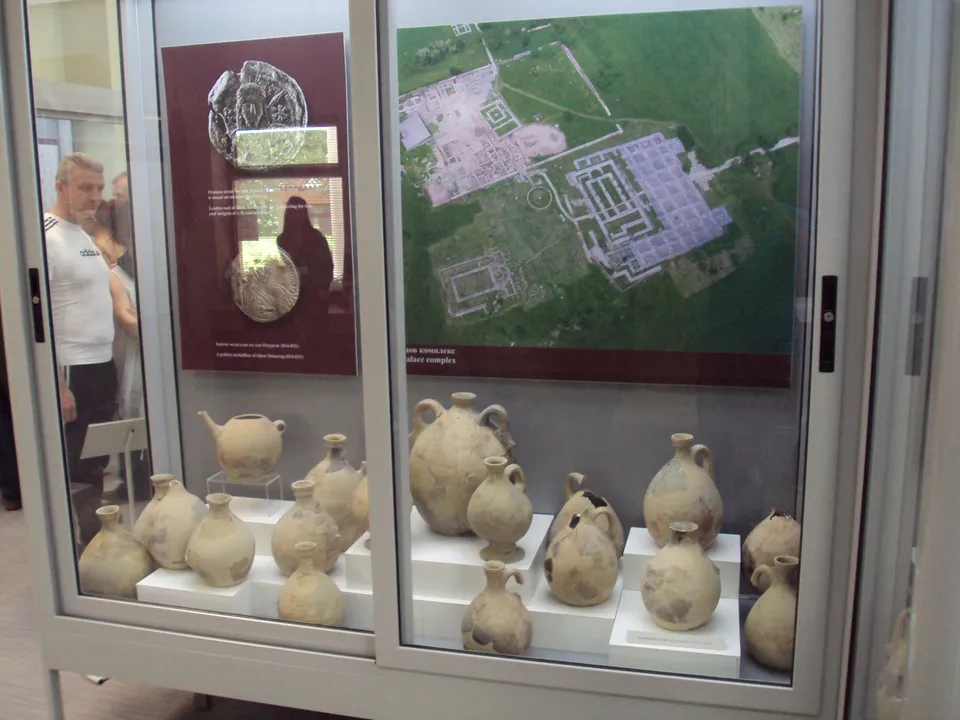
After the capital moves to Preslav in 893, more homes and workshops appear in the Inner City. Buried remains reveal this.
Excavations begin in 1899. In 2016 and 2018, researchers use ground-penetrating radar and magnetic measurements. The radar sends signals underground and records their reflections. Other instruments measure changes in the earth’s magnetic field. These methods seek buried remains without digging. Measurements reveal outlines that still need explaining.
Sources · 2
- Roland Filzwieser; Andrey Aladzhov; Jona Schlegel; Alois Hinterleitner; Nives Doneus; Hannes Schiel; Janko Dimitrov; Martin Gamon; Falko Daim; Wolfgang Neubauer Pliska – integrated geophysical prospection of the first Early Medieval Bulgarian capital
- Vislupus Pliska Museum 019.jpg
Part 9 · First Tsardom
Activity: match the evidence
Match each item with its description in the story.
Why is that?
The rampart is an earth defence. The inscription records building activity. The tall arches show modern restoration.
- Roland Filzwieser; Andrey Aladzhov; Jona Schlegel; Alois Hinterleitner; Nives Doneus; Hannes Schiel; Janko Dimitrov; Martin Gamon; Falko Daim; Wolfgang Neubauer Pliska – integrated geophysical prospection of the first Early Medieval Bulgarian capital
- National Archaeological Institute with Museum, BAS; editors Metodi Daskalov, Snezhana Goryanova, Milena Raycheva, Galina Grozdanova; entry signed КК (initials as printed) Езическа България. Власт и общество / Pagan Bulgaria. Power and Society PDF
- Théophile Théophilov La Grande Basilique de Pliska. Projet pour sa conservation et sa restauration PDF
Sources · 3
- Roland Filzwieser; Andrey Aladzhov; Jona Schlegel; Alois Hinterleitner; Nives Doneus; Hannes Schiel; Janko Dimitrov; Martin Gamon; Falko Daim; Wolfgang Neubauer Pliska – integrated geophysical prospection of the first Early Medieval Bulgarian capital
- National Archaeological Institute with Museum, BAS; editors Metodi Daskalov, Snezhana Goryanova, Milena Raycheva, Galina Grozdanova; entry signed КК (initials as printed) Езическа България. Власт и общество / Pagan Bulgaria. Power and Society PDF
- Théophile Théophilov La Grande Basilique de Pliska. Projet pour sa conservation et sa restauration PDF
A new find for your collection
An excavated remain, a scholarly interpretation and a modern restoration are different kinds of evidence.
People in this story
Sources
- Roland Filzwieser; Andrey Aladzhov; Jona Schlegel; Alois Hinterleitner; Nives Doneus; Hannes Schiel; Janko Dimitrov; Martin Gamon; Falko Daim; Wolfgang Neubauer Pliska – integrated geophysical prospection of the first Early Medieval Bulgarian capital
- National Archaeological Institute with Museum, BAS; editors Metodi Daskalov, Snezhana Goryanova, Milena Raycheva, Galina Grozdanova; entry signed КК (initials as printed) Езическа България. Власт и общество / Pagan Bulgaria. Power and Society PDF
- Valentin Neikov The Grand Palace in Pliska: Conservation and Presentation PDF
- Izvora Old Basilika,Pliska 4.jpg
- Izvora Copy of Chatalar Inscription.jpg
- Vislupus Pliska Fortress 030.jpg
- Vislupus Pliska Museum 019.jpg
- Rasho Rashev; Yanko Dimitrov Pliska – 100 years of archaeological excavations
- Théophile Théophilov La Grande Basilique de Pliska. Projet pour sa conservation et sa restauration PDF
Images
Vislupus · CC BY-SA 4.0 · Wikimedia Commons
Museum case at Pliska: a broken handled vessel on the left and a ceramic fragment on the right. Exact dates and find contexts of individual objects have not been established.
Full attribution
Photo: Vislupus, Wikimedia Commons, CC BY-SA 4.0. Cut-out detail; background removed.
Vislupus · CC BY-SA 4.0 · Wikimedia Commons
Exposed foundations and low walls at Pliska. Modern photograph of a conserved site; the extent of additions is not established.
Full attribution
Photo: Vislupus, Wikimedia Commons, CC BY-SA 4.0. Processed image.
Vislupus · CC BY-SA 4.0 · Wikimedia Commons
Courses of stone at Pliska, photographed after conservation. The image does not establish that every block is in its original position.
Full attribution
Photo: Vislupus, Wikimedia Commons, CC BY-SA 4.0. Processed image.
Izvora · Public domain · Wikimedia Commons
Copy of the Chatalar inscription in Pliska Museum. The story’s text follows the museum catalogue. The original is at the National Archaeological Museum, inventory number 697.
Full attribution
Photo: Izvora, Wikimedia Commons, Public domain. Processed image.
Izvora · Public domain · Wikimedia Commons
Great Basilica at Pliska. The tall arches form part of modern restoration. The columns show an arrangement, not an intact building.
Full attribution
Photo: Izvora, Wikimedia Commons, Public domain. Processed image.
Vislupus · CC BY-SA 4.0 · Wikimedia Commons
Ceramic vessels in Pliska Museum. Arranged for display; the photograph does not show how they were found.
Full attribution
Photo: Vislupus, Wikimedia Commons, CC BY-SA 4.0. Processed image.
Geographic context, without historical borders
Tom Patterson · Nathaniel Vaughn Kelso · Public domain · Natural Earth
Full attribution
Tom Patterson · Nathaniel Vaughn Kelso