 History of Bulgaria
Todor Bozhinov · CC BY-SA 3.0 · Wikimedia Commons
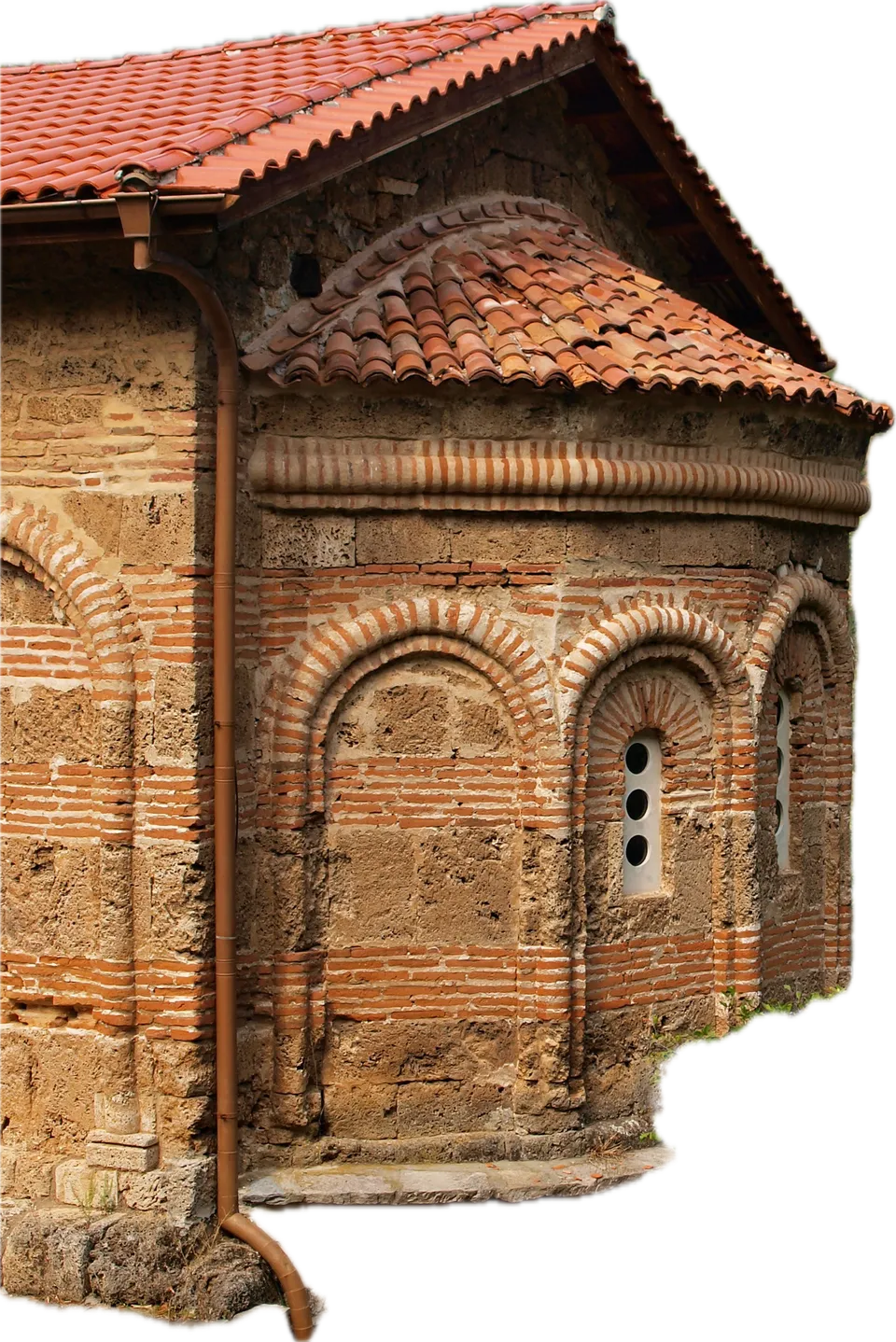
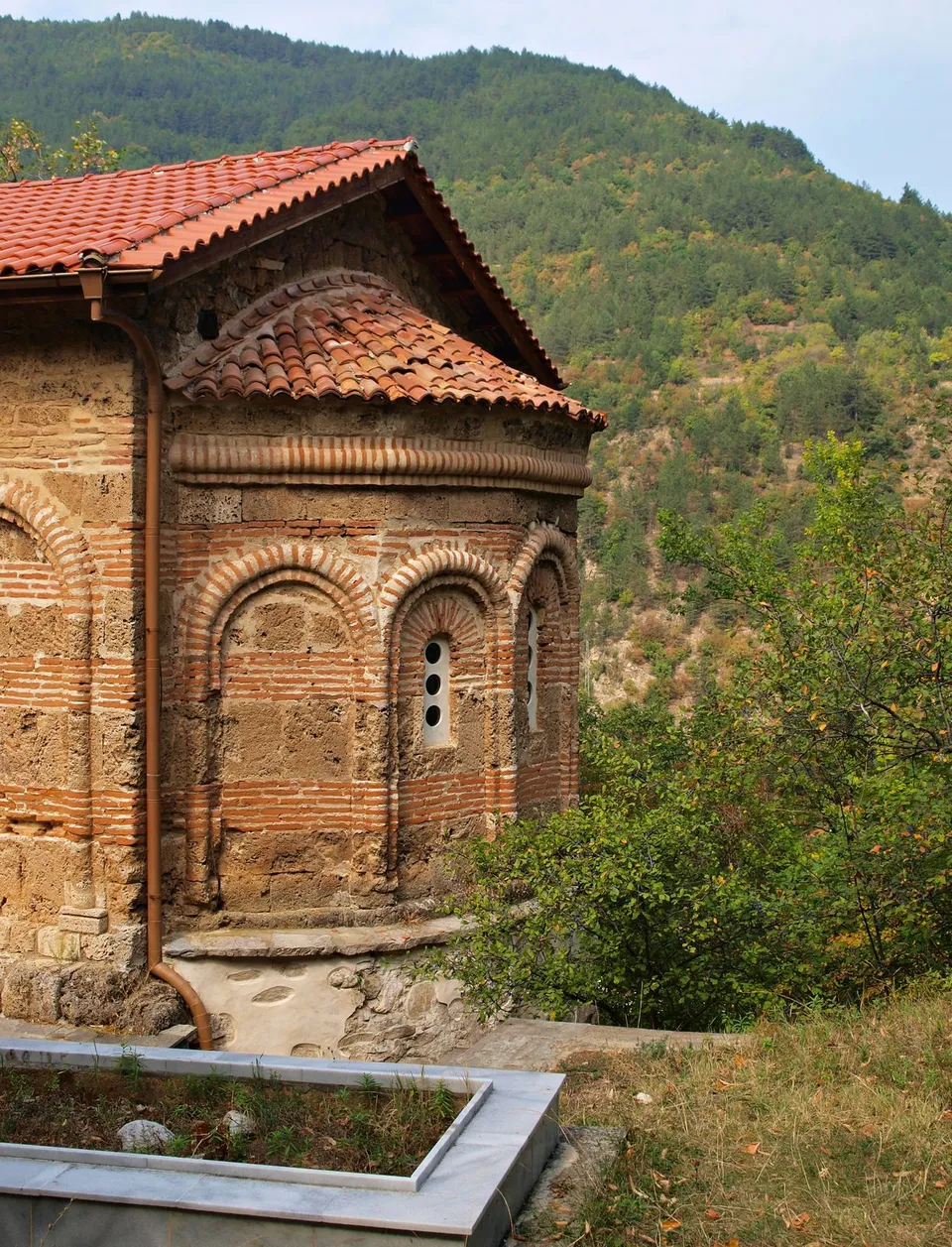
The semicircular projecting part of the ossuary, called an apse. Modern photograph.
Full attribution
Photo: Todor Bozhinov, Wikimedia Commons, CC BY-SA 3.0. Unmodified. Cut-out detail; background removed.
Bachkovo Monastery · Byzantine rule
Gregory writes a rulebook
What rules does Gregory leave for the monks?
Gregory Pakourianos founds a monastery and donates estates inherited from his brother Apasios. His rulebook governs life together. The ossuary and later murals help us distinguish different kinds of evidence.
Part 1 · Byzantine rule
Gregory writes the rules
In 1083, the Byzantine commander Gregory Pakourianos founded a monastery in the Rhodope Mountains. His brother Apasios had already died. Gregory also donated estates he had inherited from Apasios to the monastery.
In the rule, Gregory calls himself Georgian. The monastery was intended for a Georgian community. Gregory wrote a typikon. This is a written rulebook for life together.
Sources · 2
- Gregory Pakourianos; Robert Jordan (translator); John Thomas and Angela Constantinides Hero (editors) 23. Pakourianos: Typikon of Gregory Pakourianos for the Monastery of the Mother of God Petritzonitissa in Bačkovo PDF
- Bachkovo Monastery История на Бачковския манастир


Part 2 · Byzantine rule
The monastery near Plovdiv
The site lies near present-day Asenovgrad, south of Plovdiv. In the rule, the monastery is called Petritzonitissa. The name comes from a nearby fortress. In 1083, this district belonged to the Byzantine Empire.
- Bachkovo Monastery · Approximate location
Sources · 2
- Gregory Pakourianos; Robert Jordan (translator); John Thomas and Angela Constantinides Hero (editors) 23. Pakourianos: Typikon of Gregory Pakourianos for the Monastery of the Mother of God Petritzonitissa in Bačkovo PDF
- Wikimedia contributors Bachkovo Monastery
Part 3 · Byzantine rule
The same bread, different allowances
Gregory prescribed fifty monks, plus a superior: the person leading the community. All were to eat together. Nobody, even the superior, should receive better bread or wine. Necessary assistance was allowed for the sick and very old.
This did not mean equality in everything. Money for clothing and shoes differed according to rank within the community. These are written rules, not proof that everyone always followed them.
Sources · 1
- Gregory Pakourianos; Robert Jordan (translator); John Thomas and Angela Constantinides Hero (editors) 23. Pakourianos: Typikon of Gregory Pakourianos for the Monastery of the Mother of God Petritzonitissa in Bačkovo PDF
Part 4 · Byzantine rule
Bones below, chapel above
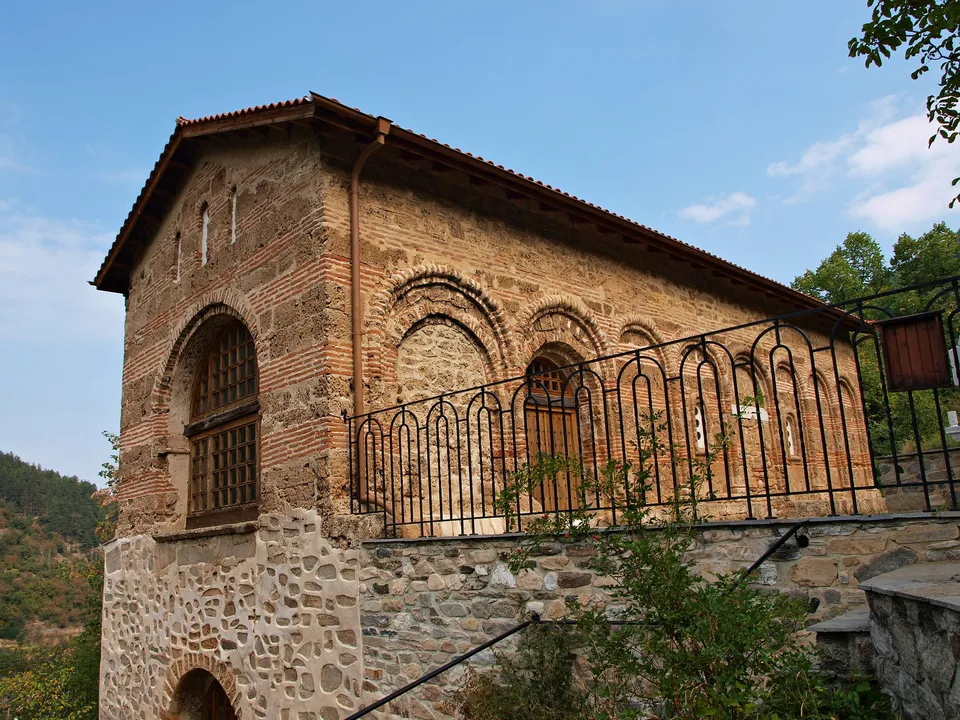
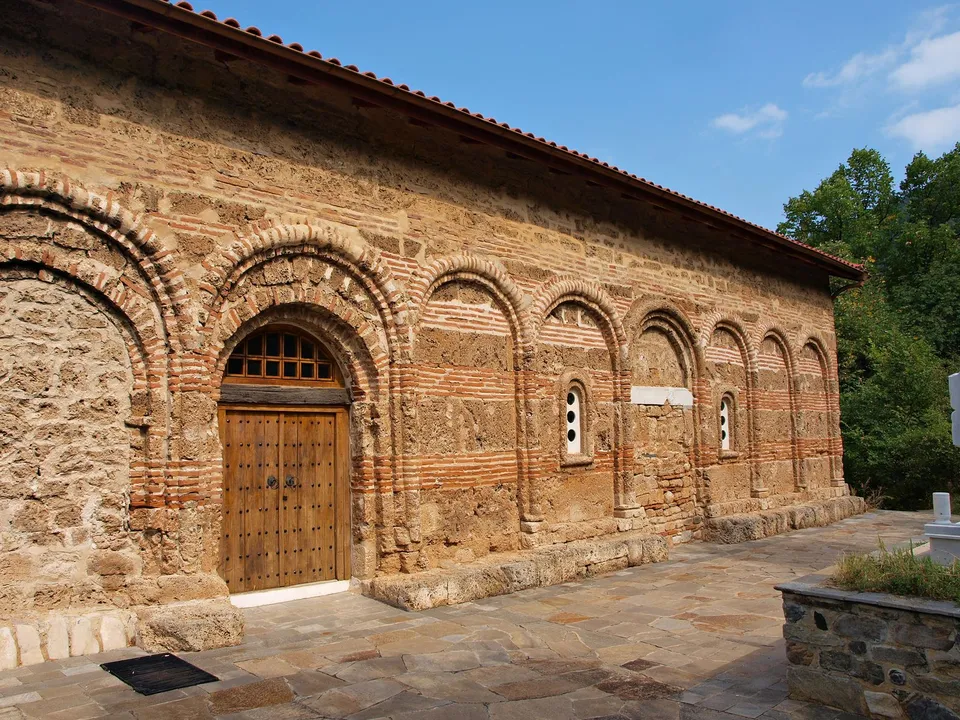
The ossuary is a building for deceased monks’ bones. These were gathered in the lower crypt, a burial space. Above it was a chapel: a small church for funeral services. Below is a painted biblical scene: Ezekiel’s vision of dry bones. One interpretation connects the painted bones with Christian hope of resurrection. Resurrection means the dead returning to life. We do not know for certain when the ossuary was built.
- 1 · The small church above
- The upper floor is a small church for funeral services. The doorway is visible in the photograph; the function comes from the research.
- 2 · The room for bones
- The lower floor held deceased monks’ bones. The photograph shows part of the entrance, not the interior or Ezekiel fresco.
- 3 · A roof from another time
- According to the monastery website, the roof and ceiling were restored in 2001. Not everything on an old building is medieval.
Sources · 4
- Jakov Đorđević The Ossuary of the Bachkovo Monastery
- Jakov Đorđević Experiencing Resurrection: Persuasive Narrative of the Pictorial Program in the Ossuary of the Bachkovo Monastery
- Bachkovo Monastery Манастирска костница
- Gregory Pakourianos; Robert Jordan (translator); John Thomas and Angela Constantinides Hero (editors) 23. Pakourianos: Typikon of Gregory Pakourianos for the Monastery of the Mother of God Petritzonitissa in Bačkovo PDF
Part 5 · Byzantine rule
Activity: what a rule proves
What do we learn from the rule about the common table?
Why is that?
The rule prescribes shared food. This is evidence of the founder’s intention.
Correct · The order Gregory wanted.
- Gregory Pakourianos; Robert Jordan (translator); John Thomas and Angela Constantinides Hero (editors) 23. Pakourianos: Typikon of Gregory Pakourianos for the Monastery of the Mother of God Petritzonitissa in Bačkovo PDF
Sources · 1
- Gregory Pakourianos; Robert Jordan (translator); John Thomas and Angela Constantinides Hero (editors) 23. Pakourianos: Typikon of Gregory Pakourianos for the Monastery of the Mother of God Petritzonitissa in Bačkovo PDF
Part 6 · Byzantine rule
The monastery on the wall
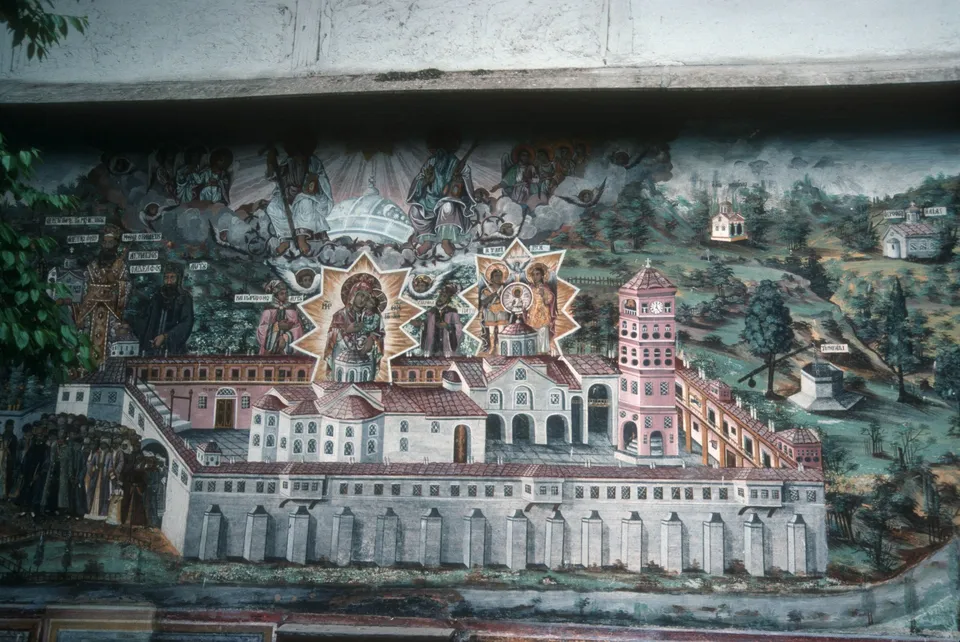
The panorama mural covers the wall of the refectory, the communal dining hall. It dates from the mid-nineteenth century. The painter also used an earlier engraving, a printed image. Buildings, a procession and sacred figures appear together. The panorama can be read as a story about the monastery’s past. It does not show the monastery in 1083.
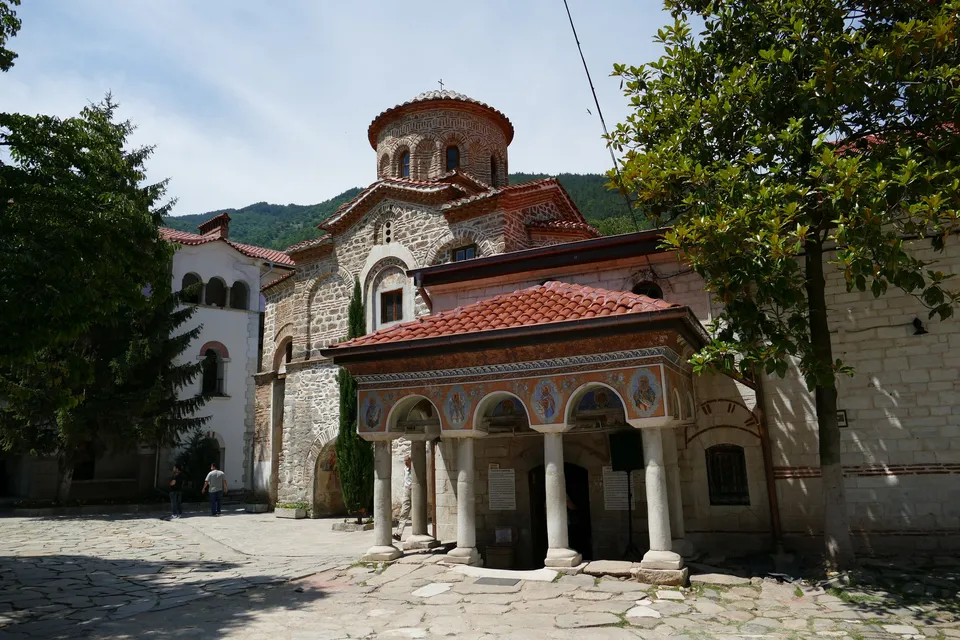
The main church in the separate photograph was built in 1604. Its narthex, the entrance room, has murals from 1643. Images and buildings have different ages.
- 1 · A painted monastery
- Buildings in a panorama mural from the mid-nineteenth century. This is not a direct view of the monastery in 1083.
- 2 · The procession
- A procession of figures appears at lower left. The panorama combines people, buildings and sacred images; it is an artistic narrative.
- 3 · Images above the buildings
- Sacred figures are placed above the architecture. This is a painter’s composition, not a scale architectural plan.
Sources · 3
- Gregory Pakourianos; Robert Jordan (translator); John Thomas and Angela Constantinides Hero (editors) 23. Pakourianos: Typikon of Gregory Pakourianos for the Monastery of the Mother of God Petritzonitissa in Bačkovo PDF
- Бачковска света обител Нова реставрация в Бачковския манастир
- Bachkovo Monastery Панорамен стенопис
Part 7 · Byzantine rule
Activity: three different times
Put the events in order, earliest first.
Why is that?
The rule predates the new church by centuries. The narthex murals are later than the church’s construction.
Correct order
- Writing the rule
- Building the main church
- Painting the narthex murals
- Gregory Pakourianos; Robert Jordan (translator); John Thomas and Angela Constantinides Hero (editors) 23. Pakourianos: Typikon of Gregory Pakourianos for the Monastery of the Mother of God Petritzonitissa in Bačkovo PDF
- Бачковска света обител Нова реставрация в Бачковския манастир
Sources · 2
- Gregory Pakourianos; Robert Jordan (translator); John Thomas and Angela Constantinides Hero (editors) 23. Pakourianos: Typikon of Gregory Pakourianos for the Monastery of the Mother of God Petritzonitissa in Bačkovo PDF
- Бачковска света обител Нова реставрация в Бачковския манастир
Part 8 · Byzantine rule
Copies preserve the rule
The rule of 1083 reaches us through copies. The signed original has not survived. The rule’s conclusion names three languages: Greek, Georgian and Armenian.
Gregory forbade changing or removing the rules. Copies preserve his text: how to share food and protect common property. It also gives rules for commemoration: remembering the dead in prayer. Stone, painting and document tell different parts of this history.
Sources · 2
- Gregory Pakourianos; Robert Jordan (translator); John Thomas and Angela Constantinides Hero (editors) 23. Pakourianos: Typikon of Gregory Pakourianos for the Monastery of the Mother of God Petritzonitissa in Bačkovo PDF
- Bachkovo Monastery История на Бачковския манастир
Part 9 · Byzantine rule
Activity: match the evidence
Match each piece of evidence with its description.
Why is that?
The text prescribes rules, the building serves remembrance of the dead, and the panorama depicts the monastery’s later life.
- Gregory Pakourianos; Robert Jordan (translator); John Thomas and Angela Constantinides Hero (editors) 23. Pakourianos: Typikon of Gregory Pakourianos for the Monastery of the Mother of God Petritzonitissa in Bačkovo PDF
- Jakov Đorđević The Ossuary of the Bachkovo Monastery
- Bachkovo Monastery Панорамен стенопис
Sources · 3
- Gregory Pakourianos; Robert Jordan (translator); John Thomas and Angela Constantinides Hero (editors) 23. Pakourianos: Typikon of Gregory Pakourianos for the Monastery of the Mother of God Petritzonitissa in Bačkovo PDF
- Jakov Đorđević The Ossuary of the Bachkovo Monastery
- Bachkovo Monastery Панорамен стенопис
A new find for your collection
The rule of 1083 is known through copies. Buildings and paintings preserve traces of different centuries.
People in this story
Sources
- Wikimedia contributors Bachkovo Monastery
- Jakov Đorđević Experiencing Resurrection: Persuasive Narrative of the Pictorial Program in the Ossuary of the Bachkovo Monastery
- Bachkovo Monastery История на Бачковския манастир
- Bachkovo Monastery Манастирска костница
- Jakov Đorđević The Ossuary of the Bachkovo Monastery
- Bachkovo Monastery Панорамен стенопис
- Бачковска света обител Нова реставрация в Бачковския манастир
- Gregory Pakourianos; Robert Jordan (translator); John Thomas and Angela Constantinides Hero (editors) 23. Pakourianos: Typikon of Gregory Pakourianos for the Monastery of the Mother of God Petritzonitissa in Bačkovo PDF
- Bulgarian Patriarchate Бачковски манастир „Св. Успение Богородично“
Images
Todor Bozhinov · CC BY-SA 3.0 · Wikimedia Commons
The semicircular projecting part of the ossuary, called an apse. Modern photograph.
Full attribution
Photo: Todor Bozhinov, Wikimedia Commons, CC BY-SA 3.0. Unmodified. Cut-out detail; background removed.
Todor Bozhinov / Тодор Божинов · CC BY-SA 3.0 · Wikimedia Commons
The ossuary: two levels. Modern photograph.
Full attribution
Photo: Todor Bozhinov / Тодор Божинов, Wikimedia Commons, CC BY-SA 3.0. Unmodified. Processed image.
Todor Bozhinov / Тодор Божинов · CC BY-SA 3.0 · Wikimedia Commons
Side wall of the ossuary. Modern photograph.
Full attribution
Photo: Todor Bozhinov / Тодор Божинов, Wikimedia Commons, CC BY-SA 3.0. Unmodified. Processed image.
JERRYE AND ROY KLOTZ MD · CC BY-SA 3.0 · Wikimedia Commons
Modern photograph of a panorama mural from the mid-nineteenth century.
Full attribution
Photo: JERRYE AND ROY KLOTZ MD, Wikimedia Commons, CC BY-SA 3.0. Unmodified. Processed image.
Kritzolina · CC BY-SA 4.0 · Wikimedia Commons
Modern photograph of the main church, built in 1604. Its narthex, the entrance room, has murals from 1643.
Full attribution
Photo: Kritzolina, Wikimedia Commons, CC BY-SA 4.0. Unmodified. Processed image.
Todor Bozhinov · CC BY-SA 3.0 · Wikimedia Commons
The semicircular projecting part of the ossuary, called an apse. Modern photograph.
Full attribution
Photo: Todor Bozhinov, Wikimedia Commons, CC BY-SA 3.0. Unmodified. Processed image.
Geographic context, without historical borders
Tom Patterson · Nathaniel Vaughn Kelso · Public domain · Natural Earth
Full attribution
Tom Patterson · Nathaniel Vaughn Kelso