 History of Bulgaria
Vassia Atanassova - Spiritia · Public domain · Wikimedia Commons
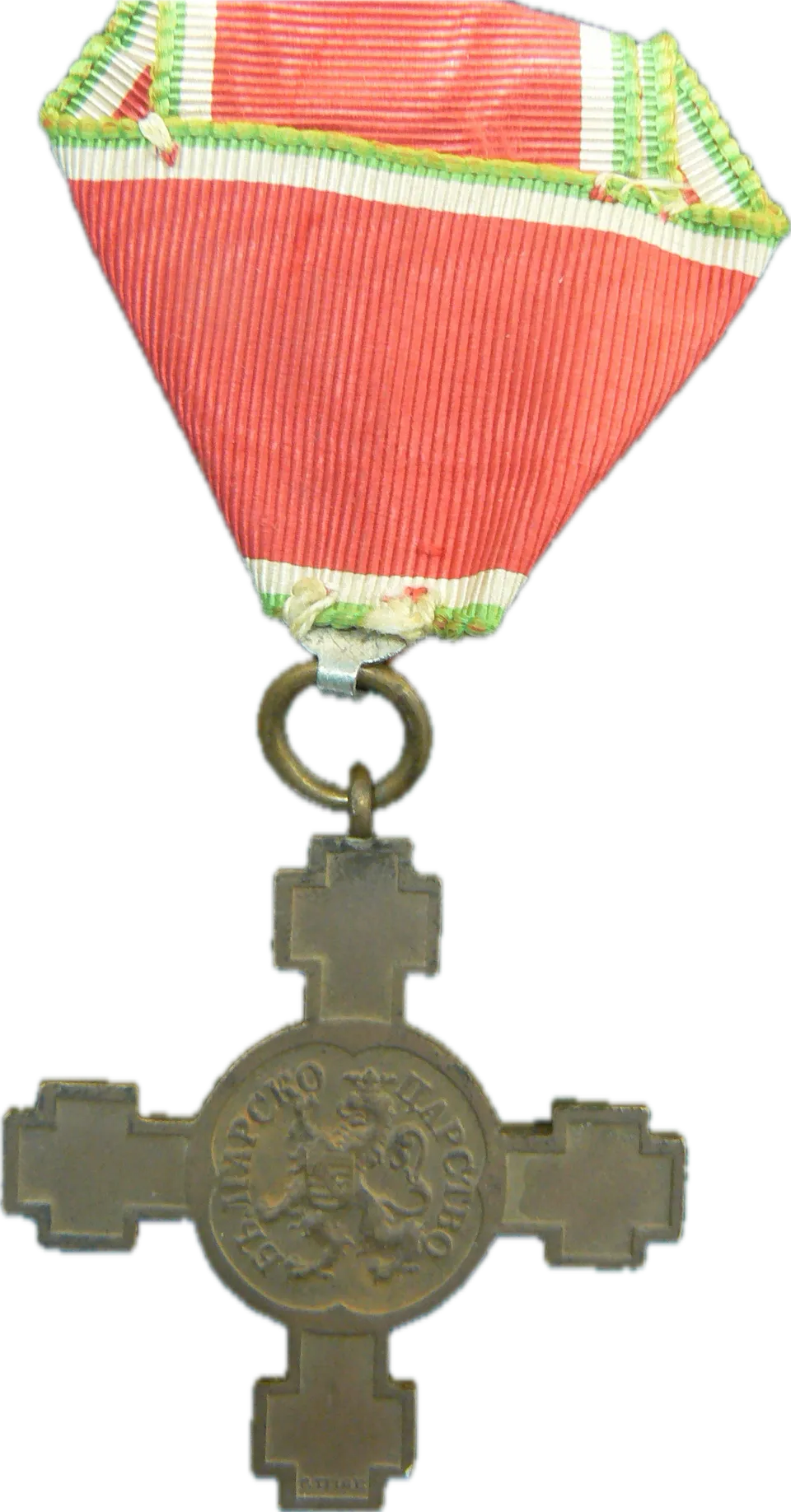
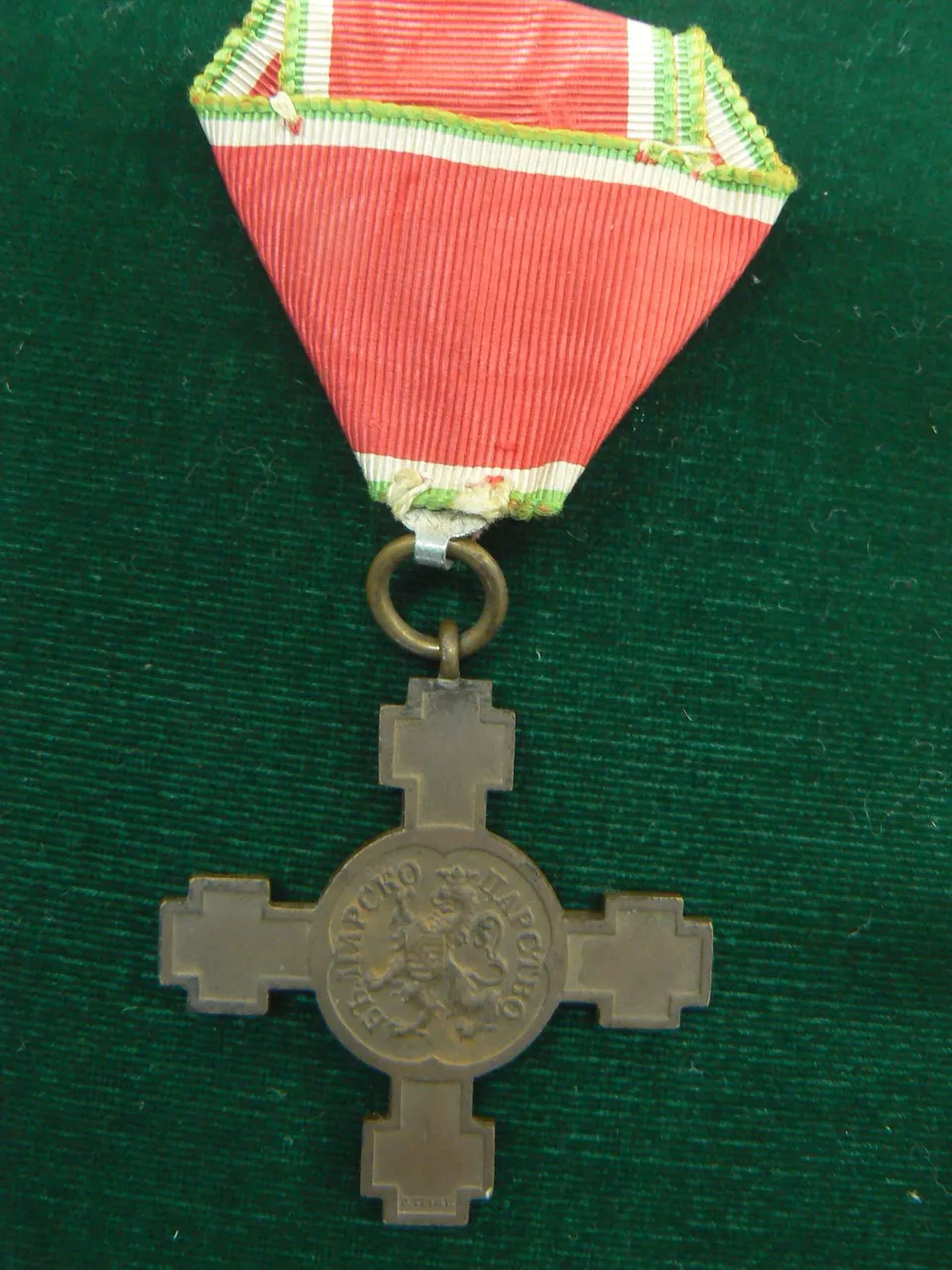
Commemorative independence cross, opposite side. Commons describes it as a decoration of 1909. The story’s sources do not establish this specimen’s manufacture date. Photographed in 2010 at the Vratsa Regional History Museum.
Full attribution
Photo: Vassia Atanassova – Spiritia, Wikimedia Commons. Public domain. Cut-out detail; background removed.
Bulgarian independence 1908 · 20th century
How Ferdinand became Tsar
Why does the prince declare independence?
A treaty leaves Bulgaria dependent on the Sultan. A strike, a manifesto and negotiations change its status.
Part 1 · 20th century
A prince, a parliament and a tax
Bulgaria has a prince, a parliament and an army. Parliament is an assembly of representatives that helps make laws. The prince heads the state. Why declare independence in 1908?
The 1878 Berlin treaty defines Bulgaria as an autonomous principality, a state ruled by a prince. “Autonomous” means it runs its internal affairs. Yet it remains under the Ottoman Sultan, ruler of the Ottoman Empire. The treaty requires Bulgaria to pay him a tax. In 1908 this dependence has still not been removed.
Sources · 3
- Great Britain, Austria-Hungary, France, Germany, Italy, Russia and the Ottoman Empire; transmitted by Horace Maynard Treaty of Berlin, 13 July (English translation); enclosure to Maynard to Evarts, 28 September
- Учредително народно събрание; Народно събрание на Република България (digital edition) Конституция на Българското княжество PDF
- Национален военноисторически музей Обявяване на независимостта на България – 1908 г.


Part 2 · 20th century
The two parts unite
South of the Balkan Mountains, the treaty creates Eastern Rumelia. This province has its own local government, but remains under the Sultan’s direct authority. In 1885 it unites with the Bulgarian principality. The two parts are now governed together. But under the treaty, Bulgaria remains under the Sultan’s authority.
- Holy Forty Martyrs Church · Approximate location
- Constantinople · Approximate location
Sources · 5
- Great Britain, Austria-Hungary, France, Germany, Italy, Russia and the Ottoman Empire; transmitted by Horace Maynard Treaty of Berlin, 13 July (English translation); enclosure to Maynard to Evarts, 28 September
- Council of Ministers of the Republic of Bulgaria History
- Russian, Ottoman and Bulgarian governments; Jean-Pierre Maury (digital compilation) Indépendance de la Bulgarie, 1908: proclamation et protocoles
- Община Велико Търново Държавата предоставя църквата „Св. Четиридесет мъченици“
- Powerfox File:Holy Forty Martyrs Church, Veliko Tarnovo.jpg
Part 3 · 20th century
Activity: what is still missing?
What still limits Bulgaria after unification in 1885?
Why is that?
The two parts are governed together, but the Sultan’s authority under the treaty remains until independence is proclaimed.
Correct · The Sultan’s authority
- Great Britain, Austria-Hungary, France, Germany, Italy, Russia and the Ottoman Empire; transmitted by Horace Maynard Treaty of Berlin, 13 July (English translation); enclosure to Maynard to Evarts, 28 September
- Council of Ministers of the Republic of Bulgaria History
Sources · 2
- Great Britain, Austria-Hungary, France, Germany, Italy, Russia and the Ottoman Empire; transmitted by Horace Maynard Treaty of Berlin, 13 July (English translation); enclosure to Maynard to Evarts, 28 September
- Council of Ministers of the Republic of Bulgaria History
Part 4 · 20th century
Who controls the rails?
In September 1908, Eastern Railways employees go on strike. Some lines lie in Bulgaria. But the treaty preserves Ottoman rights over them. The Bulgarian state takes control and sends railway workers and soldiers. The railway dispute can also be understood as a dispute over state authority.
Aleksandar Malinov, the head of government, presses for action. The government decides to declare independence.
Sources · 3
- Национален военноисторически музей Обявяване на независимостта на България – 1908 г.
- Николай Гълъбов Роля и развитие на обществения сектор в областта на транспортната инфраструктура на България (1879–1947 г.) PDF
- Great Britain, Austria-Hungary, France, Germany, Italy, Russia and the Ottoman Empire; transmitted by Horace Maynard Treaty of Berlin, 13 July (English translation); enclosure to Maynard to Evarts, 28 September
Part 5 · 20th century
Ferdinand reads the manifesto
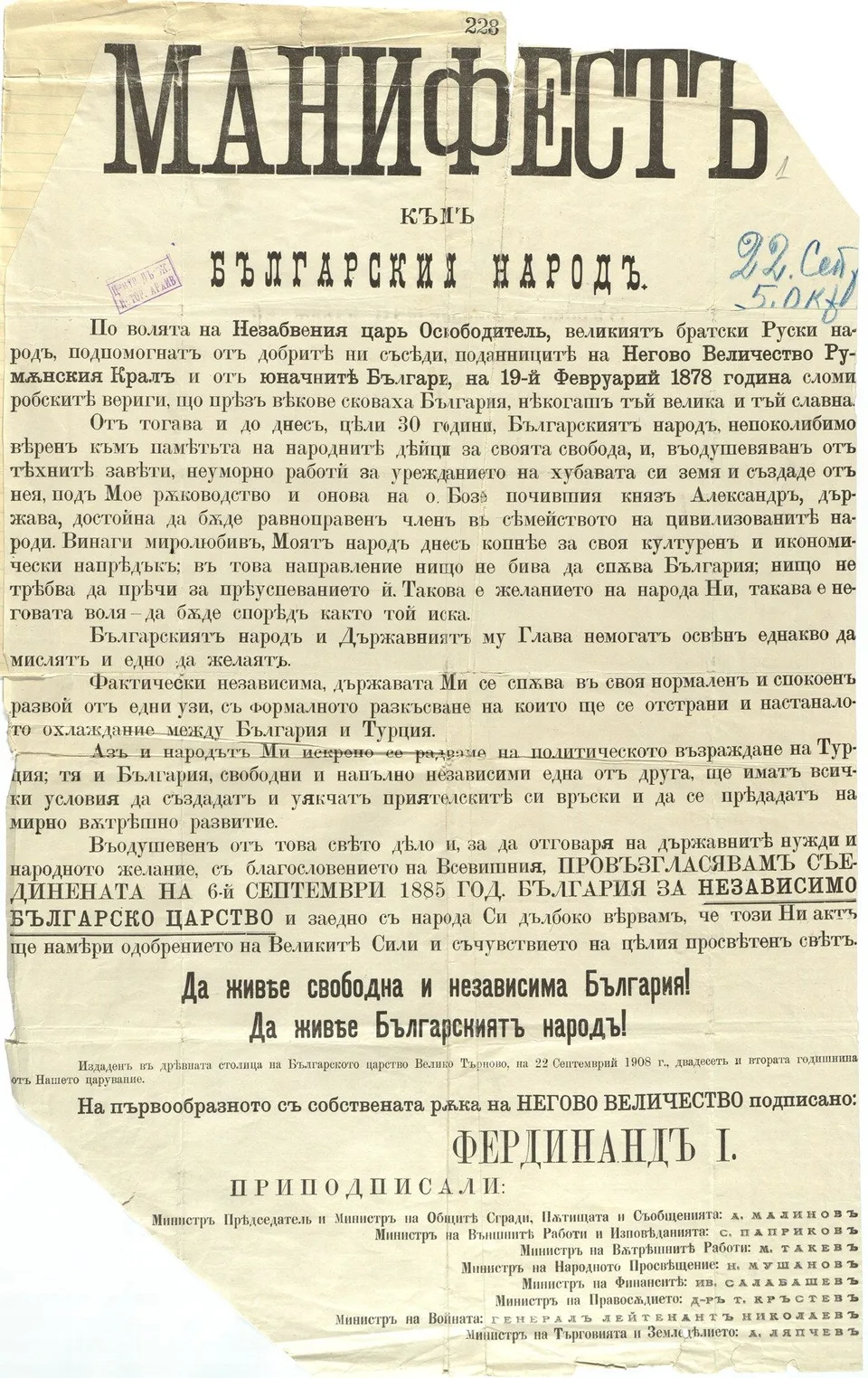
On 22 September 1908 in Bulgaria’s calendar of the time, Ferdinand reads the manifesto. This happens in the Holy Forty Martyrs Church in Tarnovo. A manifesto is a public address announcing an important decision. Bulgaria is proclaimed an independent kingdom. Ferdinand takes the title tsar, meaning the kingdom’s ruler.
Then Malinov reads it to the people on Tsarevets hill.
- 1 · Manifesto
- This is a printed sheet. The story’s sources do not establish whether Ferdinand read from this exact sheet.
- 2 · Independent kingdom
- Here is the decision: united Bulgaria is proclaimed an independent kingdom.
- 3 · Ferdinand and the ministers
- Below Ferdinand’s name are the ministers’ printed names, including Prime Minister Aleksandar Malinov.
Sources · 5
- Национален военноисторически музей Обявяване на независимостта на България – 1908 г.
- Стефан Паприков; Horace G. Knowles (forwarding dispatch) The Minister for Foreign Affairs to Minister Knowles, Tirnovo, 5 October; enclosure to Knowles to the Secretary of State, 6 October
- Russian, Ottoman and Bulgarian governments; Jean-Pierre Maury (digital compilation) Indépendance de la Bulgarie, 1908: proclamation et protocoles
- Ferdinand I (text); Bulgarian Archives State Agency (digital copy) File:BASA-143K-1-124-1-Bulgarian Indipendence Manifesto 1908.jpg
- Столична библиотека 22 септември – Ден на независимостта на България
Part 6 · 20th century
Activity: put the decisions in order
Put the events in order, earliest first.
Why is that?
The treaty precedes unification. The strike and takeover of the lines come before the manifesto is read.
Correct order
- Treaty of Berlin
- Unification
- Railway strike
- Independence manifesto
- Great Britain, Austria-Hungary, France, Germany, Italy, Russia and the Ottoman Empire; transmitted by Horace Maynard Treaty of Berlin, 13 July (English translation); enclosure to Maynard to Evarts, 28 September
- Council of Ministers of the Republic of Bulgaria History
- Национален военноисторически музей Обявяване на независимостта на България – 1908 г.
- Russian, Ottoman and Bulgarian governments; Jean-Pierre Maury (digital compilation) Indépendance de la Bulgarie, 1908: proclamation et protocoles
Sources · 4
- Great Britain, Austria-Hungary, France, Germany, Italy, Russia and the Ottoman Empire; transmitted by Horace Maynard Treaty of Berlin, 13 July (English translation); enclosure to Maynard to Evarts, 28 September
- Council of Ministers of the Republic of Bulgaria History
- Национален военноисторически музей Обявяване на независимостта на България – 1908 г.
- Russian, Ottoman and Bulgarian governments; Jean-Pierre Maury (digital compilation) Indépendance de la Bulgarie, 1908: proclamation et protocoles
Part 7 · 20th century
Other states must respond
The manifesto announces a decision, but cannot oblige other states to recognise it. Minister Stefan Paprikov informs foreign representatives and seeks support for the declared independence. The Ottoman government and the Great Powers do not recognise it immediately. Negotiations follow. Proclamation and international recognition are therefore different events.
Sources · 3
- Стефан Паприков; Horace G. Knowles (forwarding dispatch) The Minister for Foreign Affairs to Minister Knowles, Tirnovo, 5 October; enclosure to Knowles to the Secretary of State, 6 October
- Russian, Ottoman and Bulgarian governments; Jean-Pierre Maury (digital compilation) Indépendance de la Bulgarie, 1908: proclamation et protocoles
- Национален военноисторически музей Обявяване на независимостта на България – 1908 г.
Part 8 · 20th century
Two states sign an agreement
The Ottoman government and the Great Powers, the large influential states, do not immediately recognise independence. Negotiations follow.
On 6 April 1909 in the old calendar, Bulgaria and the Ottoman Empire sign a protocol: a written agreement. In the new calendar, the date is 19 April. Through it, the Ottoman government recognises Bulgaria’s independence. The document promises religious freedom and equal rights to Muslims, followers of Islam. The Great Powers also give recognition, as does the United States that year.
Sources · 7
- Russian, Ottoman and Bulgarian governments; Jean-Pierre Maury (digital compilation) Indépendance de la Bulgarie, 1908: proclamation et protocoles
- Norman Hutchinson Chargé Hutchinson to the Secretary of State, 30 April
- Philander C. Knox, U.S. Department of State The Secretary of State to Chargé Hutchinson, 3 May
- Office of the Historian, U.S. Department of State A Guide to the United States’ History of Recognition, Diplomatic, and Consular Relations, by Country, since 1776: Bulgaria
- Министерство на външните работи на Република България Съединени американски щати (САЩ)
- Vassia Atanassova - Spiritia File:Bulgarian Commemorative Cross of the Independence of Bulgaria 1909 front.jpg
- Vassia Atanassova - Spiritia File:Bulgarian Commemorative Cross of the Independence of Bulgaria 1909 back.jpg
Part 9 · 20th century
Activity: person, document, object
Match each person or object to its role in the story.
Why is that?
Ferdinand and Malinov read in different places. The protocol settles recognition; the cross commemorates the event.
- Национален военноисторически музей Обявяване на независимостта на България – 1908 г.
- Russian, Ottoman and Bulgarian governments; Jean-Pierre Maury (digital compilation) Indépendance de la Bulgarie, 1908: proclamation et protocoles
- Vassia Atanassova - Spiritia File:Bulgarian Commemorative Cross of the Independence of Bulgaria 1909 front.jpg
Sources · 3
- Национален военноисторически музей Обявяване на независимостта на България – 1908 г.
- Russian, Ottoman and Bulgarian governments; Jean-Pierre Maury (digital compilation) Indépendance de la Bulgarie, 1908: proclamation et protocoles
- Vassia Atanassova - Spiritia File:Bulgarian Commemorative Cross of the Independence of Bulgaria 1909 front.jpg
A new find for your collection
The proclamation of independence in 1908 is followed by international recognition in 1909.
People in this story
Sources
- Николай Гълъбов Роля и развитие на обществения сектор в областта на транспортната инфраструктура на България (1879–1947 г.) PDF
- Great Britain, Austria-Hungary, France, Germany, Italy, Russia and the Ottoman Empire; transmitted by Horace Maynard Treaty of Berlin, 13 July (English translation); enclosure to Maynard to Evarts, 28 September
- Учредително народно събрание; Народно събрание на Република България (digital edition) Конституция на Българското княжество PDF
- Norman Hutchinson Chargé Hutchinson to the Secretary of State, 30 April
- Philander C. Knox, U.S. Department of State The Secretary of State to Chargé Hutchinson, 3 May
- Council of Ministers of the Republic of Bulgaria History
- Столична библиотека 22 септември – Ден на независимостта на България
- Министерство на външните работи на Република България Съединени американски щати (САЩ)
- Национален военноисторически музей Обявяване на независимостта на България – 1908 г.
- Стефан Паприков; Horace G. Knowles (forwarding dispatch) The Minister for Foreign Affairs to Minister Knowles, Tirnovo, 5 October; enclosure to Knowles to the Secretary of State, 6 October
- Powerfox File:Holy Forty Martyrs Church, Veliko Tarnovo.jpg
- Vassia Atanassova - Spiritia File:Bulgarian Commemorative Cross of the Independence of Bulgaria 1909 back.jpg
- Vassia Atanassova - Spiritia File:Bulgarian Commemorative Cross of the Independence of Bulgaria 1909 front.jpg
- Ferdinand I (text); Bulgarian Archives State Agency (digital copy) File:BASA-143K-1-124-1-Bulgarian Indipendence Manifesto 1908.jpg
- Russian, Ottoman and Bulgarian governments; Jean-Pierre Maury (digital compilation) Indépendance de la Bulgarie, 1908: proclamation et protocoles
- Община Велико Търново Държавата предоставя църквата „Св. Четиридесет мъченици“
- Office of the Historian, U.S. Department of State A Guide to the United States’ History of Recognition, Diplomatic, and Consular Relations, by Country, since 1776: Bulgaria
Images
Vassia Atanassova - Spiritia · Public domain · Wikimedia Commons
Commemorative independence cross, opposite side. Commons describes it as a decoration of 1909. The story’s sources do not establish this specimen’s manufacture date. Photographed in 2010 at the Vratsa Regional History Museum.
Full attribution
Photo: Vassia Atanassova – Spiritia, Wikimedia Commons. Public domain. Cut-out detail; background removed.
Archive
Photographer not established · Public domain · Wikimedia Commons
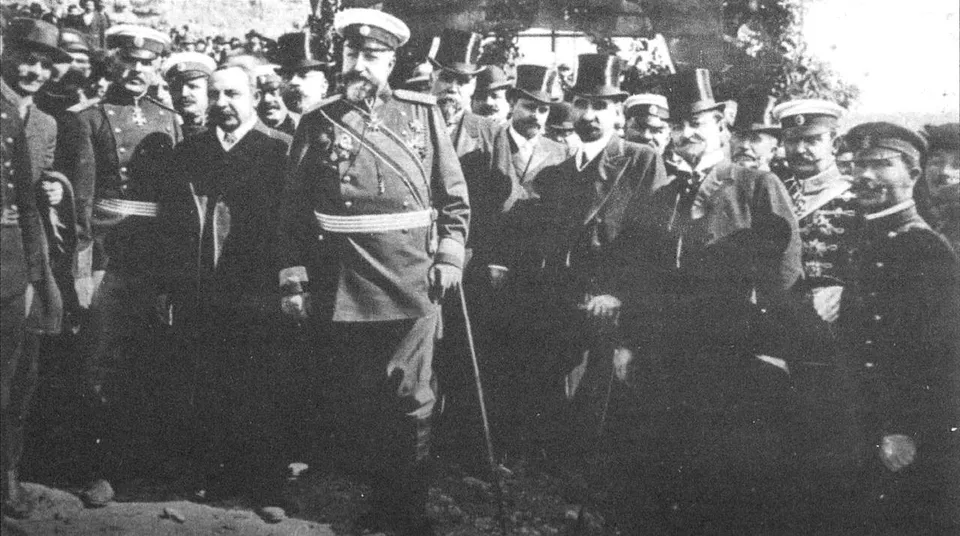
Archival photograph from Tarnovo, 1908. It does not show the reading inside the church.
Full attribution
The photographer is not established. Source: Wikimedia Commons, credit БИА (Bulgarian Historical Archive). Commons states Public domain. Processed image. Archival photograph
Powerfox · CC BY-SA 4.0 · Wikimedia Commons
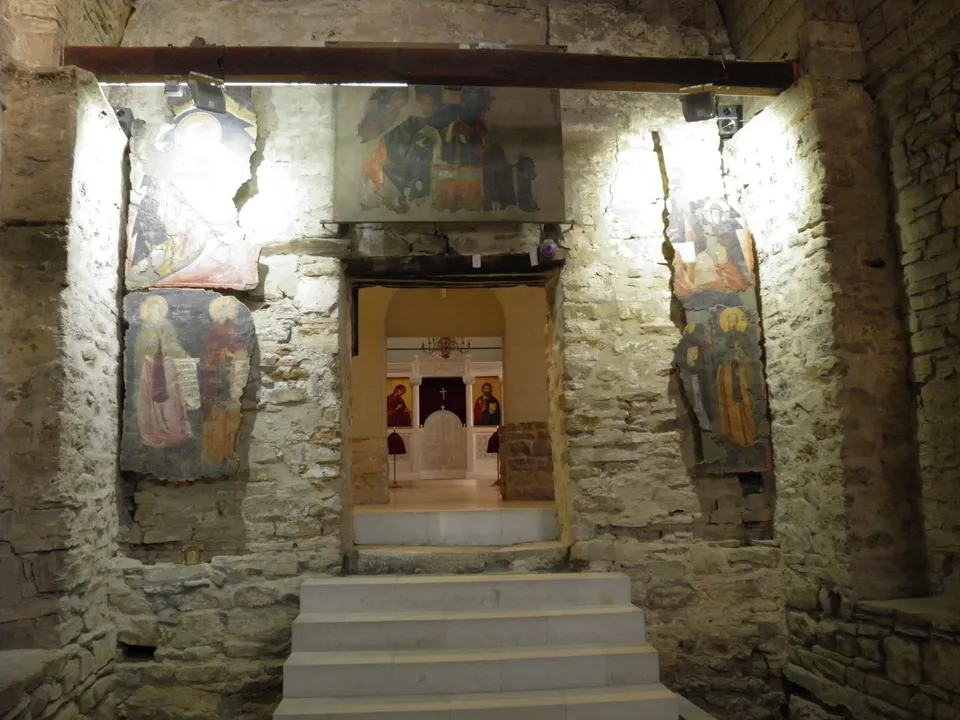
Interior in 2016, after the church’s restoration in 2006. The photograph does not reproduce the exact setting of 1908.
Full attribution
Photo: Powerfox, Wikimedia Commons, CC BY-SA 4.0. Unmodified. Processed image.
Ferdinand I · Public domain · Bulgarian Archives State Agency, 143К/1/124/1; via Wikimedia Commons
This is a printed sheet. The story’s sources do not establish whether Ferdinand read from this exact sheet.
Full attribution
Text: manifesto of Ferdinand I. Copy: Bulgarian Archives State Agency, fonds 143К, inventory 1, archival unit 124, sheet 1; via Wikimedia Commons. Public domain. Processed image.
Vassia Atanassova - Spiritia · Public domain · Wikimedia Commons
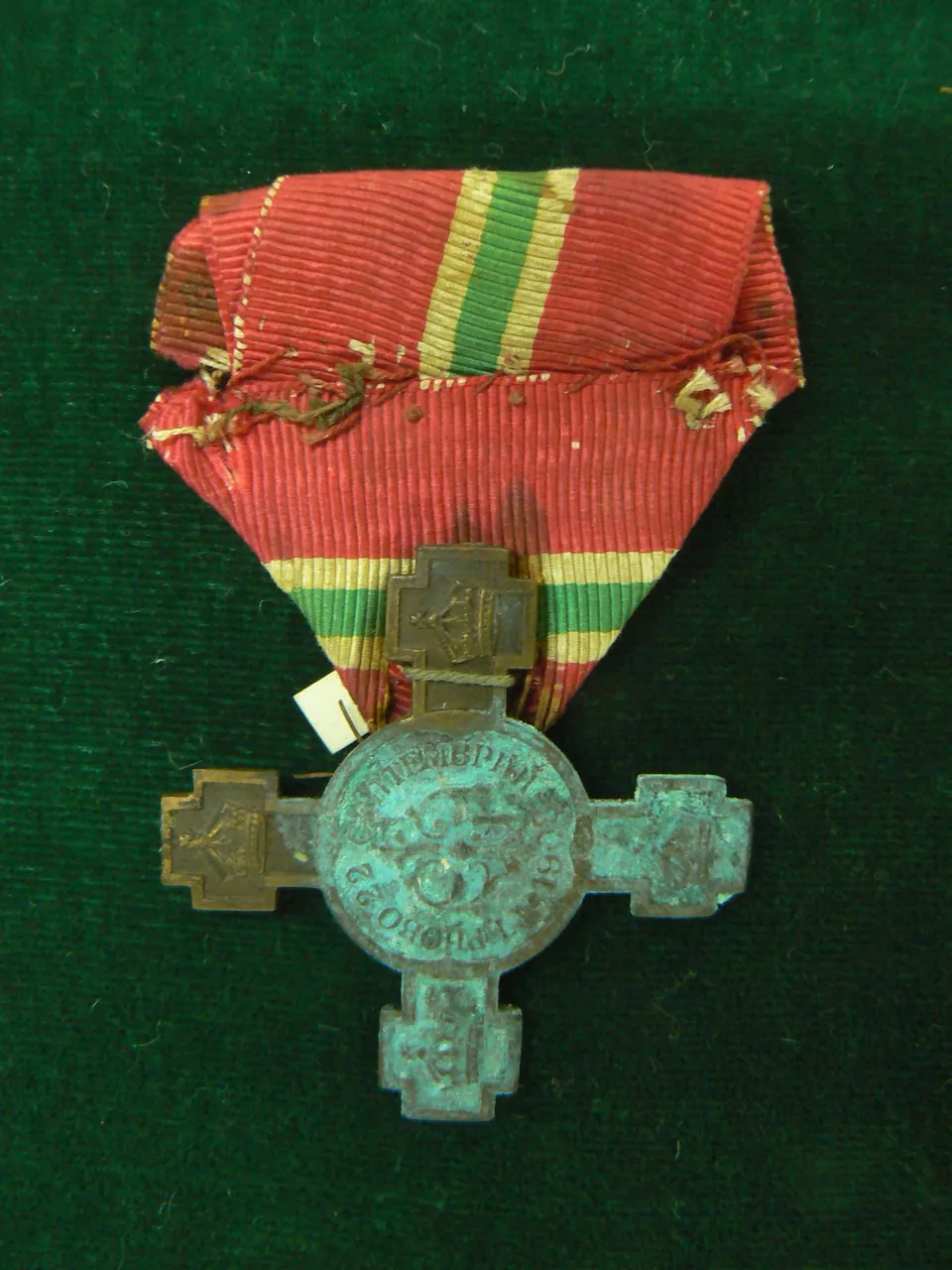
Commemorative independence cross. It bears the date 22 September 1908. Commons describes it as a decoration of 1909. Photographed in 2010 at the Vratsa Regional History Museum.
Full attribution
Photo: Vassia Atanassova – Spiritia, Wikimedia Commons. Public domain. Processed image.
Vassia Atanassova - Spiritia · Public domain · Wikimedia Commons
Commemorative independence cross, opposite side. Commons describes it as a decoration of 1909. The story’s sources do not establish this specimen’s manufacture date. Photographed in 2010 at the Vratsa Regional History Museum.
Full attribution
Photo: Vassia Atanassova – Spiritia, Wikimedia Commons. Public domain. Processed image.
Geographic context, without historical borders
Tom Patterson · Nathaniel Vaughn Kelso · Public domain · Natural Earth
Full attribution
Tom Patterson · Nathaniel Vaughn Kelso